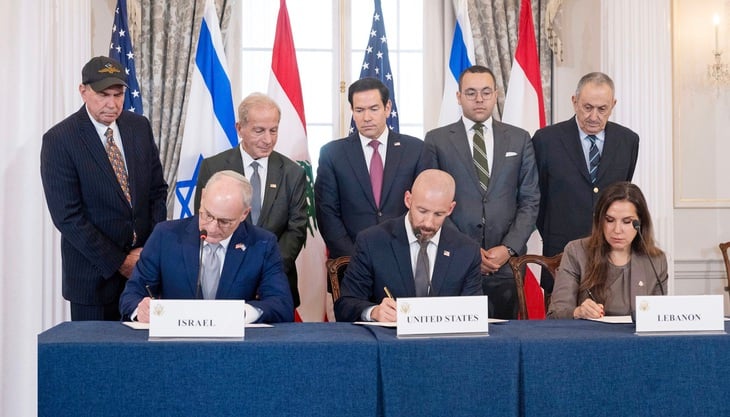
The trilateral framework agreement between the US, Israel, and Lebanon relates to the interim agreement between the US and Iran - Photo: AP
The tit-for-tat missile launches on June 28 exposed the ambiguity in the interpretation of the 14-point interim agreement between the US and Iran on June 17.
Accusing Iran of attacking commercial ships in the Strait of Hormuz last weekend, the US launched airstrikes against Iranian military targets near the shipping lane. Tehran retaliated with missiles and drones against US military targets in Kuwait and Bahrain. Both sides called these actions retaliation or self-defense.
Differences in interpretation
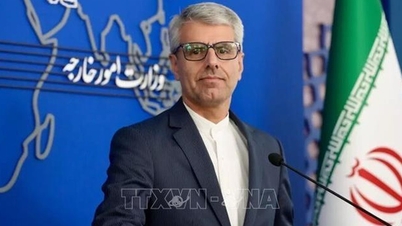
During his visit to Iraq on June 28, Iranian Foreign Minister Abbas Araghchi affirmed that the Strait of Hormuz remains under Iran's complete supervision and control, warning that any unilateral intervention would worsen the situation.
"Once all obstacles are removed, the full navigability of the waterway will be restored. That's what we will do," he said.
For Iran, the Strait of Hormuz is not just a shipping route, but also a strategic leverage point to force the US and Gulf states to consider Tehran's security interests.
For Washington, the immediate priority is to keep the strait open, as it is a vital shipping lane for the global energy market and also contains many of America's allies and interests.
It is precisely this differing perspective on interests that has led both sides to interpret certain provisions of the interim agreement in a way that benefits them. In particular, point 5 concerning the Strait of Hormuz is controversial and can be considered one of the direct causes of the events of the past weekend.


This point calls for dialogue between Iran and Oman and other Gulf states to ensure safe passage for 60 days, while also stating the principle of "freedom of navigation," with Iran guaranteeing the freedom and safety of vessels through the strait.
However, in an effort to avoid Iranian checkpoints, commercial vessels were encouraged to travel along a route close to the Omani coast. Iran argued that using this route without consulting them constituted a violation of the agreement by the U.S., leading to attacks on several ships. The Iranian navy stated that firing on the offending vessels "would remind other ships of where the clear passage is."
"Iran continues to insist on controlling the Strait of Hormuz. On the other hand, the US and Arab nations insist on freedom of navigation through the Strait of Hormuz. To emphasize its position, Iran has attacked ships in the strait twice, and the US retaliation is not surprising, but I think the situation is still manageable," Wolfgang Pusztai, a defense analyst in Vienna, told Al Jazeera.
In other words, although the situation seems tense, the attacks from both sides are just enough to send a message, not enough to force both sides into conflict almost every day as before.
The problem with America
The interim US-Iran agreement is only one part of the larger picture of Middle East peace. Shortly after its signing, observers began to question the extent of compliance by both countries, as well as the regional uncertainties that could disrupt it.
Iranian Foreign Minister Abbas Araghchi's remarks in Iraq suggest Tehran is acknowledging one of those uncertainties. He accused Israel of continuing airstrikes on Lebanon and demanded that Washington force Israel to end the attacks, as this is point 1 of the interim agreement.
Amidst these concerns, the trilateral framework agreement between the US, Israel, and Lebanon arrived just in time on June 26, seen as the second piece of the puzzle, partly reflecting Washington's caution regarding the uncertainties in the region.
However, the weakness of this agreement may lie with parties not included in the document. Hezbollah did not directly sign and strongly opposed it, even though it is the most influential force on the ground in southern Lebanon.
If Lebanon is unable to control the armed groups, Israel will have reason to continue the attacks. If Tel Aviv continues the airstrikes, Iran could accuse the US of failing to fulfill its commitment to de-escalate tensions in Lebanon, as stipulated in point 1 of the June 17 agreement.



In short, the current situation presents Washington with a difficult dilemma: it must contain Iran, keep Israel within limits, and help the Lebanese state regain its role within its own territory.
The trilateral framework agreement between the US, Israel, and Lebanon, announced on June 26, outlines a step-by-step process: the Lebanese army will restore control of the south, non-state armed groups will be disarmed, and Israel will gradually withdraw from the areas it controls.
The "proceed and withdraw" approach aims to build trust gradually, rather than demanding immediate peace. This is seen as the second piece, alongside the interim US-Iran agreement of June 17, in the picture of de-escalating tensions in the Middle East.
Source: https://tuoitre.vn/hoa-binh-trung-dong-mong-manh-tren-giay-100260628235842073.htm

![[Photo] National Assembly Chairman Tran Thanh Man attends the Conference to announce the Master Plan for Hanoi Capital City with a 100-year vision.](https://vphoto.vietnam.vn/thumb/1200x675/vietnam/resource/IMAGE/2026/06/29/1782709639728_ndo_br_1-jpg.webp)

![[Photo] General Secretary and President To Lam works with the Party Committee of the Government on the work of preventing and combating storms, floods, extreme natural disasters and climate change.](https://vphoto.vietnam.vn/thumb/1200x675/vietnam/resource/IMAGE/2026/06/29/1782729441945_a1-bnd-0385-9454-jpg.webp)

![[Image] A look back at the capital's preparations for the century-long master plan.](https://vphoto.vietnam.vn/thumb/1200x675/vietnam/resource/IMAGE/2026/06/29/1782750453122_quy-hoach-100-nam-minh-duy-1-2118-jpg.webp)



































































![[Image] Building an elevated road through the Ma Da forest.](https://vphoto.vietnam.vn/thumb/402x226/vietnam/resource/IMAGE/2026/06/29/1782724737750_anh-man-hinh-2026-06-29-luc-16-18-43.png)