

As part of the "Bringing Schools to Students" program in 2026, on May 26th, the Nguoi Lao Dong newspaper organized an online talk show with the theme "Smart Pathways After High School Graduation". Guests participating stated that in 2026, many new fields of study such as microchips and semiconductors, renewable energy, etc., are being actively promoted by colleges, creating broad job opportunities and relieving the pressure of choosing a school for students.
Advantages and job opportunities when pursuing vocational training.
Opening the talk show, Ms. Nguyen Thuy Vuong Khanh, Deputy Director of the Center for Communication, Admissions and Services, Ho Chi Minh City College of Economics , presented specific figures demonstrating that vocational education is developing strongly and becoming increasingly relevant to the current market's recruitment needs.
According to Ms. Khanh, data for 2025 shows that the whole country will enroll approximately 2.2 million people in vocational education and training. Of these, the employment rate for graduates will be over 80%, with about 70%-75% finding jobs in their trained field.
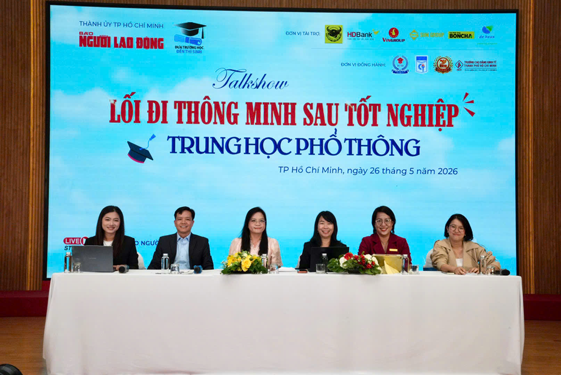
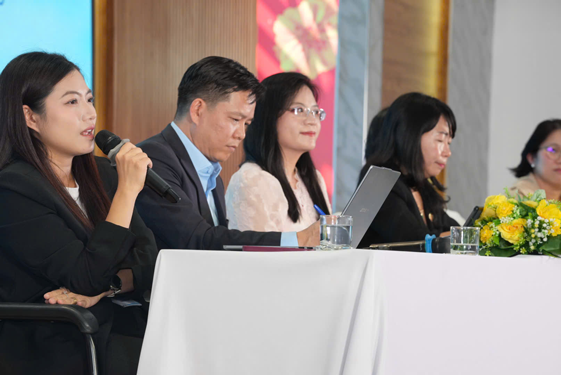
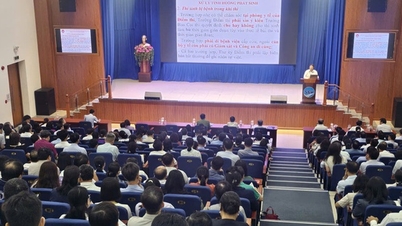
The guest speakers answered many questions from the contestants and provided a lot of useful information. Photo: QUANG LIEM
In particular, sectors within the trade and service industry such as marketing, logistics, hotel management, tourism guiding, and social languages such as English and Korean have the highest demand for human resources. Many language students have found jobs even while still in school.
"Today's economy requires a workforce that not only possesses specialized knowledge but also practical skills, digital skills, communication skills, problem-solving abilities, and the capacity to adapt quickly to the business environment," Ms. Khanh emphasized.
Sharing the same view, Mr. Tran Viet Dung, Head of Training Department - Cao Thang Technical College, said that in the context of rapidly developing technology and AI, what businesses need most from candidates is not a prestigious degree but high technical skills and the ability to immediately meet the job requirements.
In 2026, the university will open five new majors: electrical engineering and renewable energy technology, semiconductor and integrated circuit engineering technology, industrial equipment maintenance engineering technology, agricultural automation engineering technology, and financial technology and digital business. These are fields that will anticipate the workforce demand in the next 5-10 years.
Sharing more about the semiconductor industry, Mr. Dung said that at universities, the field of study typically focuses on high-end segments such as research, design, and construction – areas requiring long training periods and significant investment costs – while colleges choose a different path that is more practical and manageable.
Specifically, the school's approach focuses on training in assembly, operation, and packaging. This direction helps reduce the burden of costs and time for students while precisely meeting the needs of positions that businesses are currently experiencing a shortage of skilled workers for.
Ms. Vo Thanh Huong, Head of Admissions and Communications at Ho Chi Minh City International College, said that the school is currently offering 100% free INTENSE scholarships for students studying at the school who wish to transfer to an international university for most majors, especially semiconductor technology.
According to the program, students study their major for the first two years in Vietnam, while also learning Traditional Chinese. Upon achieving TOCFL A2 level proficiency, students can transfer to a university in Taiwan (China) with full funding from the Taiwanese government, universities, and partner businesses.
In particular, this program offers many attractive benefits: students only pay 30% of the tuition fee for the Chinese language course at the college, and if they pass the interview, the tuition fee will be refunded; studying in Taiwan, students receive 100% free tuition, 100% free dormitory accommodation, and a living allowance of over 22.5 million VND/month. After graduation, students are offered employment in Taiwan for two years by a company, after which they can flexibly choose to return home or continue studying or working long-term.
At the program, Dr. Phan Thi Le Thu, Permanent Vice Principal of Vien Dong College, stated that in 2026, the Ministry of Education and Training will recognize the first 10 colleges as meeting high-quality standards. Among them, Vien Dong College is the only private college to receive this recognition.
According to Dr. Thu, the mentality of prioritizing academic degrees and the pressure from the prejudice of "having to get into a public university, having to get into a university" has long been a major psychological burden for both students and parents.
"The school proactively 'brings university programs to colleges.' Students can choose to study at a college and then directly transfer to the University of Economics Ho Chi Minh City or the University of Technology Ho Chi Minh City right at the college. Students can even choose to study two systems simultaneously: a full-time college program and a part-time university program," Dr. Thu added.
Finalize your college application early and focus on your studies with peace of mind.
Addressing students' concerns about the difficulty of career advancement after graduating from a college and the preference for top-tier university graduates, Ms. Ngo Thi Oanh Vu, Head of Human Resources Projects at De Heus Vietnam, affirmed that these are outdated perspectives.
According to Ms. Vu, in the recruitment process, managers choose the person who is suitable for the job position, not the person with the highest qualifications.
De Heus operates in the agricultural sector, primarily focusing on production. Previously, De Heus only recruited university students, but in recent years they have also hired college graduates, notably possessing excellent practical skills and equipment operation abilities.
For positions requiring specialized expertise, degrees and transcripts will serve as the first "filter" on applications. However, for many other positions, college graduates are preferred due to their practical skills, willingness to work hard, and ability to adapt quickly to real-world situations.
"The reality at large enterprises has proven that many chain managers or factory managers have risen from the lowest technical worker positions, understanding every machine and every corner of the factory. Their journey is the clearest evidence that: Where you start doesn't matter; what determines your future stature is your self-learning spirit and your ability to create value for the business," Ms. Oanh Vu shared.
Based on current recruitment trends, experts share a common point: college education is not an "easy" option in the sense of being simpler or less prestigious than university education, but rather a practical, flexible choice that aligns with labor market trends.
According to Ms. Khanh, candidates should not wait until they fail to get into university before rushing to find a college. At that point, many majors that match their interests and abilities may already be nearly full or have reached their enrollment quota. This is especially true for high-demand fields such as logistics, marketing, hotel management, English, Korean, accounting, business administration, and tourism; if candidates delay registration, their chances of choosing their desired major will be significantly reduced.
"Students should choose their major based on their true abilities, genuine interests, and real career opportunities, not based on herd mentality," Ms. Khanh emphasized.
Ms. Huong noted that the decision of over 63,800 independent candidates to return to the "race" this year is making the competition for "hot" majors fiercer than ever. To create opportunities for themselves, candidates should proactively submit applications early to "reserve a spot" and avoid the unfortunate risk of colleges closing their admissions portals due to reaching their quotas.
Priority will be given to applicants based on their academic transcripts.
Regarding admission methods, most colleges in Ho Chi Minh City prioritize admission based on academic transcripts (based on the average grade of 12th grade or all three years of high school), high school graduation exam scores, or aptitude test scores organized by the Vietnam National University Ho Chi Minh City. For specialized fields such as health sciences (pharmacy, nursing), there will be additional regulations regarding minimum entrance requirements, while talent-based fields will require an additional aptitude test organized by the school.
The program received support from the following organizations: Binh Dien Fertilizer Joint Stock Company, Ho Chi Minh City Development Commercial Bank (HDBank), Vingroup, Sun Group, Uniben Joint Stock Company, and De Heus Vietnam Group. The talk show was supported by: Cao Thang Technical College, Ho Chi Minh City College of Economics, Vien Dong College, and Ho Chi Minh City International College.
Source: https://nld.com.vn/hoc-cao-dang-la-huong-di-chien-luoc-196260526214801448.htm
![[Photo] The heat at the fireworks display site on the opening night of the Da Nang International Fireworks Festival 2026](https://vphoto.vietnam.vn/thumb/1200x675/vietnam/resource/IMAGE/2026/05/27/1779889741485_ndo_br_z7872039145157-fecaba5112f39e8352544099d7ef4738-5140-jpg.webp)



![[Photo] The courage of new recruits of Brigade 144 on the training ground.](https://vphoto.vietnam.vn/thumb/1200x675/vietnam/resource/IMAGE/2026/05/27/1779881651341_anh-man-hinh-2026-05-27-luc-18-32-52.png)









































![[Photo] The courage of new recruits of Brigade 144 on the training ground.](https://vphoto.vietnam.vn/thumb/402x226/vietnam/resource/IMAGE/2026/05/27/1779881651341_anh-man-hinh-2026-05-27-luc-18-32-52.png)

























Comment (0)