

For the first time since 2011, the United States will host the 30th Asia-Pacific Economic Cooperation (APEC) Summit Week, from November 11-17. Leaders from the 21 APEC member countries will gather in San Francisco to discuss ways to foster better economic growth and trade across the region.
But the focus this year is on a side event: the face-to-face meeting between US President Joe Biden and Chinese President Xi Jinping on November 15th.
This year's US-China summit is taking place against a backdrop of frosty relations between Beijing and Washington, as well as global turmoil with conflict hotspots in the Middle East and Ukraine.
Find ways to promote bilateral communication.
The highly anticipated meeting between Biden and Xi on U.S. soil will focus on strengthening bilateral communication amid escalating global conflict and addressing challenges such as the illicit fentanyl trade, the White House said on November 13.
White House National Security Advisor Jake Sullivan told reporters that the U.S. is looking for “concrete results” from the first meeting between the two leaders in a year, and while he didn’t name any specific results, he did offer some clues. He said, “We believe there are areas where our interests intersect, such as our efforts to combat illicit trafficking of fentanyl.”
“There are also areas where we can manage competition more effectively – for example, by re-establishing communication between militaries. And of course, there are important global issues that the two leaders will need to discuss, including Russia’s war in Ukraine and the escalating crisis in the Middle East,” Sullivan said.
Communication between the Chinese People's Liberation Army (PLA) and the U.S. military has been disrupted since last year following a visit to Taiwan by then-Speaker of the U.S. House of Representatives Nancy Pelosi. The relationship further deteriorated after the U.S. shot down a suspected Chinese spy balloon flying over North America in February of this year.
Mr. Sullivan said that contact between the two countries' militaries is a way to ensure competition does not lead to conflict, and that China has shown a "constructive" attitude on this issue in dialogue ahead of the summit between Mr. Xi and Mr. Biden.
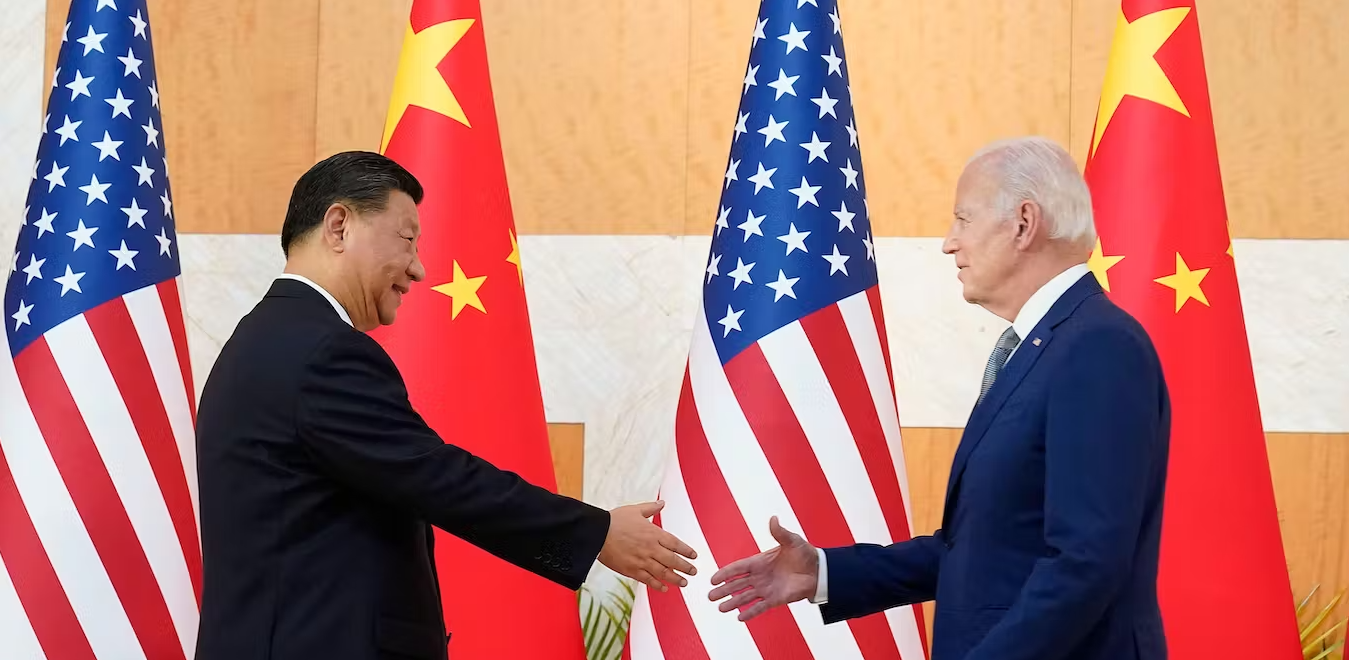
US President Joe Biden and Chinese President Xi Jinping shake hands when they meet on the sidelines of the G20 Summit in Bali, Indonesia, on November 14, 2022. Photo: The Conversation
"We'll see what happens in San Francisco and whether we make progress in restoring military-to-military contact," Sullivan said.
The meeting is also expected to address global issues ranging from the Israel-Hamas conflict in the Middle East to the Russia-Ukraine conflict in Eastern Europe, North Korea's relationship with Russia, the Taiwan issue, human rights , artificial intelligence (AI), and "fair" economic and trade relations, senior officials in the Biden administration said.
Biden and Xi have known each other for more than a decade and have spoken for hours on end in six interactions since Biden became US President in early 2021. However, since then, the two leaders have only met in person once, in Indonesia last November, and Xi has not visited the US since 2017.
The Chinese Foreign Ministry said it hoped the two leaders would have “deep communication on issues of fundamental, overarching and strategic importance” to both bilateral and global relations, and that Beijing was not seeking conflict.
"China is not afraid of competition, but we do not agree that Sino-US relations should be defined by competition," Chinese Foreign Ministry spokesman Mao Ning told reporters in Beijing on November 13.
"We hope the U.S. will act in accordance with its commitment not to seek a new Cold War with China and not to seek conflict with China, and will cooperate with China to bring bilateral relations back onto a healthy and stable development trajectory," Mao added.
Focused on crisis prevention
US-China tensions have escalated over the past few years, beginning with tariffs under the Donald Trump administration and spreading to broader technology restrictions under the Biden administration.
The controversy surrounding the suspected Chinese spy balloon flying in U.S. airspace in February revealed just how fragile bilateral relations had become. The incident led to the suspension of already limited high-level talks between the two countries.
In April, amid a new low in bilateral relations, the Washington DC-based Center for Strategic and International Studies (CSIS) released a report describing the US-China relationship as seemingly "trapped in an increasingly worsening vicious cycle."
“This translates into a stalemate – and, in fact, escalating tensions – that goes even further than a typical security dilemma, in which each side takes steps to defend itself, thereby creating insecurity for the other and followed by a proportionate response,” the CSIS report stated.
Things only started to improve in June after US Secretary of State Antony Blinken's visit to Beijing, followed by visits from several other high-ranking officials.
In early October, U.S. Senate Majority Leader Chuck Schumer and five other U.S. Senators representing both the Republican and Democratic parties held an 80-minute meeting with Chinese President Xi Jinping.

Pedestrians walk under signs for the Asia-Pacific Economic Cooperation (APEC) Summit Week at the Moscone Center in San Francisco, California, USA. Photo: AFP/Digital Journal
But expectations for this week's summit between the US president and the Chinese leader remain relatively low. Current Washington-Beijing relations are more focused on crisis prevention, and both sides are still waiting for further action.
"The focus will be on expanding dialogue to mitigate risks in the relationship and prevent a crisis that neither leader wants," said Michael Hirson, head of China research at 22V Research.
"Hot issues like Taiwan and the South China Sea need to be managed carefully," Hirson said, noting that the meeting was taking place ahead of Taiwan's leadership race in January and the US presidential election in November.
Shen Yamei, head of American Studies at the China Institute of International Studies (CIIS) under the Chinese Ministry of Foreign Affairs, believes that current Sino-American relations are in a "loosening" phase.
“This easing is to create a relaxed atmosphere. No actual changes are happening,” Shen said in Mandarin, as translated by CNBC. However, she pointed out that establishing more channels of communication means there is still much to look forward to.
"Aside from the Taiwan issue, export controls are a top concern for Beijing, but there is no political space in Washington to lift existing controls," Gabriel Wildau, managing director at the consulting firm Teneo, said in a note.
"The outcome following the meeting between Biden and Xi could mark a cyclical peak for bilateral relations," Wildau observed.
“The crucial question is whether this peak will sustain stability, or whether political pressure will trigger a new recessionary cycle,” he said. “As we know, the period since June has presented an opportunity to stabilize relations, but after the high-level talks, it is unclear whether this window will close.”
APEC stands for Asia-Pacific Economic Cooperation. It is a forum aimed at promoting trade, investment, and economic development among countries around the Pacific Ocean.
The group started with 12 members in 1989, but has now grown to 21 members including China, Russia, Japan, the United States, and Australia. The annual Leaders' Meeting (Summit) brings together heads of state and other top economic and diplomatic leaders.
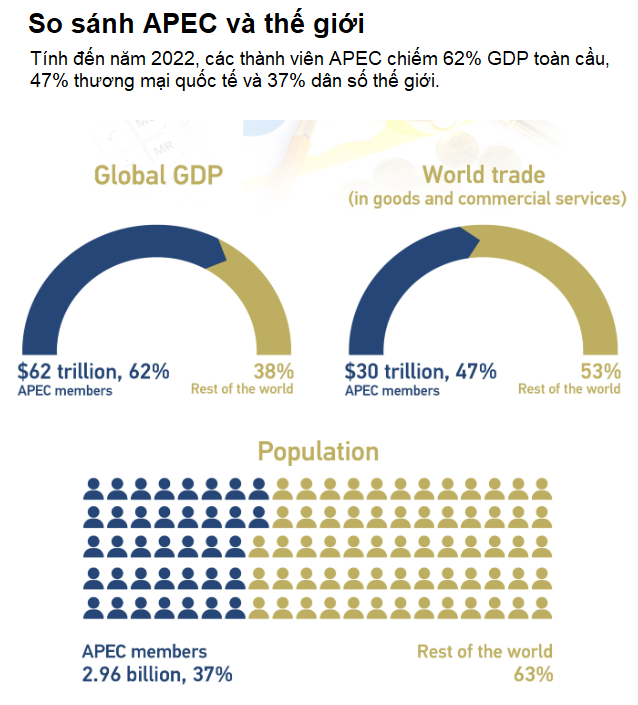
Graphics: CGTN
The White House said the goal of this year's APEC Summit is to try to make APEC economies more resilient, especially in the face of growing climate issues and after a global pandemic that has killed millions and strained supply chains.
APEC's strength lies in its ability to encourage countries to cooperate on major initiatives and loosen business ties without the need for binding agreements. Economists point to how APEC contributes to reducing tariffs and other trade barriers.
But the current trade landscape is different from when APEC began during a period of increasing globalization. The US strategy focuses on economic competition with China rather than cooperation, even as US leaders continue to emphasize the importance of cooperation.
US President Biden is seeking partnerships with other countries in the region to develop alternatives to imports from China such as electronics, machinery, furniture, textiles, and other goods .
Minh Duc (Based on Reuters, AP, CNBC, Global News)
Source




![[Photo] General Secretary and President To Lam meets with National Assembly delegates from ethnic minorities.](https://vphoto.vietnam.vn/thumb/1200x675/vietnam/resource/IMAGE/2026/04/20/1776696701056_a1-bnd-8331-3342-jpg.webp)
![[Image] National Assembly discusses the implementation of the socio-economic development plan.](https://vphoto.vietnam.vn/thumb/1200x675/vietnam/resource/IMAGE/2026/04/20/1776696707422_ndo_br_img-20260420-185419-jpg.webp)

























































































Comment (0)