

Mechanic... making ao dai (traditional Vietnamese dress)
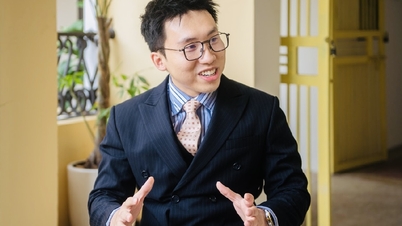
“I never imagined I would become so skilled in tailoring thanks to my mechanical engineering background,” artisan Nam Tuyen (real name Pham Van Tuyen) began his story with passion, reminiscing about the past. At that time, his hometown ( Hung Yen province) had a garment cooperative, but because he was born into a poor family, he only had the opportunity to watch from the sidelines, fascinated by the stitches from afar. “I loved tailoring so much. When I was in 9th grade, I already knew how to cut and sew clothes by hand,” he recounted. After finishing high school, he attended a technical college, specializing in mechanical welding.
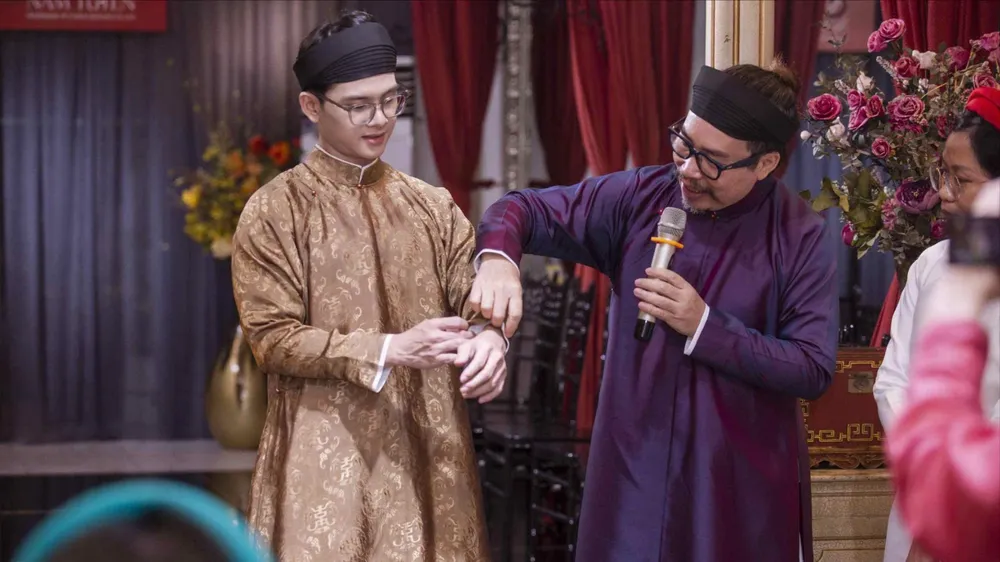
Although he studied mechanics, young Pham Van Tuyen never actually worked in the field. A cousin who was studying fashion showed him a specialized book that captivated him and inspired him to pursue the profession. He hasn't been involved with the five-panel ao dai (traditional Vietnamese dress) for very long, only since 2019, through a chance encounter. Artisan Nam Tuyen jokingly says, "I'm slow at everything." However, that slowness was nurtured by a passionate love for fashion, conceived over many years before this "intoxicating feeling" led him on his journey with the five-panel ao dai. The encounter between Nam Tuyen and the five-panel ao dai can be likened to a journey of "finding one's true self."
According to him, the fields of mechanics and fashion, seemingly unrelated, are actually closely connected. The mechanical engineering profession includes a branch of engineering requiring meticulous calculations of mechanical forces, and apprentices must study spatial geometry. Applying these principles to the design of the traditional Vietnamese five-panel dress (áo ngũ thân) helps him create the perfect silhouette for each product. “Each of my dresses has the right drape, flow, and elasticity. All of this is based on mechanical engineering calculations and the development of spatial shapes,” he shared.
The principles of mechanical engineering also helped Mr. Nam Tuyen in the early stages of his career in wedding fashion with the A Soen Bridal brand in the late 1990s, before developing the five-panel ao dai (traditional Vietnamese dress) and "digitizing" the ao dai tailoring process (making five-panel ao dai according to size). Understanding the principles of stretch and contraction of different fabrics and the differences in each part of the dress allowed the tailor to calculate the force needed to adjust the sewing machine for each stitch. In particular, when "digitizing" ao dai tailoring, the knowledge he had acquired helped him refine and create products that suited the characteristics, style, and body shape of customers in each region.
Because of his deep understanding of technical details and shapes, artisan Nam Tuyen is known for his meticulousness. From selecting fabrics and colors to the finished product, he demands the highest standards. He orders fabrics specifically from weavers, calculating the thickness, drape, and sheen for each individual. According to him, fabrics for men's clothing are usually thicker; although heavy, they must still have a flowing quality that moves with the body. Every seam, every hem of the garment is carefully controlled so that when walking, the shirt doesn't cling stiffly to the body or flap loosely, but "flows with the wind" naturally.
Breathing life into clothes
Throughout his research and practice, artisan Nam Tuyen repeatedly questioned: Why has the five-panel áo ngũ thân (traditional Vietnamese tunic), originating in the 18th century, endured to this day, despite the French colonial period and waves of Westernized fashion? Why does this style remain so well-suited to the Vietnamese physique and mindset?
And he found the answer encapsulated in three words: "the golden ratio." He explained that over hundreds of years, with many changes and innovations, his ancestors have continuously worn, modified, and passed down the garment to each generation. "We only need to explore the heritage left by our forefathers; we don't need to create anything new to make it beautiful. I always believe that if we rush to modify the five-panel ao dai without fully understanding its value and beauty, it might not be right. Therefore, I don't need to improve the form anymore; I only need to create patterns and materials to bring the ao dai into modern life," he reflected.
Making clothes is like cooking rice; each type of rice requires a different amount of water, and each customer will be suited to a different type of fabric, color, and technique. Only with a solid foundation in craftsmanship can one accurately transition to industrialization.
Artisan Nam Tuyen
The two collections, "Flower Petals" and "Fragrance of Time," are the clearest evidence. Artisan Nam Tuyen incorporated the beauty of classical Western art into the five-panel dress, creating garments that are both elegant and sophisticated, suitable for various occasions, including evening parties. This stylization demonstrates that, with careful exploration, inheritance, and skillful development, the ao dai (Vietnamese traditional dress) in particular, and similar values from traditional clothing in general, can become a living heritage, constantly evolving and shining in the flow of contemporary culture.
The deeper he delved into his research, the more artisan Nam Tuyen realized the layers of cultural values hidden behind each five-panel ao dai. For him, the appeal of the five-panel ao dai lies not only in its tailoring techniques but also in its humble cultural philosophy. In the past, women wore many layers of clothing, subtly coordinating colors – simple on the outside, magnificent on the inside – as if wanting to keep their beauty to themselves; this is the beauty of subtlety. This is the virtue of humility, a refined characteristic of the Vietnamese people, elegant without ostentation. "For our ancestors, a single ao dai was so elaborate. Besides its role as clothing, the ao dai also carries an educational meaning," artisan Nam Tuyen added. Even more remarkably, this heritage possesses a rare versatility. Compared to Kimono (Japan) or Hanbok (Korea), which are only worn on special occasions, the five-panel ao dai has a soul whether worn for work, school, or for formal occasions like festivals and weddings.
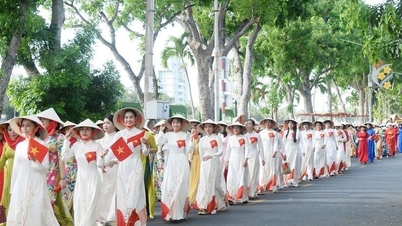
When talking about the ao dai (Vietnamese traditional dress), he would ramble on endlessly because he loves and cherishes this traditional garment. As the head of the Ao Dai Cultural Heritage Branch (part of the Ho Chi Minh City Heritage Association), he has repeatedly suggested that, in addition to the annual Ao Dai Festival, the city should organize a cultural heritage festival where the ao dai serves as a connecting element through a professional approach. The journey that artisan Nam Tuyen is on is not just about fashion, but also about a person diligently extending the essence of time through the soul of the century-old ao dai.
Source: https://www.sggp.org.vn/hon-ao-noi-tram-nam-post831596.html


![[Photo] General Secretary and President To Lam presides over a working session with the Central Policy and Strategy Committee on the development of the materials industry.](https://vphoto.vietnam.vn/thumb/1200x675/vietnam/resource/IMAGE/2026/05/21/1779359935432_a3-bnd-3129-1412-jpg.webp)


























































Comment (0)