

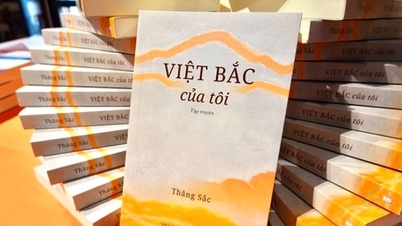
With a three-part structure: "The Source," "Calling the Homeland," and "Simple Things," the poet aims to differentiate thematic areas to guide the reception of the work, but it seems that the spirit of the countryside has permeated the poetry so deeply that it is difficult to distinguish between "the source" and "simple things."
The spirit of the countryside in poetry symbolizes the simple, rustic beauty, from family affection to the camaraderie of the village. Familiar imagery includes bamboo groves, rice fields, egrets, the lullabies of mothers, the calls of fathers, and cherished, intimate cultural traditions and festivals.
The spirit of the countryside in "Calling the Fields" has a powerful impact, evoking a warm and affectionate connection between the reader and the poet through beautiful memories and recollections. This is also the humanistic value of the poetry collection, as it nurtures love for one's homeland in the soul of each person, so that even when far away, they still remember their roots.
Nostalgia for one's homeland is not just about Nghèn village , "the village in the boatman's song / the flock of birds flying back, chirping like fairy tales / the village square mats of flowers and wood / the village deity listening to ceremonial singing" ("My Village"); it is Trảo Nha, "an ancient village named Trảo Nha" - clearly identified, because this is the birthplace of "the king of love poetry" Xuân Diệu; it is Hồng Lĩnh, "Hồng Lĩnh, the eagle soaring through distant clouds" ("The Source"); but it is also where the image of mother "mother, like a crane or heron / in lullabies..." ("Mother's Name"), or "Father's name, so familiar / the eternal, enduring farmer of the countryside" ("Father's Name"), and also the long-standing festival traditions of the Ngô family.
“I am a grain of sand from Central Vietnam / The Lao wind pierces the Hanoi afternoon / a scorched grain / wandering on the gentle road of days gone by... Central Vietnam embraces me / the burning length / sand within me, a restless nomad / the day I leave, the sand is existential” (“I”). “I” – a grain of sand from Central Vietnam – a self-identification characteristic of Nghe An province – expresses pride in its origins, pride in a land that, though poor, is a land of “spiritual and talented people.” Self-identification, self-definition, self-affirmation is the way the poet's self wants to express and reveal itself in the world of poetry.
The poverty and hardship of the people of Central Vietnam instilled in him a burning longing: “The mulberry and crape myrtle trees call the wind in all four seasons / green like children / I love the poor alley / sheltering the soul of the city / I often come back and sit under the crape myrtle tree / calling your name / when I am hungry / behind the mulberry tree there is a stall selling leftover rice...” (“My Alley”). As a person from Central Vietnam, bearing the identity of Central Vietnam, surely everyone carries within them a region of memories of the Lao wind, white sand, and the image of a mother and father toiling from dawn till dusk: “Father’s back is covered in mud all year round / Mother is like a rice stalk that makes up the homeland / winter chills even their smile / summer exposes drops of sweat on the fields” (“Mother and Father”).
His poetry flows like an undercurrent of emotion—powerful yet not boisterous, controlled, profound, and not easily revealed outwardly.
“I light incense in the bamboo grove of the departed village / the sound of my father's pipe / my mother's carrying pole / and the walking stick of my grandparents from long ago... The spirit of bamboo returns, rustling / the village abandons its clogs and puts on shoes to go to the city / the old fence where we met / you lean against the curtain, writing shy verses / I go back to the past / meeting the spirit of bamboo returning to demand a debt / bamboo encroaches on the sea, covering the village / covering the soul with gentle lullabies...” (“The Spirit of Bamboo”). Poetry beyond words. A poem that contains so many profound meanings, with reflections emerging unconsciously about the connection between culture - origins and transformation.
To create his unique poetic voice, he skillfully combines language choice with poetic imagery, often employing associative, simultaneous, and expansive structures. Through the poem "Calling the Homeland," readers recognize his deep longing for home, a longing shared by many who are far from their homeland. Similarly, poems like "Ginger and Mother," "Looking at the Eggplant Flowers, Remembering Mother," "Every Day Is Father's Day," and "The Ancestral Jackfruit Tree" evoke countless memories and feelings of nostalgia for parents, ancestors, and village.
“Mother is like a ginger plant / struggling to grow through those days / the plant blossoms and beckons / hardship and bitterness become the spice of life...” (“Ginger Plant and Mother”), the poem evokes the many years of hardship endured by a hardworking mother, the ginger plant serving as a metaphor for strong vitality, resilience, and the ability to overcome difficulties. Writing about his mother and the familiar plants in his garden, the poet expresses his overflowing emotions about the connection between childhood memories and love for his homeland.
His poetry comes from the heart, without embellishment or exaggeration, expressing itself naturally, creating a sense of familiarity and ease of empathy. His poems touch the reader's soul because the spirit of the countryside permeates his verses through familiar and intimate images and emotions.
Source: https://hanoimoi.vn/hon-que-trong-goi-dong-729062.html
![[Photo] General Secretary and President To Lam presides over a meeting on assessing national development resources.](https://vphoto.vietnam.vn/thumb/1200x675/vietnam/resource/IMAGE/2026/05/20/1779253785852_a1-bnd-2943-8519-jpg.webp)


![[Photo] National Assembly Chairman Tran Thanh Man working with the Standing Committee of the Economic and Financial Committee](https://vphoto.vietnam.vn/thumb/1200x675/vietnam/resource/IMAGE/2026/05/20/1779249584387_ndo_br_1-jpg.webp)

























![[Workers' Month 2026] Spreading love on the Vinh - Dong Hoi frontline: Nearly 1 billion VND spent on caring for the lives of workers.](https://vphoto.vietnam.vn/thumb/402x226/vietnam/resource/IMAGE/2026/05/20/1779237885217_img_8650.jpeg)



























Comment (0)