

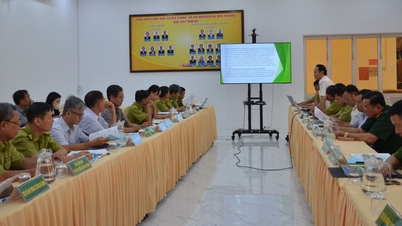
On the morning of October 11th, the Hanoi Department of Industry and Trade, in coordination with the Department of Local Industry and Trade ( Ministry of Industry and Trade ) and the Departments of Industry and Trade of provinces and cities, organized a conference to connect supply and demand for raw materials for the handicraft industry in the northern provinces and cities in 2024.
Demand increased but supply did not.
According to the latest survey data from the Center for Industrial Promotion and Development Consulting ( Hanoi Department of Industry and Trade), on average, Hanoi's rattan and bamboo weaving villages consume approximately 6,800 tons of raw materials annually. Of this, an average enterprise consumes about 50 tons of raw materials per month, and households consume about 20 tons per month; ceramic villages consume about 620,000 tons of raw materials, mainly clay and kaolin; lacquer villages consume about 4,000 tons; and woodworking villages consume over 1,000,000 cubic meters of wood.
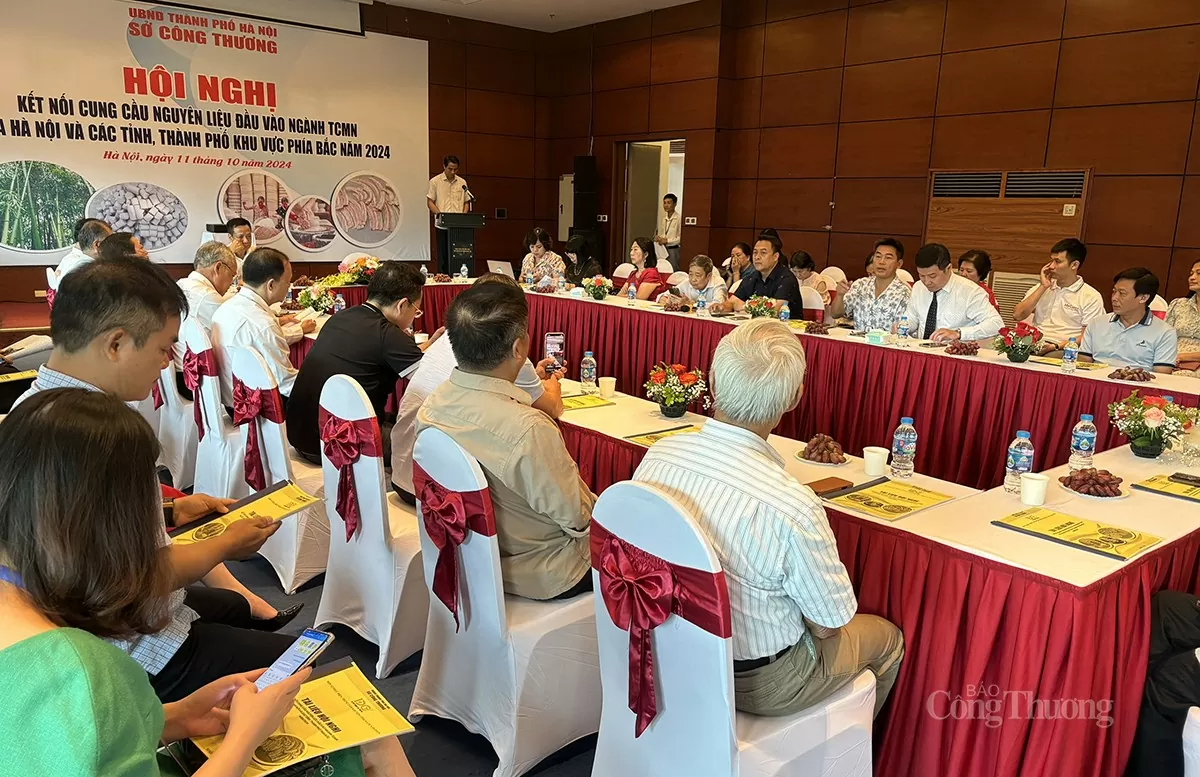 |
| Overview of the Conference |
Raw materials play a crucial role in the sustainable development of craft villages. However, Mr. Vuong Dinh Thanh – Deputy Director of the Hanoi Industrial Promotion and Development Consulting Center – stated that, in reality, the supply of raw materials for handicraft production such as rattan, bamboo, wood, sedge, kaolin, horn, etc., in Vietnam is severely lacking due to shrinking raw material areas, while the quantity of products produced for domestic consumption and export demand is increasing. Wood, in particular, is the most imported raw material group because export-oriented wood product manufacturers are facing a serious shortage of domestic raw materials.
The dependence of Hanoi's craft villages on external sources for raw materials prevents producers from being proactive. In recent years, several provinces and cities have been developing raw material sourcing plans. However, these plans have not yet identified specific raw material areas. The plans are only being developed for individual provinces and localities, without being integrated on a regional scale to maximize the advantages of each region across the country.
Sharing about this difficulty, artisan Nguyen Van Trung - from the Phu Vinh rattan and bamboo weaving village (Phu Nghia commune, Chuong My district) - said that currently, the rattan, bamboo, and grass materials available in Hanoi only meet 20% of the market's demand. Therefore, businesses have had to find their own raw material sources to organize procurement, provide guidance on harvesting techniques, processing, and preserving the raw materials to ensure a sufficient supply for production.
Another difficulty, as pointed out by Mr. Nguyen Van Trung, is the limited two-way communication between producers and suppliers of raw materials. This leads to a supply shortage, causing difficulties in production and consumption for both sides. The scarcity of raw materials results in higher prices, increasing production costs and creating challenges for businesses and producers.
Similarly, this situation is occurring in many localities. Previously, in an interview with a reporter from the Industry and Trade Newspaper, Mr. Le Ba Ngoc - General Secretary of the Vietnam Handicraft Export Association - stated that raw materials are becoming increasingly scarce and prices are rising rapidly, while export prices of handicrafts are difficult to increase. For example, in the ceramics industry, the price of clay has increased by over 90% in the last 5 years, and the price of kaolin has also increased by 75%...
Connectivity alone is not enough.
Hanoi is considered a "land of a hundred trades" and has a very high demand for raw materials. However, due to its status as the capital city, production space is limited, so basic raw materials must be imported from other localities.
According to the Action Plan for implementing the Strategy for Import and Export of Goods until 2030, Hanoi aims to have 6 to 10 groups of handicraft products from Hanoi's craft villages directly exported to foreign markets; at the same time, increasing the proportion of handicraft exports to 3-5% of the city's total exports.
For the handicraft industry to develop sustainably and achieve the goals set out in the Action Plan for implementing the strategy of import and export of goods until 2030, in addition to product development and trade promotion, the sustainable development of raw material areas is a decisive issue.
Offering his recommendations on this matter, handicraft expert Vu Huy Thieu stated that, given the current shortage of raw materials for handicraft production in Vietnam due to shrinking raw material areas, while the number of products produced for domestic consumption and export demand is increasing, Laos has significant potential for developing raw material areas due to its large, concentrated land resources, making it very convenient for large-scale agricultural and industrial production.
To address the shortage of raw materials, experts also suggest that relevant authorities at all levels need to improve land and raw material area policies, such as encouraging businesses, cooperatives, and individuals to lease land and consolidate land to develop concentrated raw material areas for production; orienting the development of concentrated and stable raw material areas to supply materials to craft villages; and closely coordinating with state management agencies on craft village development in Hanoi to cooperate in supplying input materials to craft villages, creating a linked chain for product development and consumption.
Source: https://congthuong.vn/ha-noi-ket-noi-cung-cau-nguyen-lieu-dau-vao-nganh-thu-cong-my-nghe-351673.html



























































































Comment (0)