

Domestic automobile assembly production has shown significant growth.
For many years, Vietnam's automotive industry has been the subject of much discussion, particularly regarding its localization rate and its position in the regional value chain. Compared to Thailand, Indonesia, or Malaysia, the domestic automotive industry has often been perceived as lagging behind. However, the reality is showing many other positive developments, especially with strong growth in domestic automotive production and assembly, and the gradual formation of large-scale factory complexes.
Domestic automobile assembly production is on a clear growth trajectory. In the first three quarters of 2025, production reached approximately 338,400 vehicles, an increase of over 52% compared to the same period last year. This figure reflects the recovery and expansion of production capacity amidst increasingly fierce market competition, and also demonstrates the growing role of the domestic manufacturing sector in meeting consumer demand.
However, alongside the increase in production, the debate about the localization rate continues. Recently, some have suggested that the localization rate for automobiles in Vietnam only ranges from 5-20%, a claim that raises much skepticism given the rapidly expanding scale of production.
In reality, looking only at average figures can lead to an incomplete assessment of the localization process. Data from major manufacturers shows that localization is not happening uniformly, but is accumulating step by step through factory investments, expansion of supply networks, and extension of the domestic production value chain.
Extending the supply chain from manufacturing complexes
While the automotive market is witnessing fierce competition in both products and long-term development strategies, the accelerated construction of domestic manufacturing complexes by businesses is becoming a clear trend. These complexes not only supplement assembly capacity but also serve as "anchors" to extend the domestic supply chain, facilitating the gradual and deeper participation of supporting industries.

The entire Omoda & Jaecoo factory is gradually taking shape. Photo: Huong Nguyen
In Hung Phu Industrial Park, Hung Yen province, a complex of Omoda & Jaecoo automobile manufacturing plants, a strategic joint venture between Geleximco Group (Vietnam) and Chery Group (China), is being implemented with closely monitored progress. According to updates, the project has entered an accelerated construction phase for key infrastructure items, with plans to complete the entire main steel frame of the assembly plant by January 2026.
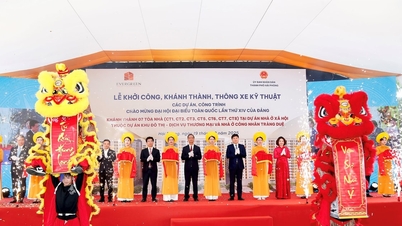
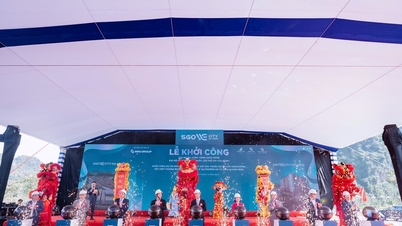
According to company representatives, following the groundbreaking ceremony in October 2025, the foundation, steel structure, auxiliary areas, and internal transportation infrastructure have gradually taken shape, creating a basis for the installation of production lines and technological systems.
Notably, this project's development strategy goes beyond simply selling vehicles; it focuses on investing in manufacturing and building a domestic value chain. This is also an approach being adopted by many businesses in the industry to increase domestic production content and gradually raise the localization rate in a substantive manner.
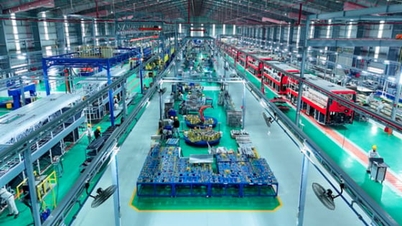
The factory project in Hung Yen has an initial investment of over 8.125 billion VND, a usable area of over 380,000 m², and a designed capacity of 120,000 vehicles per year. This complex aims to produce a diverse range of vehicles, from gasoline and hybrid to electric cars, in line with market trends. In the long term, expanding capacity to serve both the domestic and export markets is expected to contribute to retaining greater added value domestically.

The design of the Omoda & Jaecoo Vietnam manufacturing plant, expected to begin operations in 2026 with a designed capacity of 120,000 vehicles per year. Photo: Huong Nguyen
A common thread in new manufacturing complex projects is a deep-seated approach to localization, rather than simply focusing on the percentage of components. When factories are properly constructed, the domestic supply chain has the opportunity to expand, from component and material production to logistics and technical services. This forms the foundation for supporting industries to gradually participate in higher value-added stages.
Mr. Nguyen Dang Quang, Deputy General Director of Omoda & Jaecoo Vietnam, said that the factory in Hung Yen is developed according to the "Green Factory - Clean Ecosystem" model, with many environmentally friendly solutions such as utilizing natural light and ventilation, deploying rooftop solar power systems, a closed-loop wastewater treatment process, and a smart energy management system. These factors not only serve the goal of sustainable development but also set a new standard for domestic industrial production, in line with the ESG criteria widely applied worldwide .
“Once operational, the factory complex will create thousands of high-quality jobs for local workers, while also promoting the development of supporting industries and related services. More importantly, the presence of large-scale production complexes helps to form industrial ‘clusters,’ where domestic businesses have the opportunity to participate more deeply in the value chain, instead of just playing the role of individual processing,” he said.
According to experts, in the context of Vietnam's automotive industry still in the process of establishing its position, expanding the localization space should be viewed as a long-term accumulation process. Increased production, the formation of production complexes, and the gradual extension of domestic supply chains show that the industry's foundation is not as pessimistic as many have suggested. When localization is driven by the production structure itself, the domestic automotive industry will have a better chance of moving closer to the goal of sustainable development and greater self-reliance in the regional value chain.
The Ministry of Industry and Trade has just finalized the draft Strategy for the Development of Vietnam's Automotive Industry until 2030, with a vision to 2045, aiming to make Vietnam's automotive industry a pillar of the modern industrial base, closely linked to the green transition process.
According to the draft plan, by 2030, the domestic automobile market is expected to consume approximately 800,000 to 900,000 vehicles annually, with environmentally friendly vehicles accounting for 25-35%. Domestic vehicle production and assembly is projected to grow at an average rate of 12-14% per year, reaching 550,000 to 650,000 vehicles, meeting about 70-75% of domestic demand. By 2045, Vietnam aims for complete technological self-sufficiency, producing 3.8 to 4.2 million vehicles annually, with 75-80% being green vehicles, accounting for 85-90% of domestic demand.
Source: https://congthuong.vn/mo-rong-khong-gian-noi-dia-hoa-nganh-o-to-435839.html















































































Comment (0)