

Regarding the saline intrusion situation in the Mekong Delta, Mr. Hoang Van Dai, Deputy Director of the National Center for Meteorological and Hydrological Forecasting, stated that from the beginning of 2024 to the present, saline intrusion in the Mekong Delta has been higher than the multi-year average and the level of 2023. In February and March 2024 alone, the Mekong Delta experienced three periods of increased saline intrusion, affecting people's lives and agricultural production.
Monitoring the extent of saltwater intrusion shows that this year's levels are higher than the average. The deepest saltwater intrusions occurred from March 8-13, with the 4‰ and 1‰ salinity boundaries penetrating 40-66 km inland, and even deeper in some areas, such as Tien Giang and Ben Tre provinces, reaching 70-76 km. Particularly in the Ben Tre area and along the Co Chien River, saltwater intrusion has been deeper than in 2016.
"Saline intrusion in 2024 occurred early, appearing in mid-November and penetrating deep into the inland areas. During the period from March 8th to 13th, the 4 g/l salinity boundary penetrated 40-50 km inland, and even deeper in some places. To date, this is the period with the highest salinity concentration in 2024; in Tien Giang, the 1 g/l salinity boundary penetrated up to 70 km in some areas," Mr. Dai stated.
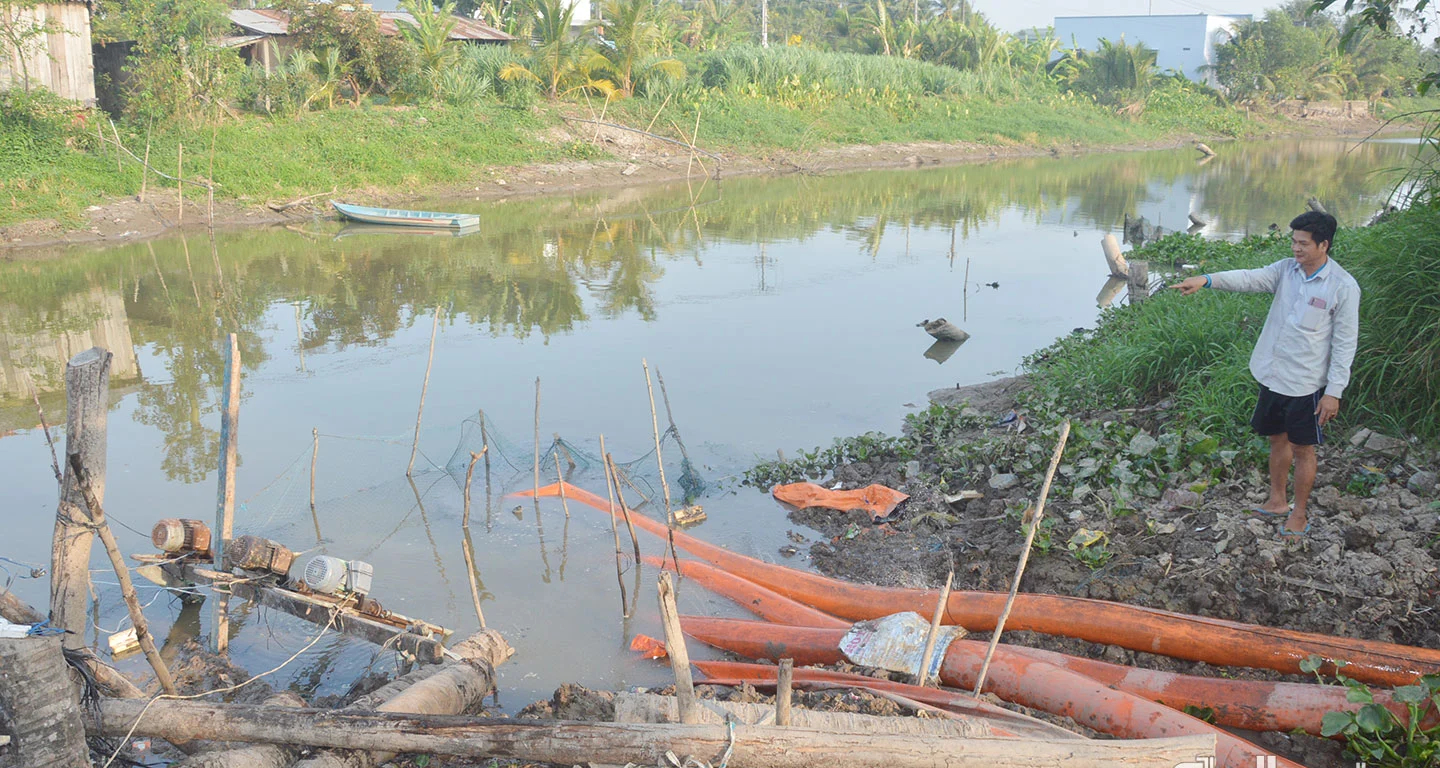
Due to severe drought and saltwater intrusion, people in Tien Giang province are pumping water to save their crops. Photo: Ap Bac Newspaper.
For example, in Ben Tre province, on the Co Chien River, salinity of 1 g/l penetrated 7.5km further inland than in 2016, and 25.8km further inland than the average annual level. Salinity of 4 g/l penetrated to Phu My hamlet, Nhuan Phu Tan commune (Mo Cay Bac district), 57.2km from the river mouth. Salinity of 1 g/l penetrated to Hoa Thuan hamlet, Vinh Binh commune (Cho Lach district), 75.8km from the river mouth.
On the Cua Dai River, similar to 2016, the 1 part per thousand boundary extended 21km further inland than the average: Salinity of 4 g/l penetrated to An My hamlet, An Khanh commune (Chau Thanh district), 53km from the river mouth. Salinity of 1 g/l penetrated to Con Doi hamlet, Phu Duc commune (Chau Thanh district), 71.3km from the river mouth.
On the Ham Luong River, the salinity level of 1 g/liter is about 5km deeper than in 2016, 6km deeper than in 2023, and 11km deeper than the average annual level.
In 2024, saltwater intrusion in Tien Giang province occurred earlier and penetrated deeper than the multi-year average. Salinity levels increased and extended further inland in late February and early March, coinciding with the high tide period at the beginning of the second lunar month. As a result, salinity levels in the Tien River increased and penetrated deeper than in the same period of 2016.
The highest salinity levels were recorded at stations such as: Vam Kenh (5km): 26.3g/l, 0.7g/l higher than in 2016; Hoa Binh (18km) 15.7g/l, 2.0g/l higher than in 2016; An Dinh (43km) 6.4g/l, 3.0g/l higher than in 2016; My Tho (48km) 4.2g/l, 0.4g/l higher than in 2016...
In Soc Trang, the stations on the Hau River in 2024 recorded the largest affected area of 63km for salinity intrusion at 1g/l, and 73km for salinity intrusion at 4g/l. The affected area on the My Thanh River in 2024 was 50-55km, and 52-57km for salinity intrusion at 4g/l.
According to the Deputy Director of the National Center for Meteorological and Hydrological Forecasting, the main cause of drought and saltwater intrusion in the Mekong Delta is the influence of the El Niño phenomenon. Since the beginning of 2024, the Mekong Delta region has experienced virtually no rain (a deficit of 60-95%), and prolonged sunny days have caused a large amount of surface water stored in fields, canals, rivers, and lakes to evaporate.
At the same time, the water flow from the upper Mekong River to the Mekong Delta is lower than the average annual level, combined with the high tide period, which has pushed saltwater further inland.
Mr. Dai warned that saltwater intrusion in the Mekong Delta continues to be at a higher level than the average for previous years, higher than in 2023. From now until the end of the 2024 dry season, there is a possibility of three saltwater intrusion events in the Mekong Delta, with the most severe intrusions concentrated during the periods of April 8-13, April 22-28, and May 7-11.
The depth of saltwater intrusion at 4‰ extends from 70-95km on the Vam Co Dong and Vam Co Tay rivers; from 50-62km on the Cua Tieu and Cua Dai rivers; from 60-68km on the Ham Luong river; from 45-55km on the Co Chien river; from 40-55km on the Hau river; and from 45-55km on the Cai Lon river.
"The saline intrusion situation in the Mekong Delta depends on water sources from the upper Mekong River, tidal surges, and is expected to fluctuate in the future. Local authorities in the Mekong Delta need to promptly update meteorological and hydrological forecasts and proactively implement measures to prevent and combat saline intrusion," Mr. Dai said.
Source





























































































Comment (0)