

Returning to Vietnam after 7 years, female traveler Natalie B. Compton experienced slow-paced travel by train, departing from Ho Chi Minh City to Hanoi.
Natalie B. Compton, a writer for The Washington Post, visited Vietnam in April and took a 3-day, 2-night train trip. Natalie said that on previous trips to Vietnam, she had only traveled by plane and hadn't had the chance to see the scenery of the "beautiful countryside." Meanwhile, traveling by train would allow her "time to admire the views from the window, explore many destinations along the way, and relax in the train carriage."
Natalie booked her tickets several weeks in advance through the Vietnam Railways System website (dsvn.vn). Just days before departure, she decided to change her schedule and received prompt assistance via email within hours. On the day of travel, she simply presented her e-ticket to board the train without needing to print a paper ticket or go through any procedures at the station.
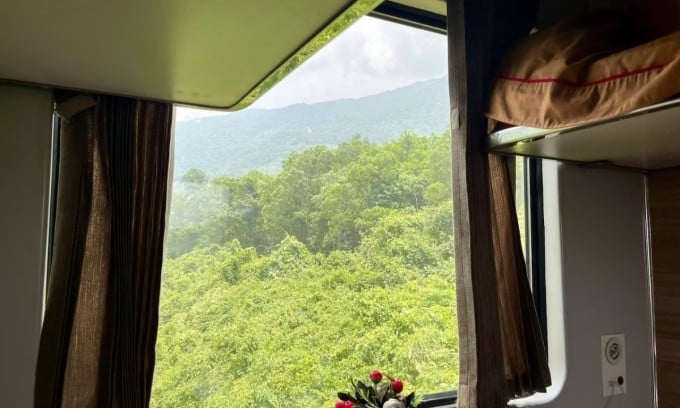
Natalie captured the scenery along the route from Ho Chi Minh City to Hue on a train journey in mid-April.
Natalie took two trains on her North-South journey. The first trip lasted over 22 hours, traveling on the Thong Nhat express train from Ho Chi Minh City to Hue. There were four types of tickets on the train: hard seat, soft seat, hard sleeper, and soft sleeper.
"I chose a soft sleeper berth, priced at $64 (approximately 1.5 million VND), which is equivalent to a flight. The train will stop in Hue after 22 hours. I've heard a lot about Hue being an ancient city with cheap local food," Natalie said.
Throughout the journey, staff regularly walk along the train carriages selling coffee, snacks, and meals such as rice, soup, and minced meat porridge. The train also stops for about 10 minutes at some stations so passengers can get off to walk around, smoke, or buy snacks from street vendors.
Natalie's bed was a bunk bed, equipped with mattresses, sheets, pillows, and a thin blanket. There was also a reading lamp and power outlets. Hot and cold water dispensers were located along the train corridor, and the restrooms were at the end of the carriage.
"The space on the train is cramped and there are no common areas. My evenings on the train weren't very quiet because my cabinmate turned up the volume to watch movies. Occasionally, some passengers would walk around in the hallway, even running noisily." Natalie shared a cabin with a Vietnamese passenger. Although she admitted to finding it difficult to connect with strangers, she still had a fairly pleasant time on the train with her new acquaintance. They chatted happily about their families and bought snacks together as the train neared its final leg in Hue.

Upon arriving at Hue station, Natalie spent a day and a night in the ancient capital before continuing her journey to Hanoi on the Lotus Express. This is a sleeper train with two ticket classes: soft sleeper berths in four-berth compartments and VIP berths in two-berth compartments. The writer for The Washington Post chose a soft sleeper berth priced at $72 (approximately 1.7 million VND).
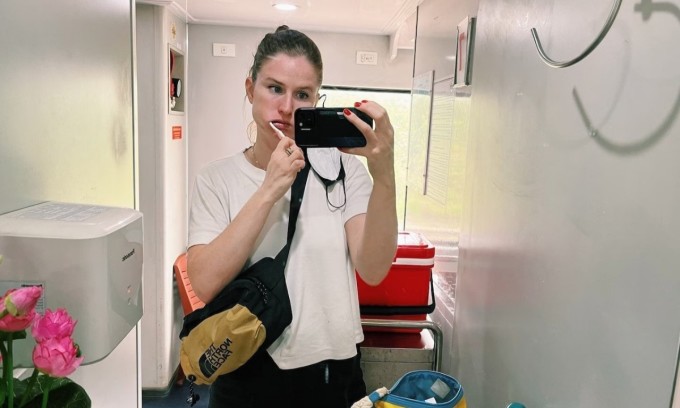
The restroom space on the train from Hue to Hanoi.
The train journey lasted 15 hours and offered free Wi-Fi. Compared to the Ho Chi Minh City - Hue leg, Natalie noted that the Hue - Hanoi train had thicker and more comfortable sleeping berths. Passengers were welcomed with a glass of wine and a bag of snacks. Although the second train was more comfortable, Natalie couldn't connect with her roommate. They remained silent throughout the 15-hour journey.
The American tourist said that she only slept fitfully during her two nights on the train. Waking up early in the morning, she often walked along the train's corridors. This was Natalie's favorite moment of the trip.
"The train passed through dense forests, logging areas, duck farms, and rice paddies. I even saw buffaloes resting on the river. That's what I had envisioned in my mind when I imagined a train journey along Vietnam. These experiences are impossible to have by plane," Natalie said.
She said that this trip's schedule was quite packed, involving two rather "cumbersome" train changes. Natalie plans to break up the schedule next time, travel for longer periods to rest, spend more time in Hue, and only travel on the Thong Nhat train.
The blankets, sheets, and pillows on the beds of the Reunification Express train were not replaced, but simply folded up and reused for the next trip. Both trains Natalie experienced were not wheelchair-friendly. The boarding stairs were small, and the doorways were narrow.
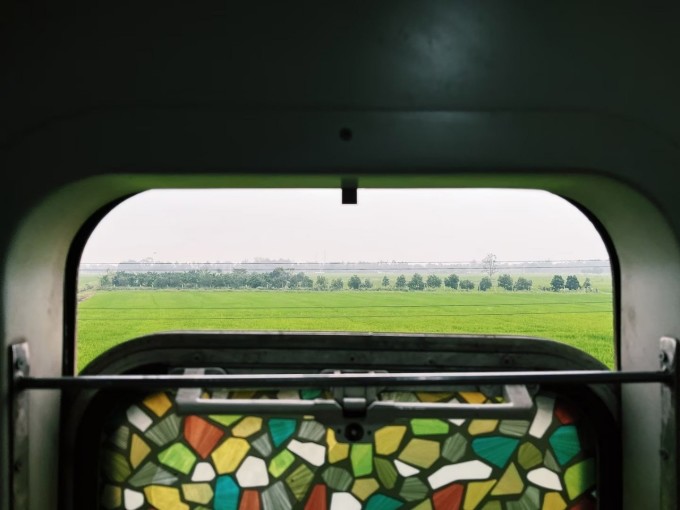
Natalie captured this rice field landscape from the Hue-Hanoi train journey in mid-April.

Regarding what to pack for a long cruise, Natalie prepared a comfortable outfit to wear on the ship, but still presentable enough since she would be sharing a cabin with strangers. She also brought a thin blanket and an eye mask. Since the ship's restrooms didn't have showers, Natalie brought a towel and dry shampoo. She advised against bringing too much food, as the ship provided plenty of food and drinks for passengers.
After a 3-day, 2-night leisurely train journey, Natalie said she would introduce this type of travel in Vietnam to many people.
Bich Phuong
According to The Washington Post
Source link



















































![[Video] Sunset at Lap An Lagoon – Where the sun sets over the fishing nets](https://vphoto.vietnam.vn/thumb/1200x675/vietnam/resource/IMAGE/2026/05/31/1780192137701_beach-landscape-sea-water-nature-grass-745871-pxhere-com.jpeg)





























Comment (0)