

A mysterious nebula located approximately 10,000 light-years from Earth is posing a new mystery. Specifically, a research team from Western University in Canada has obtained unprecedented high-resolution images and spectral data of the planetary nebula Tc 1 through observations using the James Webb Space Telescope (JWST).
They not only unraveled the mystery of the distribution of carbon molecules known as "buckyballs," but also captured a bizarre structure resembling an inverted question mark, which has attracted considerable attention.
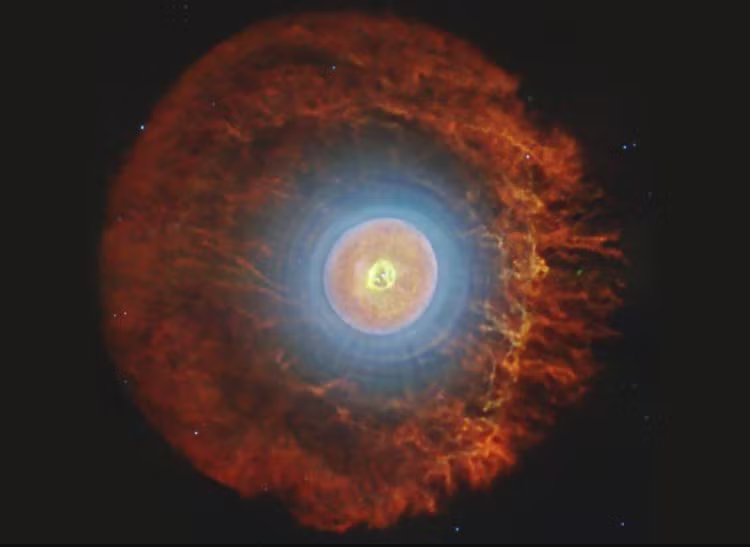
The latest images reveal that the nebula is filled with layers of gas, emitting beams of light, and complex filamentous structures. The varying colors represent variations in gas temperature, creating a distinct visual hierarchy. The most striking feature is a curved structure near the center, resembling an inverted question mark. Its origin remains unknown and will be the main focus of the research team's future analysis.
What truly surprised the scientists was the arrangement of the "Bucky spheres." These particles, composed of 60 carbon atoms, have a shape resembling a soccer ball. However, observations from the JWST telescope revealed that they are not randomly distributed, but concentrated on a thin, spherical shell within the nebula, forming a structure like a giant hollow sphere, overturning previous assumptions.
The research team at Western University points out that such a distribution is extremely rare, suggesting that the physical and chemical environment inside the Tc 1 Nebula is far more complex than expected. Through the spectroscopic capabilities of the JWST space telescope, scientists were also able to analyze the "chemical fingerprint" of each region to better understand the temperature, density, and gas movement.
In fact, Tc 1 is the remnant of a Sun-like star in its final stages of life. When the star ran out of fuel, its outer gas was ejected into space, leaving a hot white dwarf at its center, emitting intense ultraviolet radiation that causes surrounding matter to glow and form the spectacular nebula we see today.
Researchers say the discovery of Buckyball molecules helps track carbon chemistry in the universe and understand how organic molecules change in harsh environments, potentially even linking to the origins of life.
Source: https://khoahocdoisong.vn/kham-pha-bi-mat-trong-tinh-van-tc-1-qua-anh-james-webb-post2149100098.html

![[Image] Close-up view of the interchange connecting the two expressways and Long Thanh Airport.](https://vphoto.vietnam.vn/thumb/1200x675/vietnam/resource/IMAGE/2026/05/25/1779703378210_ndo_br_z7863716673926-224453a31600126cce10622af6290afd-4549-jpg.webp)

![[Image] Hanoi's urban life under the challenge of a "scorching hot" environment](https://vphoto.vietnam.vn/thumb/1200x675/vietnam/resource/IMAGE/2026/05/25/1779706979265_nang-nong-t5-2026-minh-duy-7-4636-jpg.webp)

















![[GALLERY] A completely different iPhone for the 20th anniversary edition](https://vphoto.vietnam.vn/thumb/402x226/vietnam/resource/IMAGE/2026/05/25/1779686871893_212-jpg.webp)





































































Comment (0)