Despite facing numerous challenges regarding documentation, witnesses, and technical conditions, the local authorities are focusing on reviewing and refining plans to accelerate implementation progress and are determined to achieve the assigned targets.
Many difficulties in the process of finding names for fallen soldiers.
In Khanh Hoa province, there are currently 8 martyrs' cemeteries with 7,196 graves, of which 2,234 remain unidentified. Implementing the "500-Day Campaign to Intensify the Search, Collection, and Identification of Martyrs' Remains," the province is focusing on three key tasks: searching for and collecting 150 remains of martyrs; verifying and standardizing data to draw conclusions on 168 areas and 946 pieces of information about martyrs and their graves; and collecting biological samples from all 2,234 unidentified remains for DNA testing. This is a massive undertaking, requiring a scientific , rigorous, and cautious implementation process.
 |
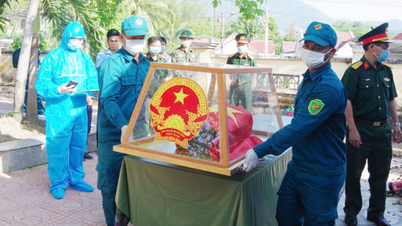
| The remains of fallen soldiers are being moved to the sampling area. Photo: VAN COC |
However, in practice, many objective difficulties are directly impacting the progress of the project. The majority of graves were reburied many years ago, and the remains have decomposed significantly over time, affecting the surveying, collection, and biological sampling work. The system of records, documents, and grave site maps stored over various periods lacks uniformity, making it difficult to re-identify areas previously searched. Meanwhile, information about martyrs and their graves is increasingly limited due to the advanced age, frailty, or death of many historical witnesses; the terrain in many areas has also changed significantly due to socio-economic development.
Colonel Vo Van Vien, Deputy Political Commissar of the Khanh Hoa Provincial Military Command, stated that, as the Standing Agency of the Provincial Steering Committee, the Provincial Military Command proactively advised the Provincial Party Committee and the Provincial People's Committee on leading and directing the synchronized implementation of the campaign throughout the entire political system; developing specific plans, clearly defining objectives, targets, and implementation roadmaps for each stage and each locality. During the implementation process, the provincial armed forces played a core role, especially in the work of collecting samples of martyrs' remains, ensuring the process was correct, safe, and accurate. Despite facing many difficulties due to the decomposition of remains over time, limited witness information, and changing terrain, the province remained determined to complete the set targets, making a significant contribution to the identification of martyrs.
Besides its profound political significance, the campaign also fulfills the legitimate aspirations of the relatives and families of fallen soldiers in their journey to find and identify their loved ones who sacrificed their lives for the country. Ms. Vo Thi Mong Tram (a relative of a fallen soldier, residing in Tan Xuong 1 village, Suoi Dau commune) shared: “I am the only child of fallen soldier Vo Hon. My father died in 1957, when I was just over two years old. My family has spent many years longing to find the grave of our loved one. Receiving the remains of the fallen soldier for burial at Hon Dung Martyrs' Cemetery was a great emotional moment and a comfort to my family after many years of waiting. Through following the information, I see that the application of science today, especially DNA testing, has brought new hope to many families whose loved ones sacrificed their lives and have been collected but whose names and hometowns have not yet been identified... I hope that the campaign will be implemented effectively, so that more and more fallen soldiers will be correctly identified and return to their hometowns and families.”
Valuable lessons learned from practical experience.


To conduct a thorough assessment before implementing the program across the entire province, the Khanh Hoa Provincial Steering Committee organized a preliminary effort to collect biological samples and digitize information from unidentified graves at the Khanh Vinh Martyrs' Cemetery. This cemetery currently contains the remains of 66 martyrs, including 39 unidentified graves requiring DNA testing. The Provincial Steering Committee established a specialized team of 20 people, divided into four working groups. The Department of Health deployed four professional staff members to participate in the coordination.
 |
| The technicians carefully collect biological samples from the remains of the fallen soldiers. |
 |
| Biological samples from the remains of fallen soldiers are carefully and meticulously packaged and preserved to ensure safety for DNA testing. Photo: VAN COC |
The sampling process was carried out strictly according to technical procedures. The results of excavating 39 graves showed that only 6 graves met the criteria for biological sample collection, representing a rate of 15.3%; the remaining 33 graves were unsuitable due to advanced decomposition of the bones, including 3 empty graves. All collected biological samples were handed over to the Military Forensic Institute for further examination.
However, the preliminary results at Khanh Vinh Martyrs' Cemetery also revealed many difficulties and obstacles that need to be addressed before widespread implementation. Many graves have been solidly restored over time, and their deep burial locations make excavation and site restoration more difficult and costly. Some features of the software for digitizing and managing biological sample information are not yet fully stable. Funding for the project is limited; some expenditure limits for sample collection, ensuring the livelihood of participating personnel, and supporting digitization work are not in line with practical realities.
Lieutenant Colonel Ha Quoc Cuong, Assistant to the Policy Department, Political Division, Khanh Hoa Provincial Military Command, who directly participated in the mission, said: “Every officer and soldier recognizes this as a sacred mission, demonstrating their responsibility to show gratitude to the heroic martyrs. The working groups always strictly adhere to technical procedures, coordinate synchronously between forces, ensuring safety and accuracy, and preventing any errors.”
Synchronizing solutions, determined to complete the task.
Based on the initial results and practical challenges, the Steering Committee of Khanh Hoa province has directed agencies, units, and localities to continue reviewing and refining the plan, determined to successfully achieve the campaign's objectives. According to Mr. Nguyen Van Dong, Secretary of the Party Committee and Chairman of the People's Council of Dien Khanh commune, the locality currently has 249 remains of martyrs; 122 have been collected, 63 remain uncollected, and 64 cases have unclear information. In 2026 alone, the commune has been assigned the target of collecting 8 remains of martyrs. This is a task requiring the decisive involvement of the entire political system and the consensus of the people. Therefore, the locality is focusing on promoting propaganda and raising awareness and responsibility among officials, Party members, and the people regarding the significance of the work of searching for and collecting the remains of martyrs.



At the conference reviewing the initial results of the new campaign, Comrade Nguyen Khac Ha, Deputy Secretary of the Provincial Party Committee and Chairman of the Vietnam Fatherland Front Committee of Khanh Hoa province, emphasized: This is an exceptionally difficult task, requiring accuracy, scientific rigor, caution, and the highest level of political determination, along with deep affection and responsibility towards the heroic martyrs and their families. To improve the effectiveness of the task, agencies, units, and localities need to research and apply all feasible solutions, including hiring experts, mobilizing experienced personnel, or investing in additional specialized equipment to enhance the efficiency of the mission.
The Steering Committee of Khanh Hoa province is urgently adjusting the overall plan, clearly defining objectives, outputs, responsibilities of each agency and individual, and completion time; while regularly checking and evaluating progress to promptly address any arising difficulties. The Provincial Military Command continues to lead the development of unified guidelines on excavation techniques, sample collection, and information digitization; and simultaneously implements the search and repatriation targets according to the plan...
Following the completion of the review of the previous phase at Khanh Vinh Martyrs' Cemetery, the Steering Committee of Khanh Hoa province continued to provide unified guidance on the implementation of biological sample collection at the remaining 7 martyrs' cemeteries. With the involvement of the entire political system and the determination of agencies, units, and localities, Khanh Hoa province strives to complete the assigned tasks, contributing to the effective implementation of the Army's rear-area support policy and the national tradition of "drinking water, remembering the source."
Source: https://www.qdnd.vn/xa-hoi/chien-dich-500-ngay-dem-tri-an-liet-si/khanh-hoa-voi-hanh-trinh-tri-an-1046674