


From a grain of rice to a new life
As the sun rose above the limestone peaks, the fields of K'Ai village buzzed with activity. On the ripening rice paddies, the Bru-Van Kieu people busily harvested their crops after months of careful cultivation.
Few people know that, in the past, the lives of many households here depended mainly on slash-and-burn agriculture. Farming was heavily dependent on the weather, resulting in unstable yields, and many families frequently faced food shortages during the lean months. Since the introduction of wet rice cultivation, the picture of life has gradually changed.
Mr. Ho Van Men, a resident of K'Ai village, shared that in the past, his family often had to go to the forest to cultivate fields, with good harvests coming and going. Now, with paddy fields, each harvest provides enough rice to last for many months, making life much more stable. Looking at the golden rice fields, everyone is happy; with rice, their children no longer have to worry about food shortages like before.

Similar changes are occurring not only in K'Ai but also in the villages of the Ma Coong people in Thuong Trach commune. The rice paddies nestled along the streams amidst the Truong Son mountain range have now become valuable assets for many families.
In many highland villages of Quang Tri province, wet rice cultivation not only provides the people with additional food but also lays the foundation for a more stable life. From fields along streams, people are gradually changing their production practices, reducing their dependence on slash-and-burn agriculture, while also contributing to preserving forests, land, and villages in this border region.
Mr. Ho Ngoc Thanh, Chairman of the People's Committee of Thuong Trach commune, said that the development of wet rice cultivation has made a significant contribution to poverty reduction and stabilizing people's lives. "Wet rice cultivation has helped people gradually change their production practices and become self-sufficient in food. More importantly, it has created motivation for people to stay in their villages and build stable lives right in their homeland," Mr. Thanh shared.
According to Mr. Thanh, with the support of the State in terms of seeds, techniques, and irrigation systems, many households have learned to apply more effective farming methods, gradually improving productivity and product quality.
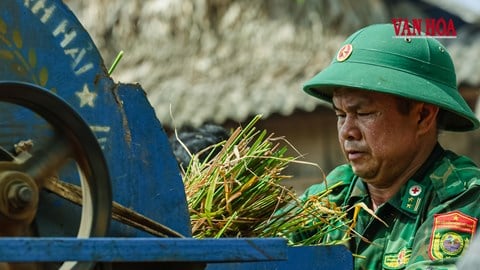
Golden season at the border
Keep people in their villages.
In remote border regions, rice cultivation holds a significance far beyond just economic gain. In Kim Phu commune, home to the Ruc ethnic minority, rice paddies are gradually replacing the fragmented farming practices of the past. Each planting and harvesting season becomes an opportunity for the villagers to exchange labor and help each other.
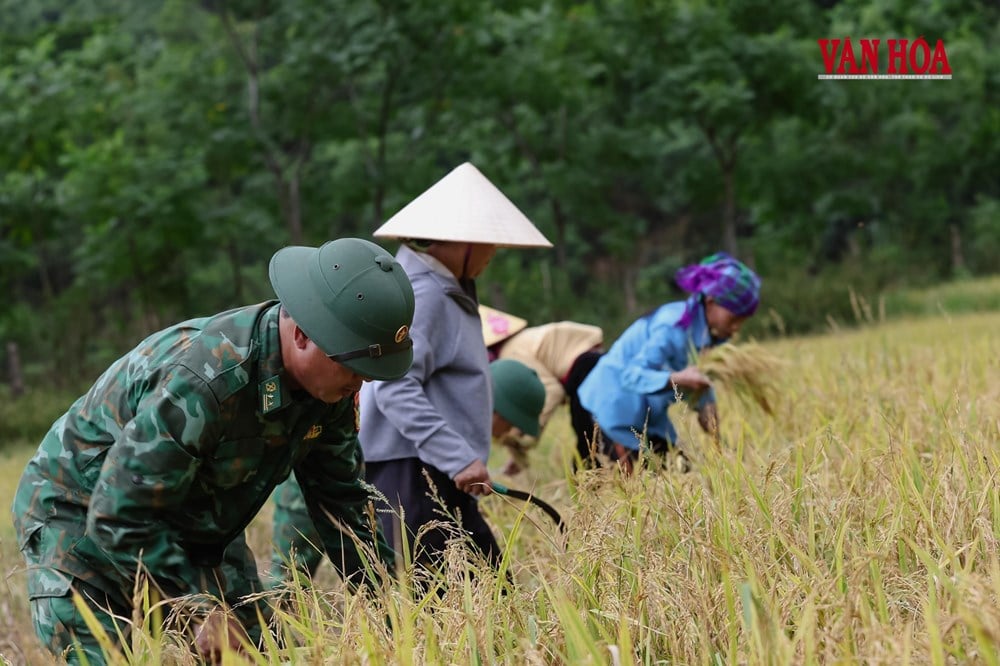
Amidst the rhythmic threshing of rice machines and the lively laughter and chatter in the fields, the villagers not only harvest their crops but also cultivate community bonds. Children grow up surrounded by the scent of freshly harvested rice and the stories of their parents' labor, fostering a deeper love for their birthplace.
For many local officials, the appearance of paddy fields is also proof of the changing mindset of the people. From being accustomed to self-sufficient production, the people have gradually formed the habit of planned labor, knowing how to care for crops at each stage and planning for subsequent seasons. This is an important foundation for sustainable economic development in the highlands.
The rice harvest seasons also help to keep people attached to the land, reduce nomadic farming practices, and lessen pressure on forest resources. When lives improve from their homeland, people have even more reason to stay and work together to build their villages.

Lieutenant Colonel Hoang Cong Hung, Commander of the Ca Xeng Border Guard Station, said: "Over the past 15 years, we have regularly coordinated with local authorities to support people in developing production, providing guidance on farming techniques, and assisting with harvests. We believe that helping people develop their livelihoods is also a way to contribute to border protection."
“When people have stable lives and a secure food supply, they will feel secure staying in their villages and working with the authorities to maintain security and order in the border area. Every harvest season, the image of border guards and villagers harvesting and transporting rice home has become familiar in many highland villages.”
"The sweat shed in the fields not only yields rice but also fosters strong bonds between the military and the people in the border region...", Lieutenant Colonel Hoang Cong Hung shared.
As evening falls, the rice fields in K'Ai, Thuong Trach, and Kim Phu gradually turn a golden yellow. Sacks of rice are transported home, and the laughter of children echoes through the villages after a busy day.

Amidst the vast Trường Sơn mountain range, rice today has transcended the meaning of a mere food crop. It is a symbol of change, the result of tireless efforts from the people, the government, and the armed forces.
More importantly, each rice harvest season is contributing to keeping people in their villages, preserving traditional cultural values, and safeguarding the nation's border in a very simple yet sustainable way.
Source: https://baovanhoa.vn/dan-toc-ton-giao/khi-cay-lua-ben-re-giua-dai-ngan-233806.html




































![[Video] Sunset at Lap An Lagoon – Where the sun sets over the fishing nets](https://vphoto.vietnam.vn/thumb/1200x675/vietnam/resource/IMAGE/2026/05/31/1780192137701_beach-landscape-sea-water-nature-grass-745871-pxhere-com.jpeg)






















Comment (0)