

My family's waste disposal area has two old paint buckets. One is used for plastic bottles and beer cans; the other is used for organic waste such as vegetable stalks, fruit peels, and leftover food.
The first bucket was given to my children to "manage" and sell to a scrap collector when it was full. The kids were incredibly excited to earn small amounts of money to save for their own projects.
The second bucket is for my small garden. The garden is only a few dozen square meters, with a few chickens and some fruit trees, all "fed" by the organic waste I generate each day.
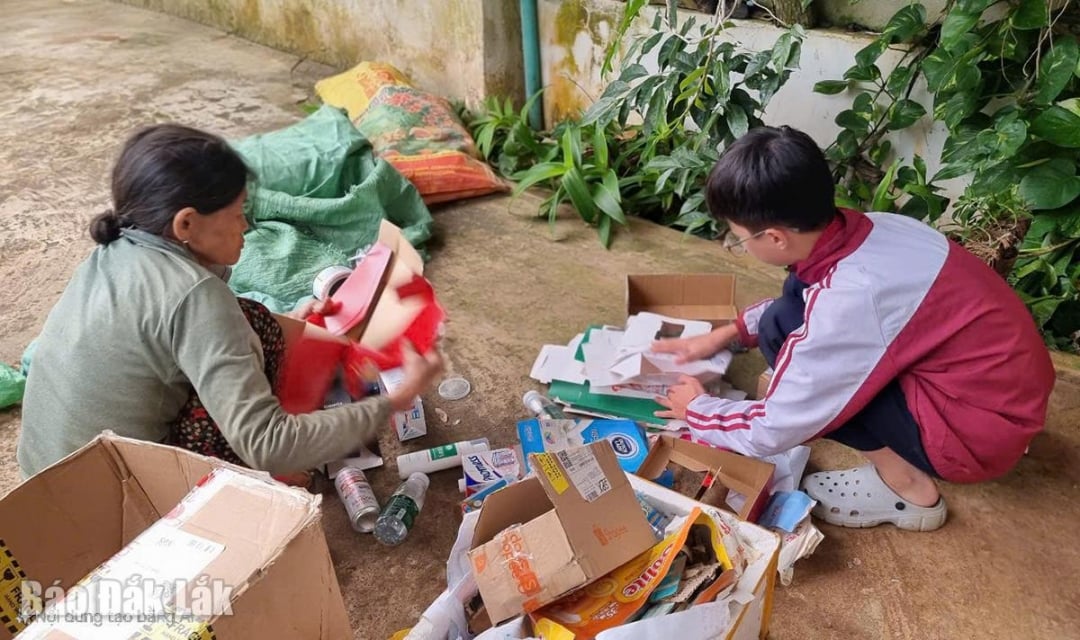 |
| My son collects paper, cans, and bottles separately to sell as scrap. |
Initially, I focused on researching ways to process organic waste before putting it in the garden. For example, raising black soldier flies – calcium worms – to process waste and create feed for chickens; composting organic waste using EM (Effective Microorganisms) products… While these methods were effective, they were time-consuming, so I returned to the quickest and easiest way: putting all organic waste in the garden. Leftover food becomes chicken feed, and the rest decomposes naturally. Periodically, I dilute EM products with Trichoderma antagonistic fungi and spray them on the surface to promote decomposition and increase beneficial microorganisms in the soil. As a result, my small garden, which used to have dry, barren soil, now has a loose, moist organic cover. Several fruit trees grow naturally in the garden, requiring no special care, yet consistently producing sweet, fragrant fruit.
The remaining waste that cannot be reused is put into bags for the environmental company to collect periodically, once a week. Compared to neighboring families, our garbage bags are always smaller, lighter, and odorless. In addition, we have a plastic bottle specifically for storing old batteries and some hazardous waste. Whenever there's a collection, my children bring their hazardous waste to exchange for gifts; even without gifts, just seeing that the hazardous waste isn't mixed with household waste is a joy for us.
Sorting waste also helps us re-evaluate our consumption habits. For example, when we see the amount of unusable waste – mostly plastic bags, plastic cups, and plastic trays – that ends up in landfills every week, we will find ways to reduce it by bringing our own water bottles and cloth bags; not using plastic straws; and refusing to use plastic bags when not absolutely necessary.
Whenever relatives visit and stay at our house, my children naturally guide guests on how to sort their trash or explain why it's important. The money earned from selling recyclable materials, besides being used for personal needs, is also set aside by the children to support disadvantaged friends, disaster-stricken areas, or to give in small, pretty envelopes to garbage collectors. These are the lessons about environmental responsibility and sharing with those around them that my children have learned through the habit of sorting trash.
According to the Law on Environmental Protection, from January 1, 2025, families and individuals are required to sort household solid waste. However, implementation still faces many shortcomings, resulting in less than expected outcomes. Hopefully, each family will find suitable ways to make waste sorting a habit, contributing to environmental protection.
Source: https://baodaklak.vn/xa-hoi/202506/khi-phan-loai-rac-la-niem-vui-eb7129a/


![[Photo] Prime Minister Pham Minh Chinh attends the Conference on the Implementation of Tasks for 2026 of the Industry and Trade Sector](/_next/image?url=https%3A%2F%2Fvphoto.vietnam.vn%2Fthumb%2F1200x675%2Fvietnam%2Fresource%2FIMAGE%2F2025%2F12%2F19%2F1766159500458_ndo_br_shared31-jpg.webp&w=3840&q=75)






























































Comment (0)