 |
| Ms. Vo Thi Ngoc Lam, M.Sc., Deputy Director of the Dong Nai Department of Health , and Deputy Head of the Standing Committee of the Inter-sectoral Steering Committee on Food Safety of Dong Nai City. |
Regarding this issue, reporters from Dong Nai Newspaper and Radio & Television had a discussion with Ms. Vo Thi Ngoc Lam, Deputy Director of the Dong Nai Department of Health and Deputy Head of the Standing Committee of the Inter-sectoral Steering Committee on Food Safety of Dong Nai City.
High pressure in food safety management.
* How is food safety management currently being implemented in the city, Madam?
- The entire city is currently managing over 28,000 food establishments, including more than 18,900 food service businesses and street food vendors; approximately 3,300 food processing, manufacturing, and production facilities; and over 5,900 food businesses. The large number and wide distribution of these establishments necessitate very strict, coordinated, and continuous food safety management.
Currently, state management of food safety is assigned to three departments: Health, Industry and Trade , and Agriculture and Environment. The City People's Committee has established an inter-departmental steering committee on food safety, with the Department of Health as the permanent agency. With this coordination mechanism, we implement control throughout the entire process, from production and processing to distribution and consumption.
However, it must be acknowledged that the pressure remains immense. The vast geographical area, large population, diverse business types, and especially the rapid development of e-commerce and online food sales via social media are posing many new challenges.
* What regulations do these establishments commonly violate, madam?
- In the first quarter of 2026, functional agencies in the city inspected more than 1,700 food processing and trading establishments. The results showed that 82.8% of establishments met requirements, while 17.2% violated regulations. Common violations included: lack of food safety certificates or expired licenses; inadequate hygiene conditions of facilities and equipment; unclear origin of raw materials, lack of invoices and documentation; and food processors not having undergone health checks, training, or not fully complying with labor protection regulations. Authorities fined 138 establishments for violations with a total amount exceeding 1.54 billion VND. Simultaneously, 161 establishments were reminded and required to rectify the issues.
Consumers should prioritize choosing food with clear origins, complete labels, and within its expiration date, purchased from reputable establishments. It is essential to follow the principles of cooking food thoroughly, boiling water, keeping raw and cooked food separate, and storing food at the correct temperature.
Ms. Vo Thi Ngoc Lam, Deputy Director of the Dong Nai Department of Health
* Which types of businesses are most prone to violations, and what are the biggest challenges in food safety management, Madam?
- The types of food with the highest risk are small-scale businesses, street food, and online food businesses.
With street food, characterized by small investment capital, flexible locations, and many spontaneously operating establishments, controlling hygiene conditions and the origin of ingredients is very difficult. Meanwhile, online businesses on social media and e-commerce platforms create new problems regarding traceability, identifying production locations, and processing conditions.
The biggest challenge currently is the enormous number of street food vendors and online businesses, their widespread distribution, the limited number of regulatory personnel, and the fact that some establishments still prioritize profit over public health. Therefore, regulatory agencies have determined that they must strengthen post-inspection and surprise checks, and intensify public awareness campaigns to improve the understanding of relevant stakeholders.
Control the entire process.
* Could you tell us what activities Dong Nai implemented during the 2026 Food Safety Action Month? What were the initial results?
- We are implementing three key solution groups. Firstly, we are strengthening communication to disseminate legal regulations and improve public awareness of safe food identification. Secondly, we are intensifying targeted inspections, focusing on collective kitchens, schools, industrial zones, food service establishments, and street food vendors. Thirdly, we are coordinating inter-agency efforts to enhance the effectiveness of preventing, monitoring, and handling food poisoning incidents.
In reality, awareness of food safety regulations at many establishments has significantly improved; many violations have been detected and corrected promptly. The important thing is to create a ripple effect so that food safety becomes a permanent awareness, not just a sporadic activity.
 |
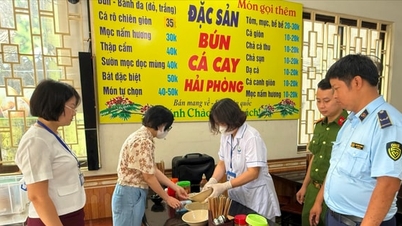
| Members of the inter-agency food safety inspection team of the city inspect the food sample storage practices of a business in Phuoc Tan ward. |
* Dong Nai has many large-scale communal kitchens. In your opinion, how can the risk of food poisoning be effectively controlled?
- Communal kitchens are a particularly important area because even a small mistake can affect thousands of people. The core solution is to control everything from input to output, including: traceable ingredients, a three-step food inspection process, food sample retention, a one-way processing system, strict hygiene, and prevention of cross-contamination.
Currently, the health sector has established 35 model safe kitchens in businesses and schools, serving more than 115,000 meals per day. Monitoring has shown that these models meet all requirements. Notably, from 2025 to the present, the entire city has not recorded any food poisoning incidents.
This shows that if the head of the unit truly values the health of workers and students and strictly enforces regulations, the risks can be completely controlled.
* Many argue that despite increased penalties, violations still occur. In your opinion, are the current penalties sufficient to deter such behavior?
- Basically, the current legal framework is quite comprehensive. According to the Food Safety Law (Law No. 55/2010/QH12) and Decree No. 115/2018/ND-CP (amended by Decree No. 124/2021/ND-CP), penalties can reach up to 200 million VND for individuals and 400 million VND for organizations, not to mention suspension of operations, revocation of licenses, destruction of products, or criminal prosecution under Article 317 of the Penal Code.
However, in reality, sanctions alone are not enough. The key is detection, monitoring, and self-discipline. Some profit-driven establishments still intentionally violate regulations. Therefore, a combination of strict penalties, public awareness campaigns, education, and community monitoring is necessary. We cannot allow a situation where penalties are imposed but violations continue. We cannot allow the health of the people to become the price paid for profit.
* What message does she want to send to businesses, manufacturing facilities, and the public?
- I want to emphasize that food safety is not just a legal regulation, but a social ethics. For businesses, don't sacrifice reputation and public health for short-term profits. For the people, become wise consumers. For regulatory agencies, we will continue to tighten inspections and strictly handle violations. Only when the whole society acts together, from regulators to producers and consumers, can we build a safe and sustainable food environment – where every meal truly is the foundation for health and quality of life.
Thank you very much, Madam!
Hanh Dung (compiled)
Source: https://baodongnai.com.vn/xa-hoi/y-te/202605/khong-danh-doi-suc-khoe-cong-dong-lay-loi-nhuan-a922f26/



![[Image] Hanoi's urban life under the challenge of a "scorching hot" environment](https://vphoto.vietnam.vn/thumb/1200x675/vietnam/resource/IMAGE/2026/05/25/1779706979265_nang-nong-t5-2026-minh-duy-7-4636-jpg.webp)



![[Image] Close-up view of the interchange connecting the two expressways and Long Thanh Airport.](https://vphoto.vietnam.vn/thumb/1200x675/vietnam/resource/IMAGE/2026/05/25/1779703378210_ndo_br_z7863716673926-224453a31600126cce10622af6290afd-4549-jpg.webp)


























































































Comment (0)