

(NLĐO) - Confusing data from the Gaia spacecraft may reveal one of the most sought-after types of objects in the Milky Way galaxy.
Gaia is a small spacecraft from the European Space Agency (ESA) that functions as a satellite to explore the Milky Way galaxy and map it.
According to Science Alert, when gazing towards a location 5,825 light-years from Earth, Gaia detected something resembling a dancing red giant star.
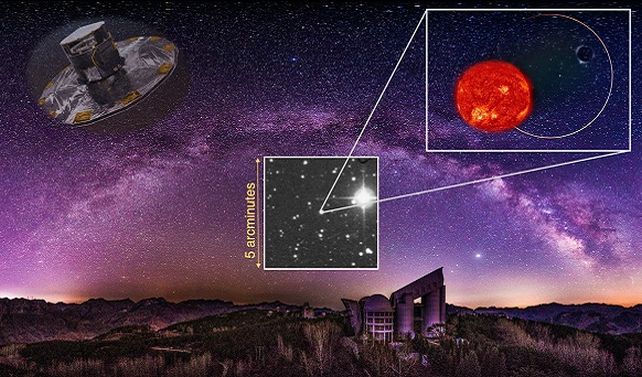
Graphic illustration depicting the Gaia spacecraft, the red giant star, and the black hole, as well as a realistic image of it in astronomical data - Photo: Song Wang/ESA
Red giant stars are dying stars that swell up for a short time before collapsing. Our Sun will also transform into this type of star in about 5 billion years, possibly swelling large enough to swallow Mercury, Venus, and Earth.
But the signal Gaia received from this new red giant star was very different. It seemed to be slowly dancing in orbit with a companion binary star.
However, no companion stars could be observed alongside this red giant star.
Based on the behavior of the red giant, a research team led by Dr. Song Wang from the Chinese Academy of Sciences determined that the mass of this invisible companion object is only 3.6 times the mass of the Sun.
All the calculations suggest it can only be a black hole.
Furthermore, its surprisingly wide circular orbit challenges current theories of binary evolution and supernovae, making it a treasure for researchers.
The red giant star-black hole pair, collectively named G3425, may have formed from the second death of a star many times larger than the Sun.
After bursting into a red giant and collapsing the first time, that star became a tiny, very dense neutron star. After some time, this neutron star exploded again and collapsed into a black hole.
According to the article published in the journal Nature, this black hole is estimated to weigh about 3.6 times the mass of the Sun.
Previously, the smallest black holes discovered weighed at least five times the mass of the Sun. Therefore, G3425 has set a new record for the smallest black hole that could possibly exist.
The sight of a giant red star dancing alongside a black hole is also fascinating.
The red giant star in G3425 has an estimated mass of about 2.7 Suns, orbiting in a relatively wide orbit, taking about 880 days to move around a common center of gravity with the black hole.
Source: https://nld.com.vn/tau-vu-tru-bat-duoc-tin-hieu-la-ky-luc-moi-ve-tu-than-vu-tru-196240922100245329.htm


![[Image] Close-up view of the interchange connecting the two expressways and Long Thanh Airport.](https://vphoto.vietnam.vn/thumb/1200x675/vietnam/resource/IMAGE/2026/05/25/1779703378210_ndo_br_z7863716673926-224453a31600126cce10622af6290afd-4549-jpg.webp)
![[Image] Hanoi's urban life under the challenge of a "scorching hot" environment](https://vphoto.vietnam.vn/thumb/1200x675/vietnam/resource/IMAGE/2026/05/25/1779706979265_nang-nong-t5-2026-minh-duy-7-4636-jpg.webp)




![[E-Magazine]: Listening in silence to the changing seasons](https://vphoto.vietnam.vn/thumb/402x226/vietnam/resource/IMAGE/2026/04/17/1776436870717_e-magazine-lang-w1200t0-di2615d199d5160004t11920l1-lynkgm-017.webp)






























































































Comment (0)