

"The soldiers of Bac Kan, a land of bloodshed and fire."
“Memories of the war, sometimes near, sometimes far, sometimes clear, sometimes forgotten, interrupted by time and age, by the harshness of war and life, are recorded in these pages… – A generation of courageous young people from Bac Kan, in the decisive moments of the Fatherland's trials, were ready to ‘put aside their pens and books’ to take up arms against the enemy, their youth spent on battlefields, sacrificing their lives or parts of their bodies for the peaceful life we have today…”
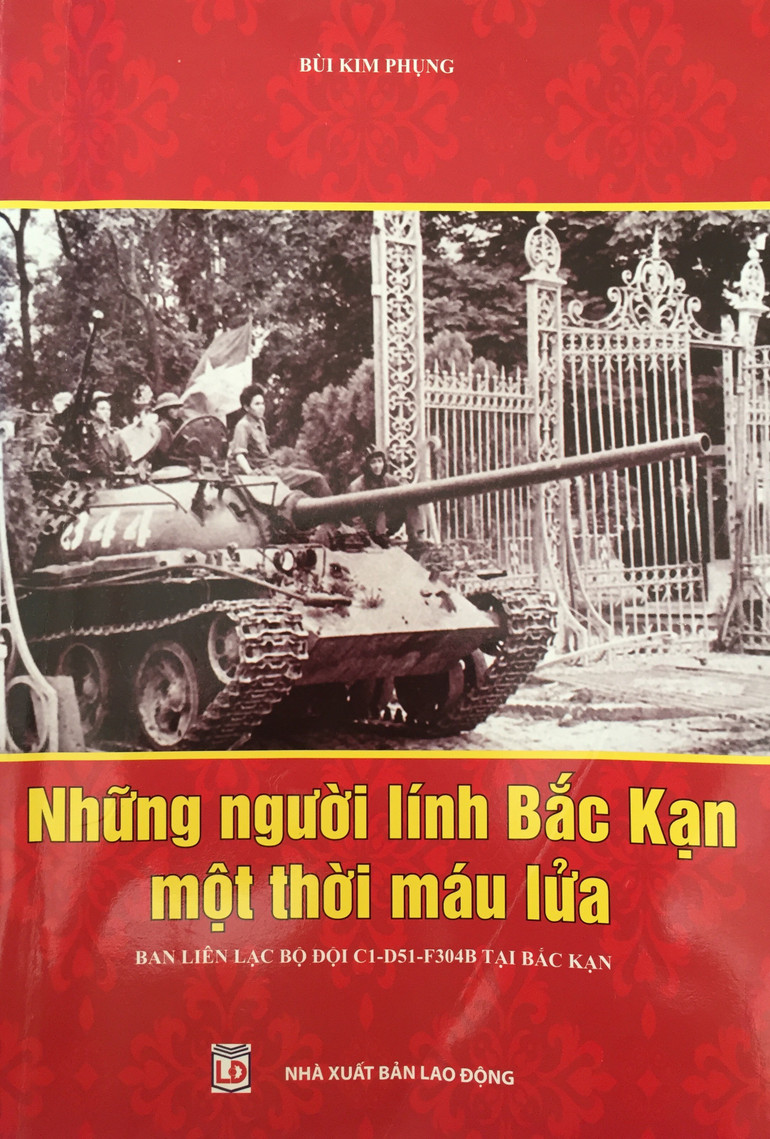
These are the first words shared by author Bui Kim Phung in his book "The Soldiers of Bac Kan: A Time of Blood and Fire." And in keeping with that spirit, readers will relive those years of bombing and shelling through the recollections of the soldiers themselves, written by Bui Kim Phung with passion and admiration…
The book opens with two lines from a song: “Although we love roses, the enemy forces us to embrace the gun!” (by composer Diep Minh Tuyen), followed by stories that are both joyful and poignant : “We went in the last recruitment drive of the year – the third drive, on December 12, 1971, in a group of 150 young, enthusiastic men from the communes of Bach Thong district, Na Ri district, and Bac Kan town. We left carrying a solemn message: Don't desert even in hardship! From our father, and the tearful advice from our mother: Take care of your health, son!... We carried the image of a loved one we kept secret in our hearts, a secret that is now no longer a secret, even though many of our classmates carelessly organized farewell parties, unaware that a heart was beating wildly for us…” ( Stories of Enlistment).
After the initial awkwardness and emotions, the soldiers truly lived amidst bombs and bullets. From here, each page of the book becomes a historical record, following each campaign, battle, and location. Thanks to this, readers will learn about the never-before-told stories of the soldiers from Bac Kan fighting at Quang Tri Citadel; the Thuong Duc Campaign; the Ho Chi Minh Campaign of 1975 – the liberation of the South… War is inherently cruel, and each segment of wartime memories is filled with ferocity and tragedy in “Haunting”; “First Time Wounded”; “Unexpected Loss”; “Comrades! Don’t Be Startled…”; “The Dream of a Soldier Guarding the B40 at Outpost 383”…
During the historic moments of April 30, 1975, young soldiers from Bac Kan province recounted their overwhelming emotions: "If, back then, from Nha Rong Wharf across the river, our President Ho Chi Minh had not accepted the fate of a nation under foreign rule, and had traveled the world to find a way to regain independence and freedom for the nation, then his descendants would not accept this suffering either."
"The road to liberation is only halfway traveled."
Half of my body was still in the boiling water.
One body cannot be divided in two.
"The fire of swords cannot sever mountains and rivers."
(Tố Hữu)
For generations, they have followed one another, sacrificing their blood and lives to reclaim half of the country... And today, right here on this very river, with the position of masters, the soldiers proudly stand on the bow of a military ship as large as a multi-story building, gazing at the picturesque river and saying: "Uncle Ho! The country is now united..."
(Last-minute decision)
Go to war!
"He was furious, raising his head to go into battle."
I wholeheartedly and resolutely follow you.
Let's put aside romantic relationships and dating for now.
"Put your bags on and head to the assembly point..."
(Joining the army)
These are the first verses in the Tay-language poetry collection "Khun tang tuc slac" (translated: Setting out to fight the enemy). The book was rewritten by veteran Ha Thiem Thuong from his battlefield diary.
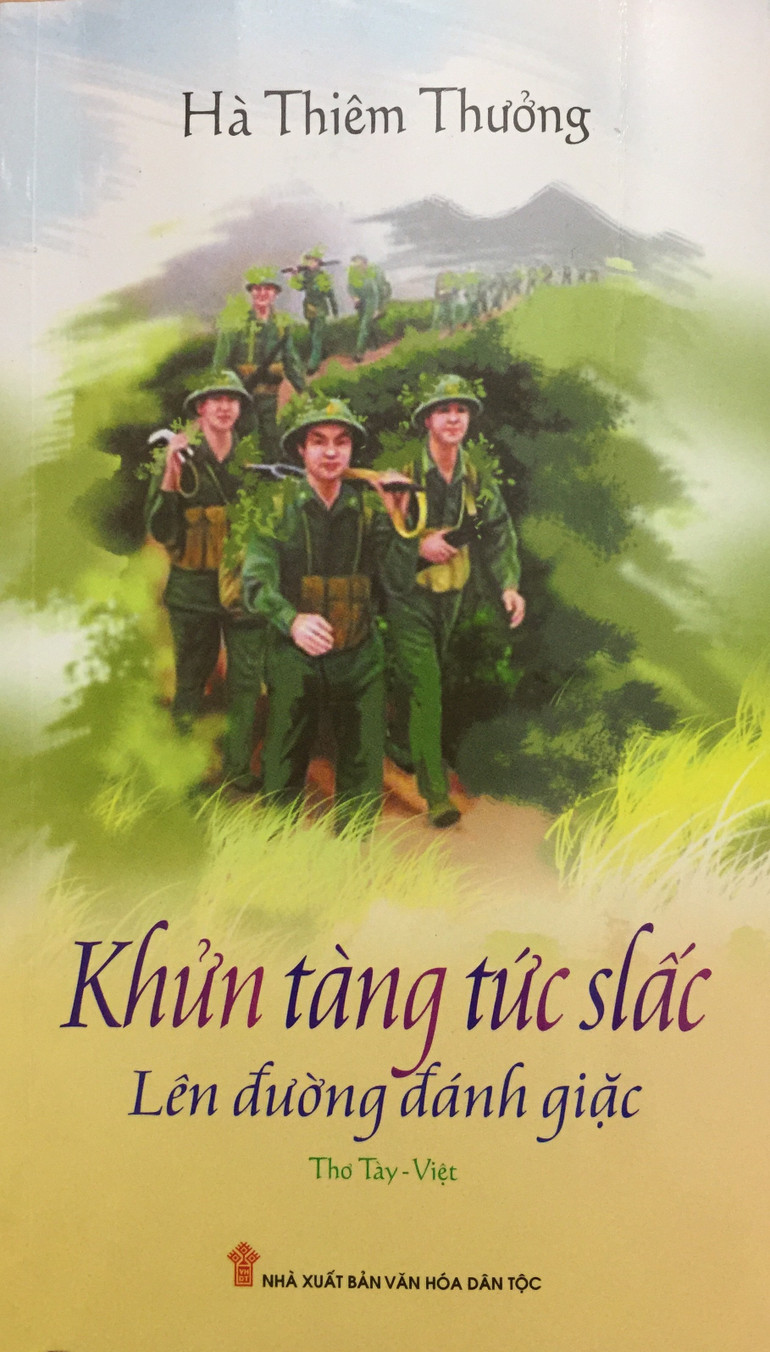
Mr. Thuong was born in 1928. From a young age, he loved studying and dreamed of becoming a writer. In early 1948, the young man of the Tay ethnic group volunteered to join the army. At his unit, he was one of the few literate people, so he was retained as an ordnance clerk. From then on, he became involved in propaganda work. Initially, he translated poems by President Ho Chi Minh into the Tay language, then wrote slogans and recorded information about the resistance war. This provided him with the material to keep his battlefield diary.
In 1968, he received orders to lead troops into the Southern battlefield. After practical experiences on the march, veteran Ha Thiem Thuong began writing in his diary. He meticulously described the days of "training," "departure," and "welcoming the troops" in his poems. Because he witnessed and experienced these events firsthand, many of his poems allow readers to understand the hardships and heroic sacrifices of the previous generation. Upon returning to work in the North, he continued to write poetry about the significant activities of our resistance war. Historical milestones such as the "Central Highlands Campaign," the "Hue-Da Nang Campaign," and the "Ho Chi Minh Campaign" were all described and recorded in poems brimming with national pride.
Perhaps this is one of the only collections of poems in the Tay language written on the battlefield in Southern Vietnam during the resistance war against the US. As a war diary, the 36 poems were completed by veteran Ha Thiem Thuong over 10 years. Of these, he remembers most vividly the poem "Vietnam's Complete Victory".
He said that everyone was tense, glued to the phone, ready to grab a pen and paper as it rang, listening to the commander's instructions and what needed to be recorded. Hearing the commander's voice, practically shouting "Vietnam's complete victory," repeated over and over, he felt a mixture of happiness and trembling as he held his pen – a truly extraordinary feeling. Afterward, he and everyone else received orders to collect all the old banners, slogans, and tarpaulins, wash them clean, and write only the four words "Vietnam's complete victory" to hang up the following day. And so, on that historic April 30th, I put pen to paper and wrote:
"News of the great victory resounded in all directions."
Complete victory! Vietnam has achieved complete victory…
I wish Uncle Ho were here.
Thirty springs, this spring is complete…”
(Vietnam achieved a complete victory)
In 2018, the author of the poetry collection "Khửn tàng tức slấc" devoted all his efforts to translating it into standard Vietnamese, hoping to preserve it for future generations. And the "lifelong wish" of this veteran has come true as the National Culture Publishing House has reprinted the book in a bilingual Tay-Vietnamese edition.
Closing each book about war written in peacetime, many readers, like us, will surely feel a flame of pride ignited in their hearts for a generation of brave and steadfast ancestors. Allow me to conclude this article with a few words of encouragement: “…The value of every moment lived in peace has been exchanged for the blood and bones of countless outstanding sons and daughters: Let not the blood shed since those days go to waste! Those who cherish every moment of peace in the present will strive their utmost to avoid seeing the blood of their fellow human beings shed again! If we do not remember these things, how can we be worthy of that sacrifice?” (excerpt from the article "The Price of Victory" in The Soldiers of Bac Kan: A Time of Bloodshed).
Source: https://baobackan.vn/ky-uc-nguoi-linh-giua-hoa-binh-post70572.html
![[Image] A night of light, many layers of message](https://vphoto.vietnam.vn/thumb/1200x675/vietnam/resource/IMAGE/2026/03/10/1773158812907_hoa-nhac9-jpg.webp)








![[Update] Announcement Ceremony for the Merger of Provincial and Commune-Level Administrative Units in Thai Nguyen and Bac Kan Provinces](https://vphoto.vietnam.vn/thumb/402x226/vietnam/resource/IMAGE/2025/6/30/0de85cb56da843d897e30016b57b1412)








































Comment (0)