

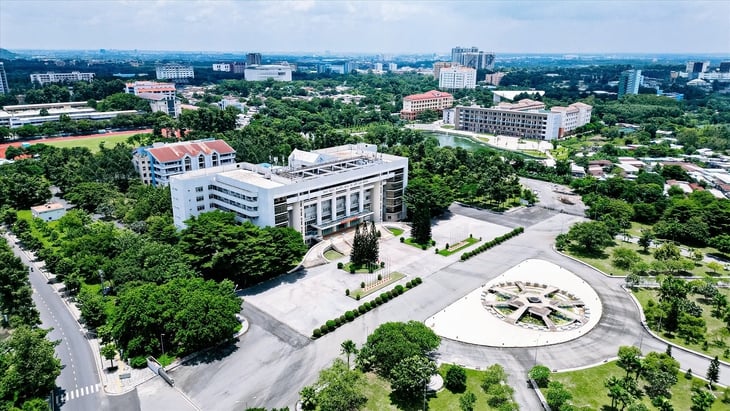
Administrative area of the Vietnam National University Ho Chi Minh City - Photo: THANH HIEP
Ho Chi Minh City once considered relocating universities to the outskirts, primarily to the Ho Chi Minh City National University urban area. However, for various reasons, after more than 30 years, the urban area's planning has yet to be completed. Now, the city is seeking solutions and resuming this initiative.
Speaking with voters in Ho Chi Minh City after the recent 10th session of the National Assembly , Ho Chi Minh City Party Secretary Tran Luu Quang said that one of the city's goals is to resolve issues in the Ho Chi Minh City National University urban area in order to develop it into a center for innovation.
The city is also considering relocating universities from the city center to this urban area to alleviate traffic congestion...
The issue of construction authority has been resolved.
A year ago (October 2024), Tuoi Tre newspaper published an article titled "Ho Chi Minh City National University: Infrastructure Still Unfinished After 30 Years," and the university had to return nearly 2,000 billion VND to the state budget due to legal and planning difficulties and land clearance issues.
On December 26th, in an interview with Tuoi Tre newspaper regarding this issue, Associate Professor Dr. Nguyen Dinh Tu - Chief of the Office of the Vietnam National University Ho Chi Minh City - stated that one of the major reasons for the slow progress in the construction and completion of the university urban area in recent times is the obstacle related to construction management authority.
The former National University area in Ho Chi Minh City was located in two localities, Ho Chi Minh City and Binh Duong , while the authority to approve projects belonged to the central government. Therefore, many investment and construction procedures had to be submitted to ministries and agencies for adjustments, leading to a lengthy back-and-forth process.
However, Mr. Tu said that this year is a significant milestone, as the university's key projects and initiatives have been fully approved. Immediately afterwards, many major construction projects officially commenced, including some that will begin implementation at the end of this year, laying the groundwork for a new phase of development.
Mr. Tu stated that, according to the plan approved by the Prime Minister , the total area of the National University campus is currently approximately 643 hectares. Land use and construction development are carried out in accordance with the 2000 master plan. The principle is that construction proceeds in areas where land clearance has been completed, while compensation and clearance continue according to schedule in areas where it is not yet finished.
The National University aims to complete approximately 40% of the total planned floor area by 2030. The land area remains unchanged, as it was previously approved; the key is to implement construction according to regulations and schedule.
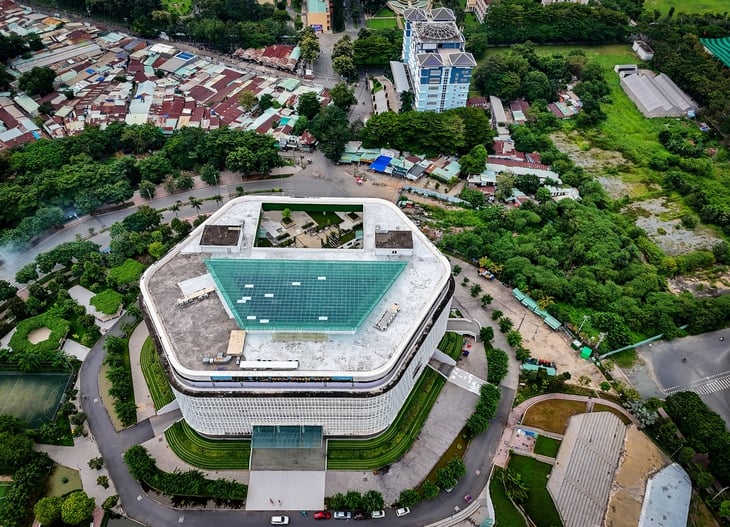
Student Cultural Center area - Vietnam National University Ho Chi Minh City - Photo: CHAU TUAN
Solving all the living and learning challenges of a large-scale community.
Speaking to Tuoi Tre newspaper , architect Huynh Xuan Thu - former Director of the Ho Chi Minh City Planning Information Center - believes that the Ho Chi Minh City National University urban area clearly has many advantages to become the nucleus of a modern university city, with a sufficiently large land area and a clear development orientation.
The fact that this area is connected by a metro line, which will be extended to Binh Duong and neighboring provinces in the future, is a crucial condition, creating a foundation for students and faculty to access public transportation.
However, it's important to acknowledge objectively that the metro only solves the transportation problem, and doesn't fully address the living and learning challenges of a large university community.
Meanwhile, the core of relocating universities is to create a complete ecosystem, including sufficient and affordable dormitories, faculty housing, service and commercial systems, and spaces for cultural activities, sports, research, and entrepreneurship.
Without these elements, a university town can easily become a place for studying during the day but quiet at night, failing to create true urban vitality.
Similarly, Dr. Vo Kim Cuong - former Deputy Chief Architect of Ho Chi Minh City - also believes that we need to clearly define a university village or university city not just as a place to locate schools, but as a complete urban area with full technical and social infrastructure, services, living spaces, jobs, recreation, and daily life.
In particular, it is essential to ensure a good quality of life for resident students, lecturers, and staff so that they can live and work there with peace of mind in the long term. If living conditions are unfavorable, the attractiveness of the university urban area will be significantly reduced.
Furthermore, the allocation of resources to the National University within the overall public investment plan and university training strategy needs to be reviewed. The delays may stem from a lack of proper prioritization of funding and investment timing.
On the other hand, for many years, connectivity between the National University area and the center of Ho Chi Minh City has been limited, relying mainly on motorbikes and buses, causing inconvenience for students and faculty. Although there are now more positive signs, an efficient and synchronized public transportation system is still needed to create real convenience.
Meanwhile, Ms. Than Thanh Thanh, Vice Principal of Dong An High-Tech College, a training facility located adjacent to the Ho Chi Minh City National University urban area, said that the policy of relocating universities out of the central area is a suitable direction for the goal of decentralizing the population, reducing infrastructure pressure, and gradually forming a network of higher education institutions in satellite areas.
However, the issue of relocating universities needs to be considered within the overall context of long-term land use planning, the integrated development of transportation infrastructure, and strategies for developing human resources for higher education.
Ho Chi Minh City's advantage in this new phase is the expanded urban space following the administrative boundary reorganization, creating favorable conditions for systematic planning of training areas linked to the new location, while also fostering close connections between training institutions and businesses, better meeting the needs of the labor market.

Students of the University of Economics and Law in the suburban area of Ho Chi Minh City - Photo: TRAN HUYNH
It should not be applied uniformly.
Another issue, according to architect Huynh Xuan Thu, requires careful consideration of the diversity and specific characteristics of current universities. A single relocation model cannot be applied uniformly to all universities.
Many schools have a long history, are located in the city center, and have close ties to hospitals, research institutes, businesses, and the city's financial and cultural centers.
For these universities, a more reasonable solution is to develop a multi-campus model, gradually transferring large-scale, mass training programs to the National University area, while retaining postgraduate training, scientific research, and international cooperation activities at the center.
Further analyzing the issue, Mr. Thu said that this approach helps reduce traffic congestion while minimizing unnecessary disruptions to faculty, students, and the academic-social connections that have been formed over decades.
More importantly, this allows the city time to adjust its infrastructure, services, and management mechanisms, instead of creating a sudden, potentially risky shift.
It is important to emphasize that relocating universities should not only aim to reduce traffic congestion, but must be placed within the overall strategy of sustainable urban development. If carefully prepared, this will be an opportunity for Ho Chi Minh City to restructure its urban space, form new development hubs, and build a true university city.
Conversely, if implemented hastily and without coordination, this solution may not yield the expected results and may even create new problems for the city.
Associate Professor Dr. Do Van Dung - former Rector of Ho Chi Minh City University of Technology and Education, a university located along Metro Line 1 - believes that relocating a university to an area too far from the city center risks "isolating" it from urban amenities. This could lead to students lacking diverse experiential learning environments, limited opportunities for part-time work and internships, and restricted access to social activities and services readily available in the city center.
In addition, the suitability of relocation varies among different groups of schools.
For universities in the social sciences or economics, relocation is relatively easy, but for engineering universities, moving equipment is a complex and costly problem because many systems were designed to fit the existing space from the outset. In fact, for some production lines, the cost of dismantling and reinstalling can even exceed the initial investment.
Therefore, Associate Professor Dr. Do Van Dung said that the relocation needs a long-term plan, careful preparation, and cautious implementation, in which the selection of pilot schools must be based on specific practical conditions.
In the long term, the focus should remain on planning new training facilities, aligned with strategies for population, urban, and human resource development, rather than simply relocating existing schools.
For example, the structure of training institutions within the same university area should be harmoniously distributed among economic, engineering, and medical fields, while also having diversity between universities and colleges, in order to create a rich academic environment and increase the potential for articulation and cooperation.
Furthermore, there is a need for mechanisms to connect and share resources among universities, including facilities, laboratories, and training equipment, in order to optimize investment and operational efficiency, especially in the initial stages when new university campuses are being established.
Regarding the policy of relocating universities out of the central area of Ho Chi Minh City, Associate Professor Dr. Nguyen Dinh Tu stated that currently, three member universities of the Vietnam National University Ho Chi Minh City have campuses in the inner city: the University of Social Sciences and Humanities, the University of Technology, and the University of Natural Sciences. However, the majority of students have been moved to study in the National University campus.
The remaining universities, such as the International University, the University of Economics and Law, and the University of Information Technology, currently conduct 100% of their training within the National University area and have no campuses in the city center.
Land clearance can be expedited if we act decisively.
According to Dr. Vo Kim Cuong, former Deputy Chief Architect of Ho Chi Minh City, right from the 1993 master plan, Ho Chi Minh City had already oriented itself towards moving universities out of the central area, planning the National University of Ho Chi Minh City area with a scale of about 800 hectares, aiming for a university village - university city model to reduce pressure on traffic, population and inner-city infrastructure.
In fact, after nearly 30 years of implementation, the plan has not progressed as quickly as expected. One of the important reasons for the slow progress, according to Mr. Cuong, is the obstacles in land clearance.
According to the plan, many areas will not be completely cleared until 2030. However, with more decisive direction from the Ho Chi Minh City Party Committee and government at this stage, this process can be accelerated, thereby facilitating the simultaneous implementation of the remaining items.
Universities in Hanoi are also slow to relocate.
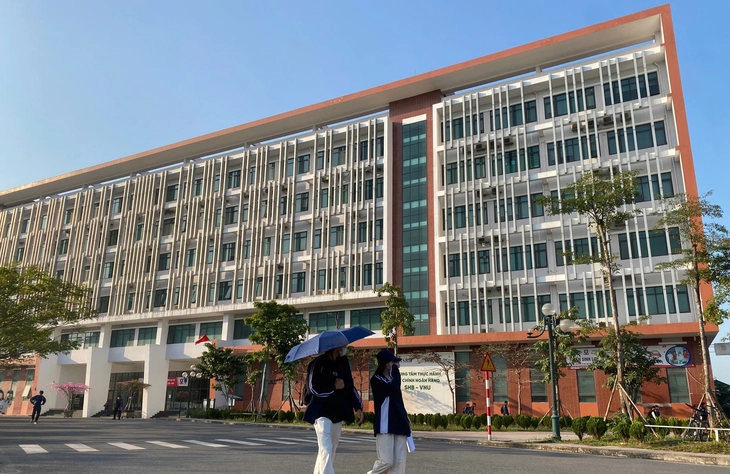
The HT2 building of Hanoi National University - where students and faculty have been working and studying since 2022 in Hoa Lac - Photo: NGUYEN BAO
After more than 20 years of implementing the plan to relocate universities out of Hanoi's inner city, no university has yet completed this policy, and the number of universities that have moved their facilities to neighboring provinces can be counted on the fingers of one hand.
Among these, information from Hanoi National University indicates that the investment project to build Hanoi National University in Hoa Lac was approved by the Government in 2003. The project's main objective is to build a modern, state-of-the-art university urban area, the best in Southeast Asia, with an investment of 22,000 billion VND.
However, by 2020, 17 years after the groundbreaking ceremony, the project had only received nearly 2 trillion VND in investment, mainly for land clearance and road construction. This is considered the root cause of the delay...
On May 19, 2022, after nearly 20 years, Vietnam National University, Hanoi officially moved its headquarters from Cau Giay to Hoa Lac, with most of its units now located in Hoa Lac.
According to observations by Tuoi Tre newspaper , many construction projects in the Hanoi National University urban area in Hoa Lac are currently underway to be completed and put into use. As of now, there are approximately 7,000-10,000 students studying in Hoa Lac, while Hanoi National University trains around 60,000 students per year.
LTV, a first-year student at the University of Education, said that after being admitted to the university, V. and other students were transferred to Hoa Lac for their first year of study, and from the second year onwards, they would be transferred back to the main campus. Students studying at Hoa Lac are provided with dormitory accommodation by the university.
After the first semester, V. felt that the learning environment at Hoa Lac was very quiet and comfortable, with modern facilities. However, students who have to study there for all four years will face many difficulties in commuting and part-time work due to the lack of integrated infrastructure in the surrounding area.
Similarly, NHT, a first-year student at the University of Medicine and Pharmacy, assessed the learning and living environment in Hoa Lac as very spacious and comfortable. However, it also came with inconveniences such as long commutes and limited nearby amenities.
From the perspective of a medical student, T. believes that the learning process requires a lot of clinical practice and frequent visits to hospitals for practical training, so having to study all years of university at Hoa Lac is impossible. Currently, the University of Medicine and Pharmacy only transfers first-year students to Hoa Lac for their studies, after which they return to the main campus.
Professor, Doctor, Lieutenant General Nguyen Xuan Yem - School of Management and Business, Vietnam National University, Hanoi - believes that the policy of relocating universities and hospitals out of the inner city is correct, but its implementation is very slow because the biggest bottleneck is that the areas surrounding the planned relocation sites have not yet developed into urban areas.
The essential needs of students, residents, and patients are lacking, such as schools for children and recreational areas.
Source: https://tuoitre.vn/lam-gi-de-doi-truong-dai-hoc-ra-ngoai-thanh-20251227080253322.htm

































































































Comment (0)