

Many guests come and stay longer, so why is their spending still low?
The tourism industry has just welcomed the new year 2026 with resounding success, as many localities set records for receiving international visitors and achieved impressive growth rates. However, the total number of visitors and revenue in these localities also reveal a clear disparity in the level of on-site spending by tourists.
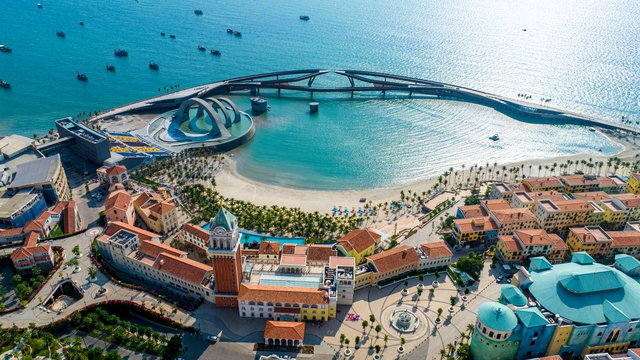
Entertainment and resort complexes are the "trump card" to attract tourists to spend money.
Photo: NA
Specifically, out of approximately 3.5 million tourists expected to visit during the 2026 New Year holiday, Ho Chi Minh City will lead, serving 1.24 million visitors, a 65% increase compared to the same period in 2025. Of these, about 75,726 will be international tourists, with total revenue from tourism estimated at 2,632 billion VND – an impressive figure.
Coming in second is Da Nang with an estimated total of 630,000 visitors. While lagging behind Ho Chi Minh City in total, the "City of Bridges" was a bright spot in international tourists, welcoming 345,000 visitors – five times more than Ho Chi Minh City. Despite this, total tourism revenue still lagged behind, estimated at 2,445 billion VND, indicating that revenue primarily relied on domestic tourists.
Hanoi, the capital city, is estimated to welcome 560,000 visitors, an increase of approximately 250%; international visitors number around 110,000, with total revenue estimated at 2,100 billion VND. Also on the list of localities earning billions of VND from tourism, Quang Ninh province is estimated to achieve 1,620 billion VND thanks to welcoming approximately 657,000 visitors, including about 70,500 international visitors.
Notably, despite a significant difference in visitor numbers—only about 363,112 visitors, including approximately 32,298 international tourists—Lao Cai province still closely rivals Quang Ninh in terms of revenue, estimated at 1,500 billion VND. Meanwhile, An Giang province, estimated to have welcomed over 349,000 tourists during the Western New Year holiday, including over 30,000 international visitors, is only slightly behind Lao Cai in terms of numbers, but its total tourism revenue is estimated at only 859 billion VND, nearly half less. Similarly, Ninh Binh province, estimated to have welcomed 723,063 visitors, including approximately 177,974 international tourists, ranking among the top provinces, even higher than Hanoi, but its total revenue is estimated at only 795 billion VND.
As can be seen, many destinations receive a large number of tourists, but the total revenue is quite modest, meaning that tourists do not spend much.
If we consider the total revenue for 2025, the tourism industry is projected to surpass 1 trillion VND for the first time, equivalent to approximately 37.8 billion USD. However, recent statistics show that the average international tourist to Vietnam spends between 1,050 and 1,150 USD, a negligible increase compared to 2019 (an average of 1,020 USD per person). Compared to direct competitors in the Southeast Asian tourism sector such as Thailand, the amount of money tourists spend in Vietnam is approximately 500 USD less, or nearly 1,000 USD less compared to Singapore.
Notably, the average length of stay for high-end tourists has increased from 10 days to nearly 14 days. This shows that we have succeeded in attracting more tourists and encouraging them to stay longer, but we still haven't been able to get them to spend their last penny.
Where there's entertainment, there are customers spending money.
In fact, localities where the growth rate of international tourists corresponds to an increase in revenue are those that have undergone significant transformation in their product systems.

Tourists not only want to visit destinations but also want to have many attractive experiences and services.
Photo: Nhat Thinh
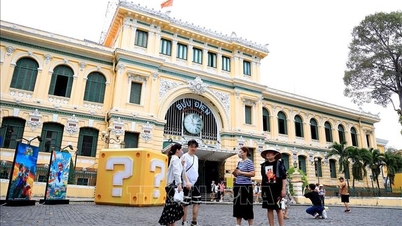
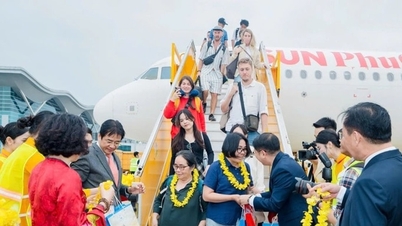
Ho Chi Minh City is pioneering the shift from "counting visitors" to focusing on revenue, and the initial results are already showing. Lydia and her husband (from the Netherlands), the first international visitors to arrive in Ho Chi Minh City on January 1st, spent two days and one night there before continuing their Southeast Asian exploration. Sharing their plans for exploring Ho Chi Minh City, Lydia and her husband said that besides visiting famous landmarks like the Saigon Notre Dame Cathedral, the Central Post Office, and the War Remnants Museum, the highlight of their trip was a nearly three-hour cooking class. At a cost of approximately $40-45 USD per person (around 1.2 million VND), this was the largest expense of their trip, but also the experience they valued most, as they learned and gained a deeper understanding of local life and cuisine.
Nguyen Dinh Le Hoa, founder of MOM Cooking Class – one of the most popular cooking classes for foreigners in Ho Chi Minh City – commented: "International visitors are increasingly wanting to experience Vietnamese cuisine firsthand, not just to enjoy the food. In reality, Ho Chi Minh City doesn't have many famous tourist attractions, so for visitors staying 2-3 days, they prioritize experiences connected to the local life, culture, and people. Cuisine is the shortest path. Visitors don't just want to eat; they want to know how the dish is cooked, where the ingredients come from, and the story behind it. Instead of spending 500,000-1 million VND on a restaurant meal, they are willing to spend the same amount to go to the market, cook in the kitchen, and eat the dish they just prepared," Hoa shared.
Besides cooking classes, according to Mr. Hoa, international tourists really enjoy experiencing Ben Thanh Market and Tan Dinh Market in the morning because it's a part of "very Vietnamese" life that they find difficult to access with just a regular city tour.
Representatives from Vietnam Adventure Tours observe that the travel behavior of foreign tourists has changed significantly compared to the pre-pandemic period. City tours are no longer the main focus, as tourists mostly travel independently using double-decker buses, ride-hailing taxis, and digital platforms. The current trend is for independent travelers to plan their own itineraries and explore on their own. While Ho Chi Minh City has researched and introduced many new tourism products, to encourage longer stays and higher spending, the city needs more experiential entertainment activities, especially in-depth shopping options and high-class entertainment complexes. Only then will international tourists truly spend beyond their tour budget, instead of just on food, accommodation, and transportation.
Around the world, these "entertainment universes" are also "magic wands" that generate millions of dollars annually for many popular destinations. For example, in Beijing (China), the Universal Beijing Resort complex, which includes a theme park, restaurants, shops, two resort hotels, and 37 attractions, helped boost the revenue growth of the culture, sports, and entertainment sector in Tongzhou District by 101.6% in 2022, surpassing the Beijing average of 97.7%.
For example, in the period of 2018-2019, more than two-thirds of surveyed tourists said they came to Shanghai (China) because of Disneyland, and most stayed for 2-3 days, generating revenue for accommodation and ancillary services. Meanwhile, since its opening, Hong Kong Disneyland Resort has contributed nearly HK$130 billion to the Hong Kong Special Administrative Region.
According to data from World Metrics, the entertainment complex industry globally generates over $52 billion and is projected to grow at an annual rate of 7.9% from 2020 to 2027, with Asia being a hotspot at 7.5%. This is a powerful weapon for destinations wanting to entice tourists to spend more.
According to information from the National Tourism Administration, in December 2025, Vietnam welcomed over 2 million international visitors, an increase of 15.7% compared to the same period last year. This impressive result contributes to bringing the total number of international visitors to Vietnam in 2025 to nearly 21.2 million, an increase of 20.4% compared to the previous year and 17.8% higher than in 2019 - the period before the Covid-19 pandemic.
Source: https://thanhnien.vn/lam-gi-de-du-khach-chi-tieu-nhieu-hon-185260106211117319.htm

![[Photo] Prime Minister Pham Minh Chinh receives the Ministers of Foreign Affairs, Defense, and Public Security of China.](https://vphoto.vietnam.vn/thumb/1200x675/vietnam/resource/IMAGE/2026/03/16/1773659638054_ndo_br_dsc-4386-6157-jpg.webp)

![[Photo] The General Secretary works with the Executive Committee of the Hai Phong City Party Committee.](https://vphoto.vietnam.vn/thumb/1200x675/vietnam/resource/IMAGE/2026/03/16/1773629925474_vna-potal-tong-bi-thu-lam-viec-voi-ban-chap-hanh-dang-bo-thanh-pho-hai-phong-8644445-332-jpg.webp)











































Comment (0)