

While the textile industry is developing with many modern machines and technologies, in Nam Cao commune, Kien Xuong district, Thai Binh province, there is still a village specializing in silk weaving that is entirely handcrafted. This village has a history of over 400 years.
17 steps in making Nam Cao silk fabric
In Nam Cao silk weaving village, the hustle and bustle of the city seems to cease. Here, there are no car horns, no noisy, crowded streets; only old-fashioned houses and the incessant clacking of looms throughout the day.
Ms. Nguyen Thi Bon and Ms. Nguyen Thi Ha, Deputy Chairperson of the Nam Cao Silk Weaving Cooperative, stand beside rolls of silk fabric, entirely handcrafted by Ms. Bon's skillful hands.
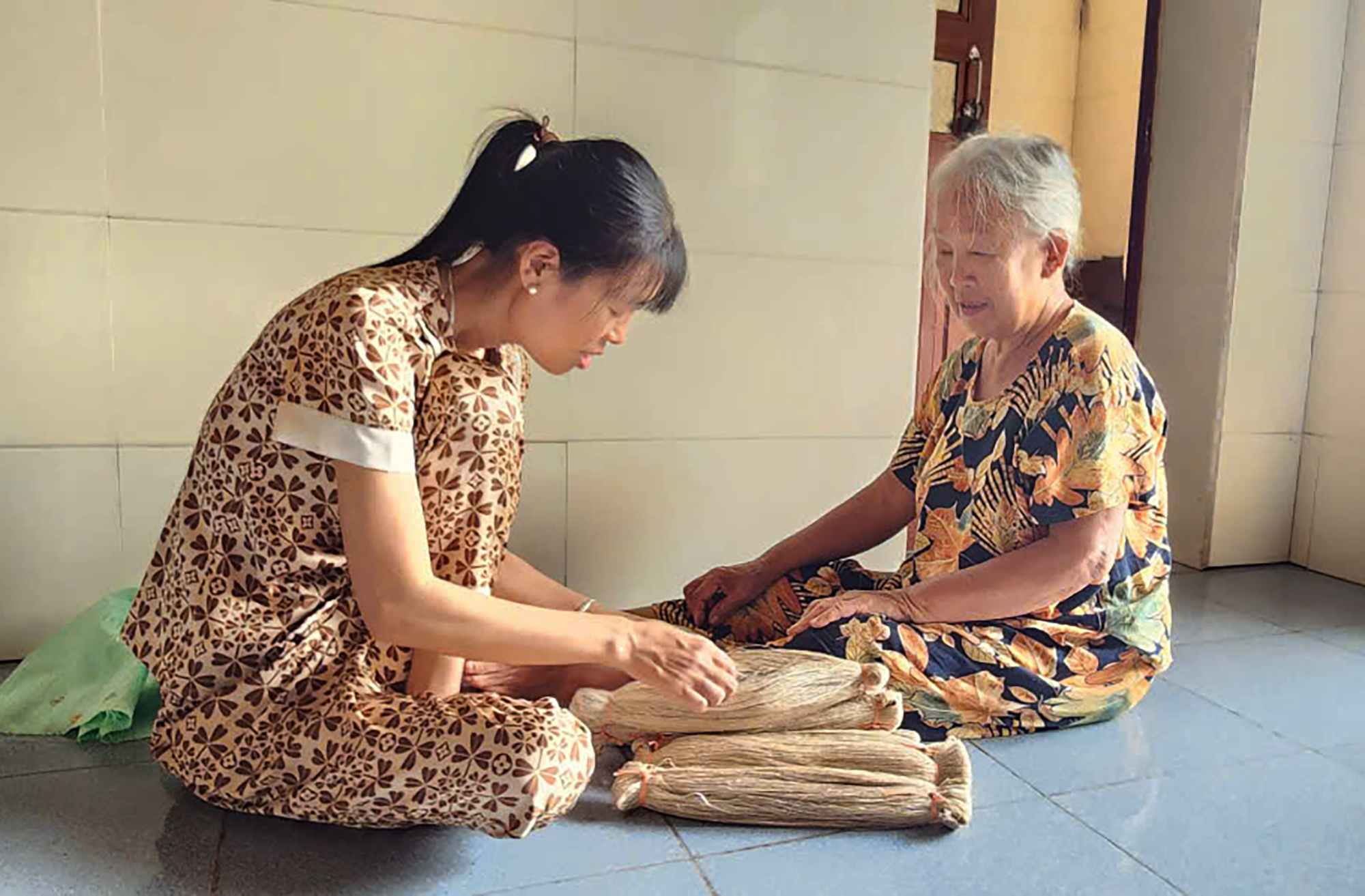
Temporarily pausing her spinning work, Mrs. Nguyen Thi Bon (77 years old, Cao Bat Doai village, Nam Cao commune) shared that the mulberry trees, gac fruit trees, and banyan trees... grown in her garden are all used to make silk fabric.
"The raw silk fabric is entirely handmade, using silk from silkworms raised in the village and dyed with natural herbs. Spinning the thread might seem simple, but it's actually very hard work. The spinner has to immerse their hands in water regardless of the season, requiring keen eyesight, skill, and diligence all day to produce 70-100 grams of raw silk," Grandma Bon explained.
Ms. Nguyen Thi Mui (69 years old, Cao Bat Doai village, Nam Cao commune) said that Nam Cao silk fabric has very unique characteristics; it looks rustic, rough, and thick, but in reality it is very soft, skin-friendly, cool to wear in summer, warm in winter, easy to bleach, wash clean, and dries quickly.
According to Ms. Mui, to produce a piece of silk fabric, the craftsman must perform at least 17 steps, all done manually. First, they cultivate mulberry trees and raise silkworms. After harvesting the cocoons, they are boiled, then soaked in water for 5-6 hours before being spun into silk. This process requires pulling and twisting entirely by hand, with one hand holding the cocoon and the other pulling.
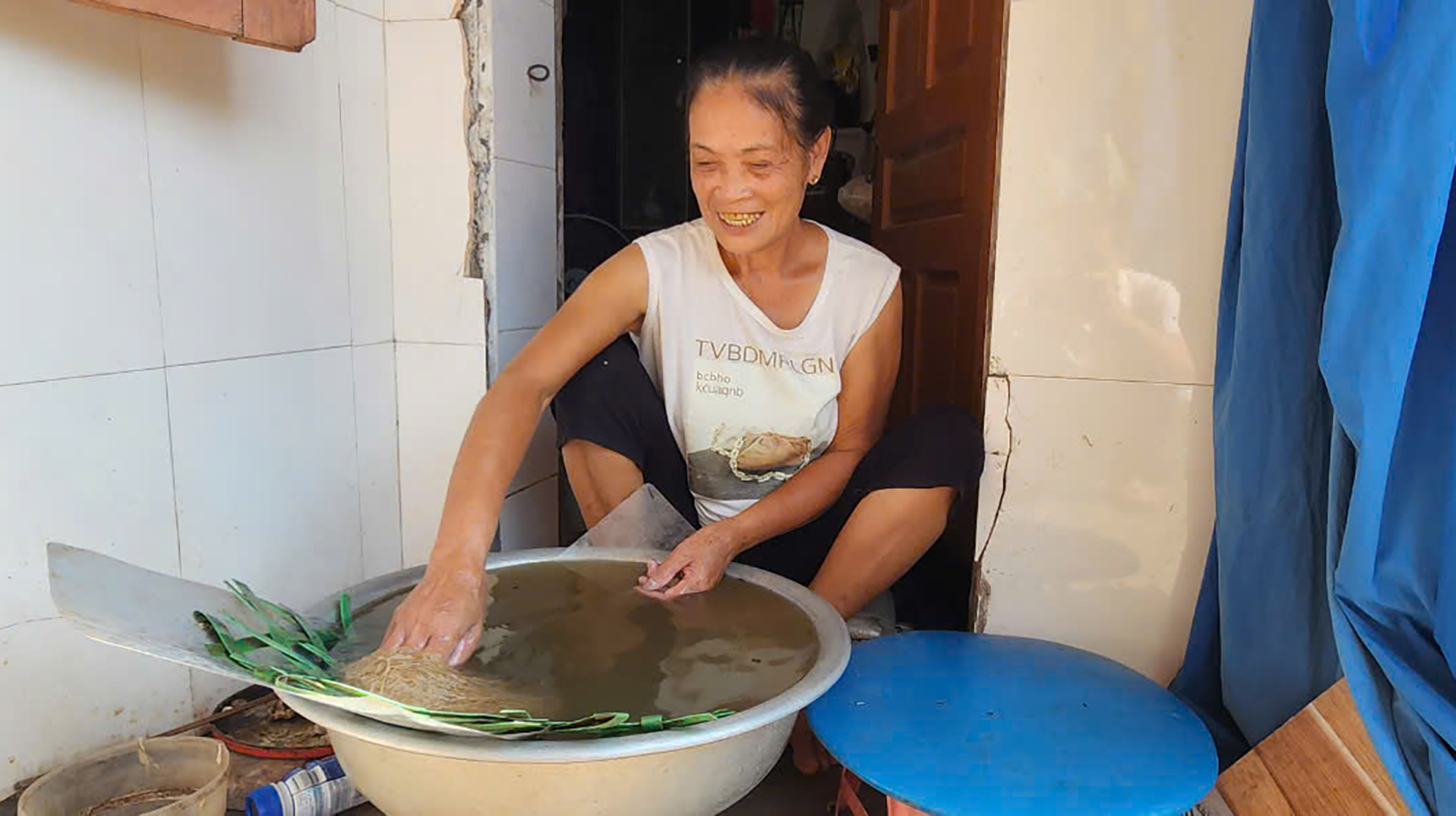
Ms. Nguyen Thi Mui pulls the silk thread by hand.
After being spun, the raw silk threads are coiled into bundles, wrung out, placed on a spinning wheel, then dried, wound onto bobbins, and strung together. Before weaving, the weavers also thoroughly boil the raw silk to soften and loosen the threads, preventing breakage.
The raw silk thread is wound onto a spool in a banana flower shape, from the widest end to the narrowest, from top to bottom, then rolled into small coils to be fed into the weaving shuttle.
The next step is joining the looms, also known as the weaving frame. This is the most important intermediate stage, requiring experienced weavers. Even a small mistake during joining can ruin the entire piece of silk fabric. The woven fabrics are carefully inspected to ensure they are breathable and soft yet strong.
The ups and downs of the silk weaving village.
Having been involved with the village's traditional craft for nearly 70 years, Mr. Bon said that, according to the elders in the village, the craft of spinning silk and weaving here dates back to 1584. At that time, the two women, Tu Tien and Tu An, returned to their ancestral village of Van Xa, Bat Bat (formerly Ha Tay province) to learn the craft of mulberry cultivation, silkworm rearing, spinning silk, and weaving, and then taught it to their descendants; they both worked in agriculture and handicrafts to make a living.
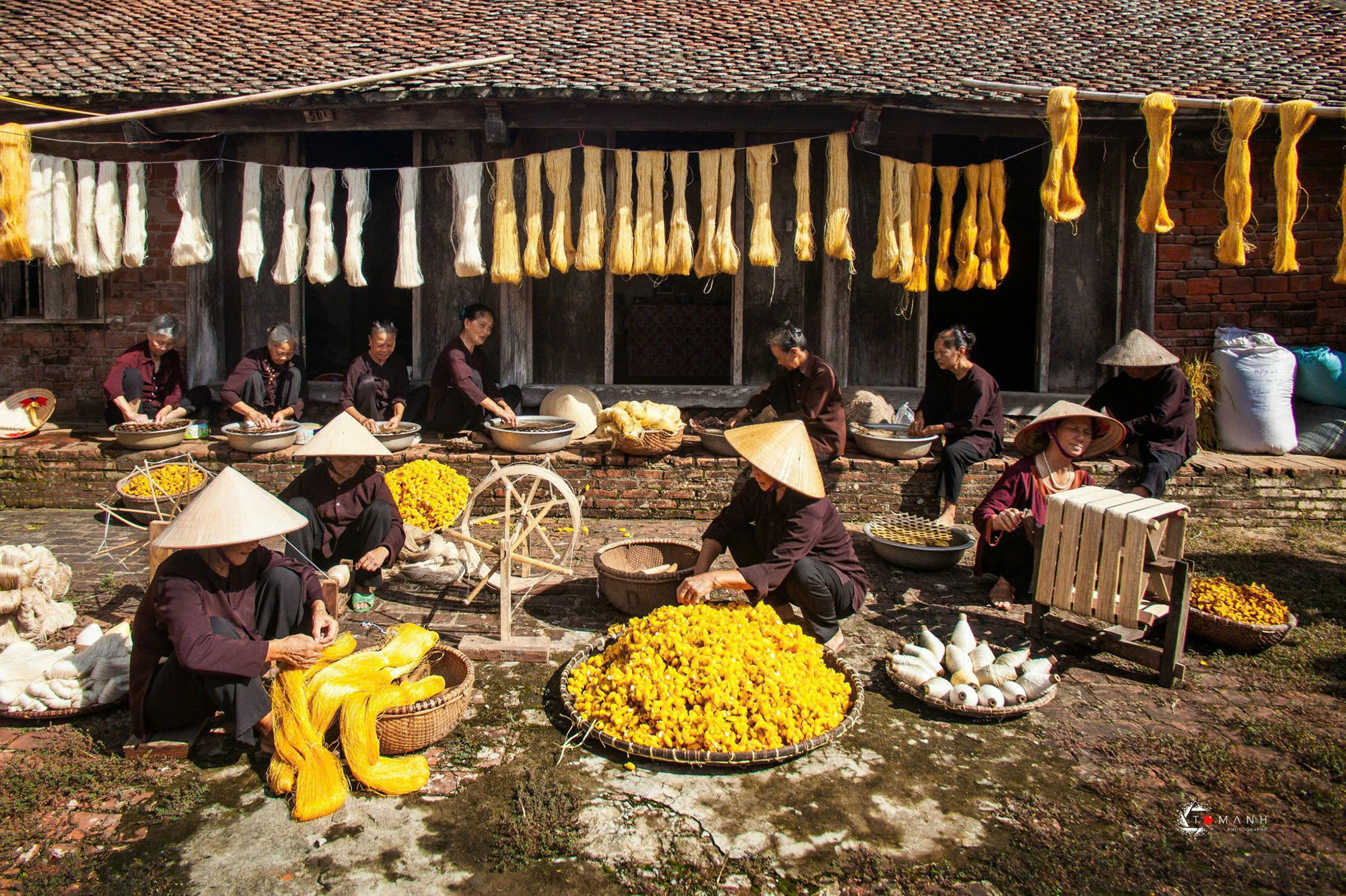
To produce the finished product, Nam Cao silk fabric must go through 17 stages.
Initially, silk fabric was used to make clothes for the people and for use in festivals. Later, silk fabric was exported to many countries around the world , mainly Eastern Europe. By the 1980s, Nam Cao silk sold millions of meters annually.
As a silk weaving workshop in Nam Cao that still preserves traditions passed down from his ancestors, Mr. Nguyen Dinh Dai (70 years old, Nam Cao commune) recounts that around 1946, his father, artisan Nguyen Dinh Ban, was instrumental in bringing the craft and adapting it from manual looms to semi-mechanical machines.
This has led to significant transformation and increased productivity in the craft village, marking the official establishment of Nam Cao village as a silk weaving craft village.
During the period from 1995 to 2000, the craft village developed strongly, spreading to neighboring communes. At that time, Nam Cao alone had over 2,000 households weaving silk and silk scarves. Each household was practically a production workshop, with 3-5 weaving machines, totaling nearly 6,000 machines operating at full capacity throughout the commune. The woven products were mainly exported to Laos and Thailand.
However, in 2004, the tsunami in Phuket, Thailand, swept away all the houses, goods, and assets of the silk businesses there, causing Nam Cao silk to lose its market and the craft village to gradually decline.
Then, in the 2010s, due to the economic recession, the craft village fell into a gloomy period that seemed beyond salvation. Only 3 or 4 households in the entire village continued the craft, and the artisans almost gave up.
Nam Cao silk is exported to 20 countries.
To preserve his ancestors' silk weaving craft, Mr. Dai decided not to chase quantity but to focus on quality. He restored ancient looms, creating silk fabrics using the most traditional and rudimentary methods. His target customers are those who are truly passionate about silk, willing to pay a higher price for completely natural products.
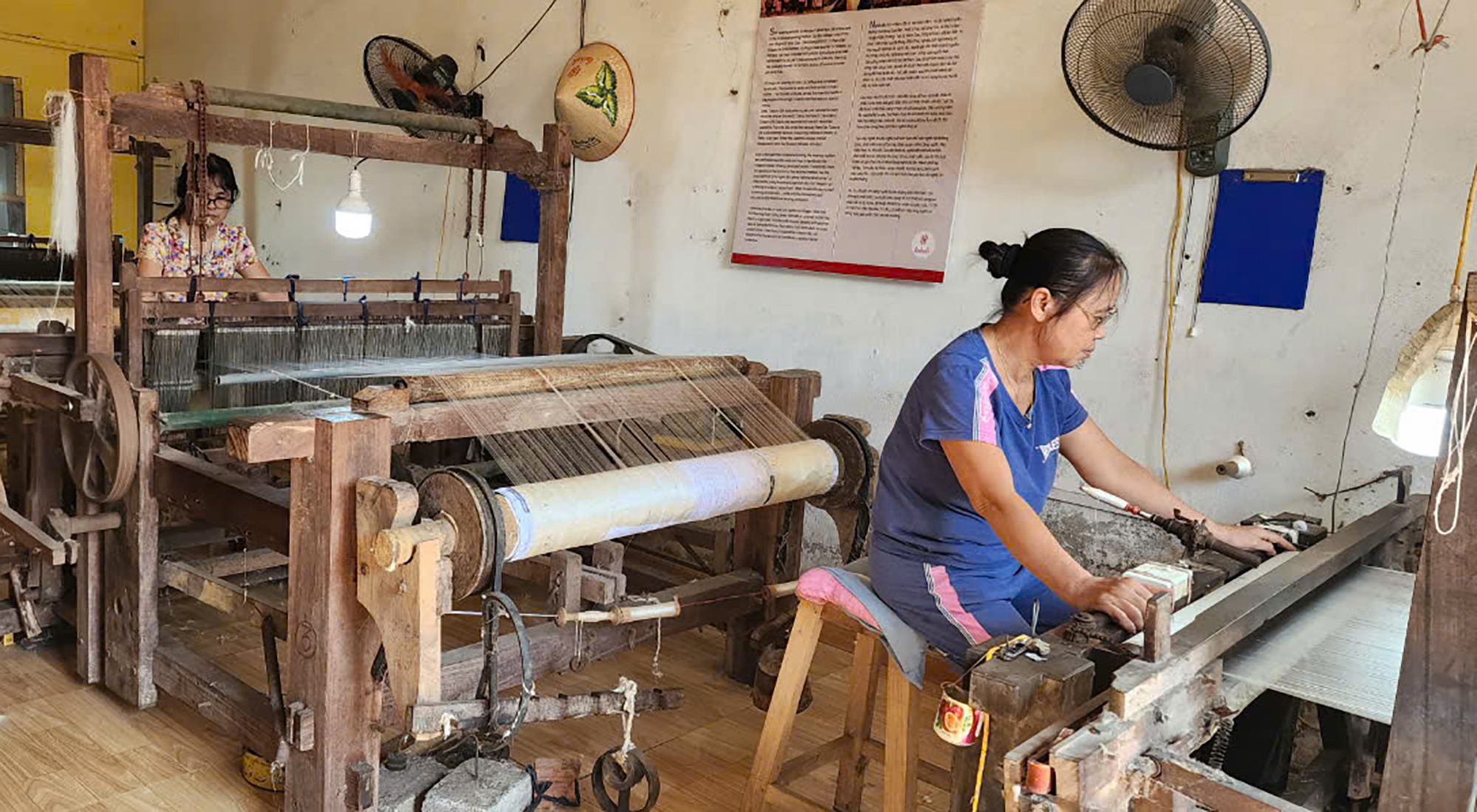
Workers at the Nam Cao Silk Weaving Cooperative stand by their looms.
Mr. Dai said that currently, besides his own weaving workshop, there are still 3-4 other production facilities in the village with about 100 people working in silk thread spinning and over 50 people working in weaving. In addition, his facility also trains the younger generation so that their children and grandchildren can continue and preserve the traditional craft.
To further develop the silk weaving craft, Nam Cao commune is maintaining a silk weaving cooperative with nearly 200 participating households. Ms. Nguyen Thi Ha, Vice Chairman of the cooperative, said that in the villages there are still 50-60 elderly people who know the craft, the oldest being Ms. Pham Thi Hong (95 years old), who is still quite sharp and can still weave silk.
According to Ms. Ha, the craft of spinning or pulling silk in Nam Cao is still entirely manual. In recent years, the Nam Cao Silk Weaving Cooperative has welcomed many international delegations to visit, directly experience, and learn about the silk weaving craft. The cooperative's Nam Cao silk products have been exported to more than 20 countries worldwide.
A concentrated production zone will be built.
According to Mr. Nguyen Thanh Khoa, Chairman of the People's Committee of Nam Cao commune, after the establishment of the Nam Cao Silk Weaving Cooperative, the Nam Cao silk weaving village has gradually recovered. The cooperative achieves an average annual sales of 40 billion VND, providing employment for hundreds of local workers with an income of 5-7 million VND per person per month.
In November 2023, the silk weaving craft in Nam Cao commune was certified by the Ministry of Culture, Sports and Tourism as a national intangible cultural heritage.
"With its strengths in entirely handcrafted, eco-friendly products, the Nam Cao silk weaving village is considered to have great potential for developing community tourism . We have persuaded 37 households to transfer 4.5 hectares of land to the Nam Cao Silk Weaving Cooperative to develop a concentrated production area and a tourist experience," Mr. Khoa said.
Source: https://www.baogiaothong.vn/lang-nghe-det-dui-400-nam-tuoi-o-que-lua-192241114224449333.htm

![[Photo] General Secretary and President To Lam presides over a meeting on preparations for the review of one year of operation of the three-tiered government system.](https://vphoto.vietnam.vn/thumb/1200x675/vietnam/resource/IMAGE/2026/06/02/1780391821195_a1-bnd-4595-9717-jpg.webp)
























































































Comment (0)