

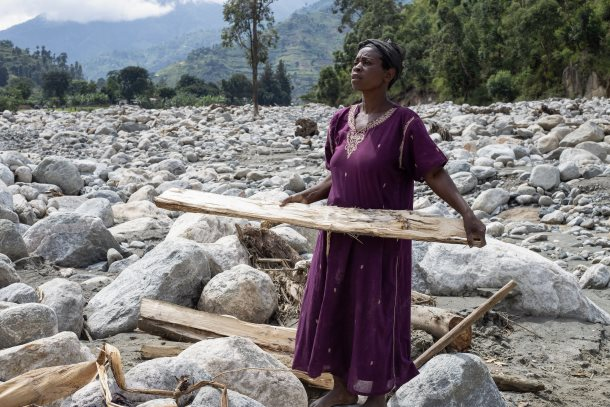
The CREWS initiative helps save lives, create livelihoods, and protect assets.
According to CREWS' 2022 Annual Report, an additional 282 million people in least developed countries (LDCs) and small island developing states (SIDS) will be protected by improved weather and climate services over the next few years.
The annual report, titled “Giving Early Warning to Everyone,” highlights how this initiative helps save lives, create livelihoods, and protect property in the world’s most vulnerable countries by building resilience to hazards such as droughts, floods, sandstorms, dust storms, and coastal flooding.
CREWS is a key contributor to the Early Warning for All (EW4All) initiative launched by UN Secretary-General Antonio Guterres, who wants to ensure everyone on Earth is protected by early warning systems by 2027.
“The CREWS initiative is key to the success of ‘early warning for all’ because it represents a people-centered approach that prioritizes community participation, while transforming and enhancing meteorological and warning services, human capacity, and ultimate action. The World Meteorological Organization (WMO) is committed to strengthening climate resilience and adaptation through CREWS and improving global weather and climate baseline information through the System Offsetting for Observation (SOFF) agency,” said Petteri Taalas, Secretary-General of the WMO, a CREWS implementation partner.
Early warning systems are a proven way to protect lives and livelihoods from climate hazards, which cause 90% of extreme weather events and are increasing as a direct consequence of climate change.
Ms. Mami Mizutori, Special Representative of the UN Secretary-General for Disaster Risk Reduction and Head of the UN Disaster Risk Reduction Strategy (UNDRR), one of the partners implementing CREWS, said: “The work of CREWS with LDCs and SIDS to build more comprehensive and multi-hazard early warning systems has never been more valuable in line with the goals set by EW4All.”
The community and local authorities are working together to find early warning solutions.
Since its establishment in 2015, the CREWS Trust Fund has received $105.6 million for nationally relevant projects. CREWS is people-centered, engaging communities and local organizations to collaboratively find appropriate early warning solutions and build resilience.
Since 2021, contributions to the CREWS Trust Fund have increased by 36%. An additional $155 million is needed to meet the fund's operational support needs through 2025.
“The CREWS Trust Fund is a fund that supports action across all elements of effective early warning services and systems. Its funding model, which invests in where early warning is most needed and commits to collaboratively delivering early warning solutions for people, communities, and nations, is a unique proposition,” said Gerhard Howe, Chairman of the CREWS Steering Committee.
Most CREWS projects are in Africa. In 2022, expanding sand and dust forecasting to six more countries helped mitigate risks for an additional 90 million people. Fifteen countries in Central and West Africa now have better access to standardized early warning information through improved mobile phone technology and warning practices. Many African national organizations and communities are adopting and building upon CREWS investments.
Risks are also exacerbated by other factors such as inequality and conflict. Twenty-three countries supported by CREWS are affected by conflict or instability, including Haiti, one of 30 countries identified to begin receiving support under the EW4All initiative. Niger, one of those 30 countries, has received flood guidance for 12 million people, while 9.5 million people in Papua New Guinea have received drought advisory services ahead of a predicted stronger-than-normal El Niño season.
Across the Pacific , a focal area of EW4All due to exposure to some of the world's most extreme climate-related phenomena, an additional 1.05 million people are now protected, representing half the region's population.
Source

![[Photo] Prime Minister Pham Minh Chinh receives the Chinese Ambassador to Vietnam](https://vphoto.vietnam.vn/thumb/1200x675/vietnam/resource/IMAGE/2026/04/05/1775397481797_ndo_br_dsc-5512-jpg.webp)







































































Comment (0)