

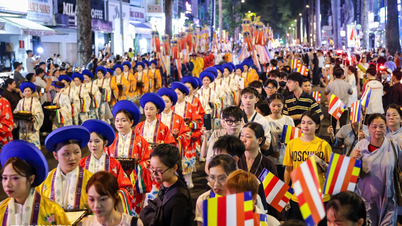
Initiated and organized by King Ly Cong Uan, the Giong Festival at Phu Dong Temple features a blend of ceremonial and festive activities with many unique cultural events. In 2010, along with the Giong Festival at Soc Temple, the Giong Festival at Phu Dong Temple was recognized by the United Nations Educational , Scientific and Cultural Organization (UNESCO) as a Representative Intangible Cultural Heritage of Humanity.
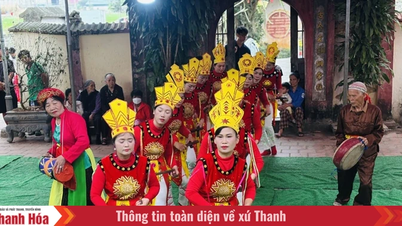
This year, the festival takes place from May 17th to 25th, with the peak period from May 23rd to 25th (corresponding to the 7th to 9th day of the fourth lunar month). The ceremonial part is held solemnly with traditional rituals such as: offering sacrifices to the Saint, inspecting the temple, carrying water in a procession, and reenacting traditional battles...; the festive part is expanded in scale and content with art programs, sports events , and the introduction of OCOP products and agricultural products.
 |
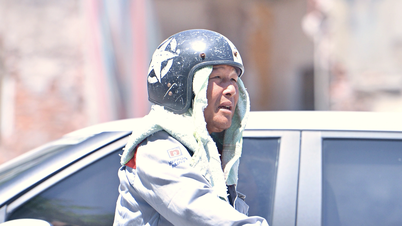
| Mr. Hieu, flag bearer at the Giong Festival at Phu Dong Temple. Photo: QUOC VUONG |
During the festival, in addition to roles such as the Red-Clothed Village, the Black-Clothed Village, the Royal Procession, the Ai Lao Pass, and the Tiger God... symbolizing the social classes and animals that followed Saint Giong into battle, the role of the "Ông Hiệu" (Headmaster) always receives the attention of the people and tourists. According to the people of Phu Dong commune, each "Ông Hiệu" has its own meaning and task: the Flag Master symbolizes the majesty of Saint Giong, waving the flag to command in battles; the Drum Master and the Gong Master alternately beat the drums and gongs to represent the rhythmic commands for the deployment and withdrawal of Saint Giong's army; the Central Commander symbolizes the court official of King Hung Vuong, directing the entire battle.
The men who play the role of Ông Hiệu are aged 18 to 40 from Phù Đổng village (Phù Đổng commune) and Đổng Xuyên village (Thuận An commune). They are men with a healthy lifestyle, good character, reputable families, and relatively good economic standing. From the moment they take on the role, the Ông Hiệu live in a separate residence, isolated from their family members. Each Ông Hiệu has a guard of about 30 bodyguards; 6 close servants; and 1 tutor. During the festival days, only these people are allowed to interact with Ông Hiệu. Everyone addresses Ông Hiệu as "Ông" (Mr.), refraining from using their given names, as they are considered "members of the sacred household."
Vuong Viet Anh, 25, who once played the role of the Gong Master, shared: “Every gesture and action of the Gong Master must be precise and powerful. Even the smallest movements, such as walking, standing, facial expressions, the rituals of beating the drums and gongs, waving the flags... all require persistent and serious practice many times. For me, the most difficult ritual is the ceremony in the shape of the letter 'ding' like a warrior, which must be performed correctly and very quickly.”
The image of Ông Hiệu, revered by the people during the Gióng Festival at Phù Đổng Temple, embodies the nation's aspiration for independence, self-reliance, and enduring strength. The festival concludes with the Ông Hiệu completing their role, returning their hats, robes, flags, and boots; shedding their costumes and returning to normal life. However, those who once played the role of Ông Hiệu remain respected by the villagers, often using the title "Ông Hiệu" alongside their everyday names for life. Because of this, they strive throughout their lives to cultivate virtue and uphold the sacredness of the hero Saint Gióng.
Source: https://www.qdnd.vn/van-hoa/doi-song/linh-hon-cua-le-hoi-giong-den-phu-dong-1040973














































































Comment (0)