

...After breakfast, from An Hiep hamlet, I asked Que for a motorbike to take Provincial Road 825 (formerly Highway 10) to Loc Giang intersection. Passing through An Hiep intersection (An Ninh Dong commune; during the war against the US, it was An Ninh commune, after liberation it was divided into two communes: An Ninh Dong and An Ninh Tay), where an asymmetrical sweep battle took place between our Company 1, Battalion 7, Regiment 271 and the 25th Division and security units of the Saigon army. 62 out of 63 of my comrades perished on this land. Their blood and bones mingled with the soil of An Hiep, contributing to the peaceful life the people here enjoy today.
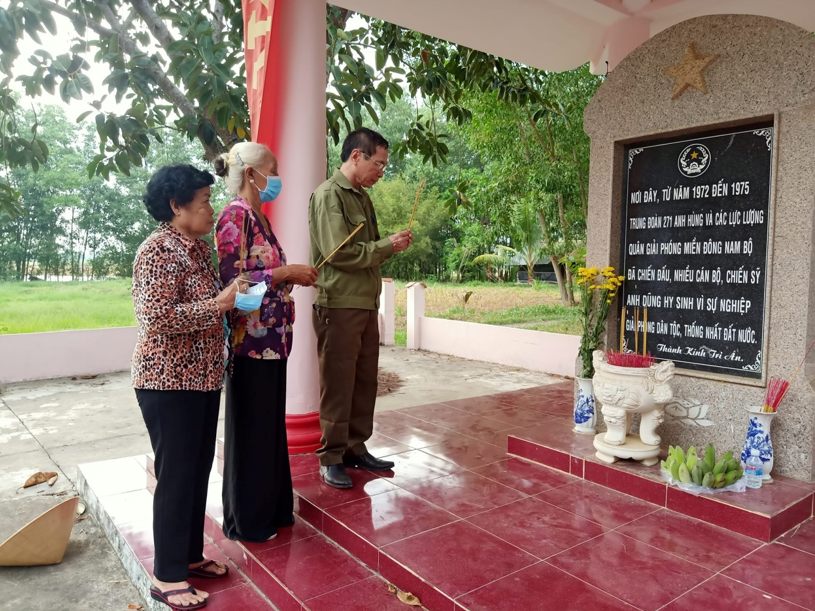
Author Vuong Kha Son, along with Ms. Nguyen Thi Rieng and Ms. Nguyen Thi Boi, offered incense at the memorial monument for martyrs of Regiment 271, An Ninh Tay commune, Duc Hoa district.
The small, narrow, and scarred Highway 10, once connecting the town (formerly a sub-district) of Hau Nghia to An Ninh and Loc Giang, was stained with the blood of countless comrades who, night after night, went into strategic hamlets to establish connections, purchase rice, food, and essential supplies for the troops, or engage in political and ideological work, or "eliminate evil and break enemy control." Most of them were ambushed or had Claymore mines planted by the vicious reconnaissance company 773 of the Hau Nghia sub-district, causing heavy casualties and losses for us. Now, the highway is being expanded and repaved.
Along both sides of the road, the dilapidated houses with thatched roofs made of coconut leaves or corrugated iron, once sheltered from enemy artillery fire and raids, now only exist in memory, replaced by tall, spacious buildings. Shops, stores, cafes, and especially An Ninh High School – where 16 years ago I visited to interact with teachers and students at the invitation of the school's administration and student union – have also undergone many changes, with spacious classrooms and modern, well-equipped facilities. In the distance, industrial zones and clusters have sprung up, attracting tens of thousands of workers, children of local residents and those from surrounding areas, to live and work there.
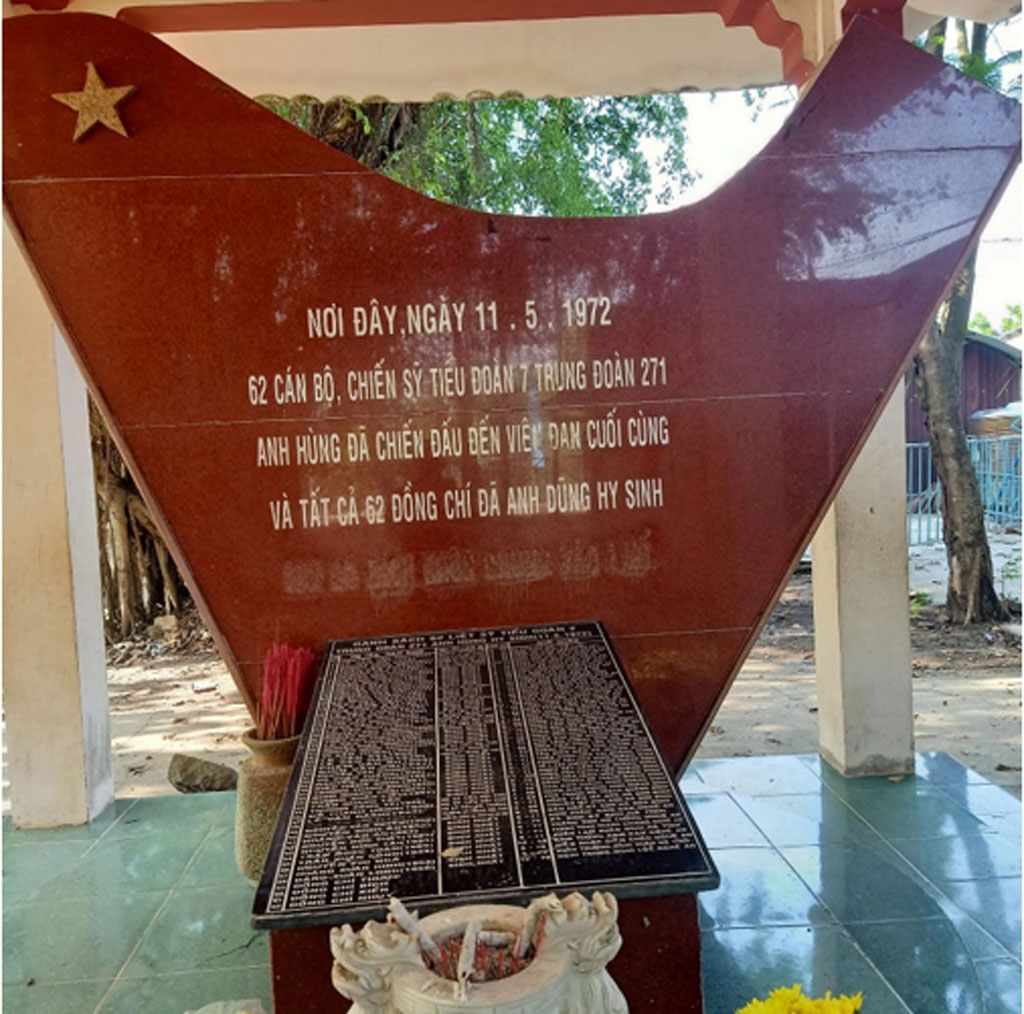
The An Hiep intersection used to be where the enemy had established a fortified outpost, surrounded by layers of sturdy barbed wire fences and heavily mined to prevent our troops from advancing. Here, during the unequal battle against the 25th Division on May 11, 1972, Company 1, Battalion 7, Regiment 271, lost 62 officers and soldiers. Today, it's a small market with a wide variety of goods and necessities for the local people. On either side are rows of relatively well-built houses, typical of a revolutionary rural area that was once very poor due to the war.
My first stop was the home of Tư Riêng (Nguyễn Thị Riêng, formerly a secret guerrilla fighter), opposite the gate of Lộc Giang crossroads market. Upon seeing me, Tư Riêng and her husband were overjoyed, as it had been over five years since "Brother Hai Sơn of Hà Tĩnh " had returned. They greeted me warmly, and although Tư Riêng was busy making coconut water for customers at the market, she stopped, pulled me inside to offer me some, then rushed back to the market to deliver more before hurrying back. Meanwhile, her husband, Uncle Năm, sat and chatted with me, asking about the past and present. And then, memories of the war years flooded back endlessly. For me, Lộc Giang and An Ninh have become an integral part of my life, filled with countless memories of bloodshed and human kindness.
 |
I remember the battle on May 3, 1972, when the 9th Battalion, 271st Regiment, attached to the 429th Special Forces, attacked the Loc Giang base. The special forces cut through the barbed wire fence for a "covert attack," but unfortunately, they hit a flash mine, exposing themselves prematurely. They had to switch to a "heavy assault" plan, resulting in heavy casualties.
We were 82mm mortar crews of the 4th Company digging trenches for mortars and personnel on the outer perimeter to engage enemy reinforcements the next morning, when we received orders to immediately withdraw to Go Noi amidst the dense barrage of mortars, artillery, machine guns, and M79 grenades from the Loc Giang Crossroads base and artillery positions in the Duc Hoa sub-district, Hau Nghia sub-district, Trang Bang, and Hiep Hoa, raining down on us like a storm.
The 429th Special Forces suffered heavy losses, with many casualties, and were forced to withdraw, taking with them a number of fallen soldiers and wounded. Our 9th Battalion also suffered some casualties during the retreat. In particular, Comrade Nguyen Van Doan, Political Commissar of Company 4, got lost during the retreat and was captured alive by the enemy. They tortured him brutally, but he didn't utter a single word. The cruel enemy then beheaded him and displayed his head in Loc Giang market to intimidate the people.
I stood silently for a long time at this crossroads, bowing my head in remembrance of the beloved company political commissar and his comrades who bravely sacrificed their lives years ago, feeling deeply moved, with tears welling up in my eyes and in the bridge of my nose...
Lunch at Tư Riêng's house was warm and full of camaraderie. On this occasion, I also had the chance to meet Tư Bòi (Nguyễn Thị Bòi) again. During the war, both Tư Riêng and Tư Bòi were secret guerrillas and revolutionary operatives. Both were captured and brutally tortured by the enemy, but they didn't utter a single word. Because they couldn't extract any information, the enemy was finally forced to release them in 1973. Both women are now war invalids.
That afternoon, my two sisters and I went to the memorial monument for the fallen soldiers of the 271st Regiment in Go Noi, An Ninh Tay, to offer incense to our comrades who sacrificed their lives on this land. Go Noi was once a liberated zone – a land flattened by the Saigon government using bulldozers, creating a white zone and pushing the population deep into enemy territory in the 1960s. They forced the people into "strategic hamlets" and "strategic zones" to isolate and prevent the liberation army and local guerrillas from contacting the people, like "separating fish from water." As a result, Go Noi became a desolate area. Later, wild plants grew taller than a person's head, becoming a base for our liberation army and a launching point for us to spread out and attack the enemy in all directions. Therefore, it became a target for bombs, artillery barrages, and B52 bombings during the years 1965-1975. Despite occupying an area of less than 1 square kilometer, the entire 271st Regiment sometimes established a base there to launch offensives and eliminate the enemy, suffering heavy losses under intense bombing and artillery fire, including from American B52s.
After offering incense, we returned to Loc Giang. I went back to the Loc Giang ferry terminal – where the enemy had previously set up a military outpost to prevent our troops from moving from Cambodia through Ba Thu to the battlefield. I stood silently for a long time amidst the crowds of people and vehicles at Phuoc Chi, on the other side of the Vam Co Dong River, bustling from the ferry, lost in thought as if in a deserted place, under the scorching sun, contemplating and reflecting on my comrades who had sacrificed their lives during the fierce battles here. At this ferry terminal, so many of my comrades fell to enemy bombs and bullets. But also during the Ho Chi Minh Campaign of 1975, tanks, artillery, and infantry from our main divisions, from Phuoc Chi on the west bank of the Vam Co Dong River, crossed the river like a raging waterfall, a surging tide, advancing to liberate Saigon...
I returned to Tư Bòi's house. Tư Bòi's house is a house built with donations from veterans of the 271st Regiment several decades ago. Tư Bòi sacrificed her youth for the revolution. After liberation, she remained unmarried until today. Even at 70 years old, she is always enthusiastic and energetic, wholeheartedly helping and supporting fellow veterans from the North whenever they return to visit their old battlefields. The women also travel to the North to visit and give gifts to the veterans of the 271st Regiment.
Back then, Tư Bòi was a staunch revolutionary base. Tư Bòi often returned to his old garden, our base during the war, under the pretext of gardening and planting cassava to feed the cows and pigs. In reality, he was communicating and relaying information about the enemy to the soldiers and guerrillas. The main purpose of planting cassava was to deceive the enemy, and also to create a local food source for the soldiers to fight hunger when the enemy was heavily blockaded and unable to enter the hamlet to "steal" rice and necessities. It was here, in 1974, that I had an unforgettable experience. While harvesting cassava to fight hunger in the field, I unexpectedly fell into Tư Bòi's long-abandoned well, which was overgrown with grass, nearly costing me my life at the bottom of the 13-meter-deep well.
This very spot was also the site of a fierce battle between our Company 3, Battalion 7, and the 25th Division and local forces on July 30, 1974. After that battle, we withdrew to the other side of the Vam Co Dong River, moving our troops to Luong Hoa, Ben Luc, and Thu Thua to fight until liberation. In that battle, three of our comrades were killed, and several others were wounded by bombs, artillery, and M79 grenades.
That night, I stayed overnight at Tư Bòi's house, a gesture of kindness. It was quite far from the noisy, bustling, and dusty Lộc Giang intersection of the city.
Night!
On the peaceful banks of the Vam Co Dong River today, there are no longer the whistling sounds of artillery and the deafening roar of bombs and bullets, the constant circling of helicopters firing relentlessly day and night... Instead, there are the melodious songs of the traditional folk music group from the neighboring house, along with the cool breezes carrying the moisture of the Vam Co Dong River, gently caressing the skin.
Suddenly, I thought of my comrades, those who had fallen here... My comrades sacrificed themselves for the Fatherland, and we were able to live to return today to this land that holds so many memories of a time of war. Unexpectedly, I felt a stinging sensation in my nose and a bitter taste in my throat. My tears welled up inside...
Tomorrow morning, I will return to the memorial for the 62 martyrs who sacrificed their lives on May 11, 1972, and the Duc Hoa District Martyrs' Cemetery – where nearly 500 of my comrades are laid to rest alongside nearly 6,000 martyrs from other units who fought on this brave and resilient land – to offer incense and pay my respects to them.
(to be continued)
Wang Keshan
Final article: Duc Hoa Cemetery - Where my comrades lie
Source link
![[Photo] Prime Minister Pham Minh Chinh receives the Chinese Ambassador to Vietnam](https://vphoto.vietnam.vn/thumb/1200x675/vietnam/resource/IMAGE/2026/04/05/1775397481797_ndo_br_dsc-5512-jpg.webp)


























































Comment (0)