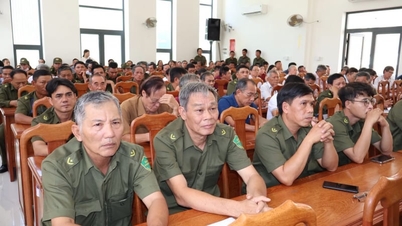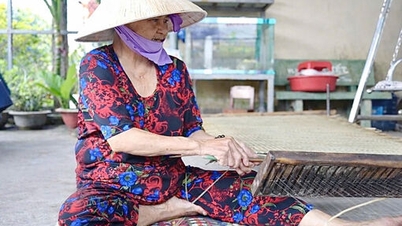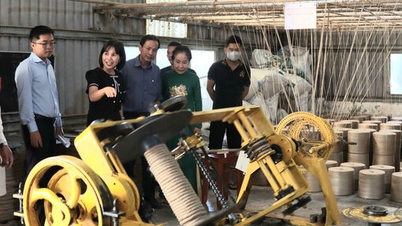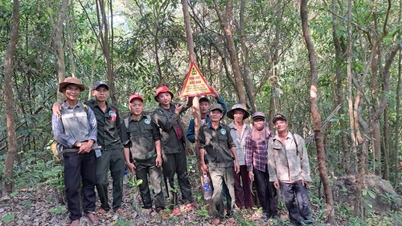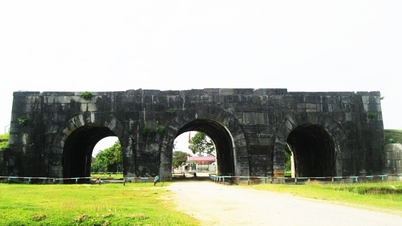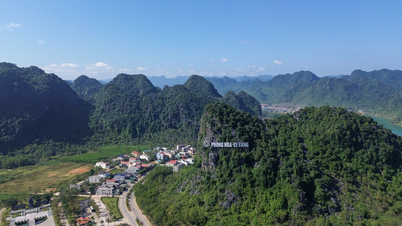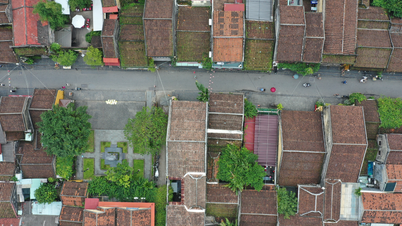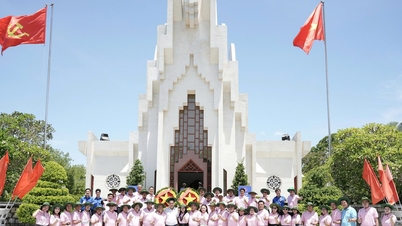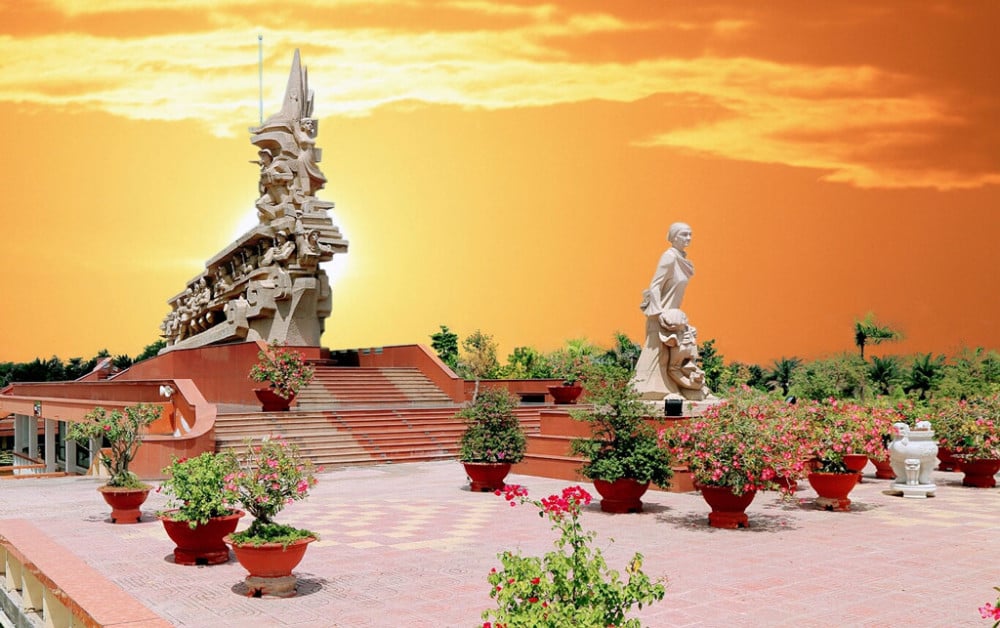
The Long An Monument, symbolizing the bravery and resilience of the entire population in fighting the enemy, is considered a symbol of Long An (Photo: Department of Culture, Sports and Tourism).
Long An - A long history
The name Long An province first appeared on administrative maps in 1956 when the enemy merged parts of Tan An province with Cho Lon province, using the common name Long An province. On our side, around July 1957, Long An province and Kien Tuong province were also established. Long An province at that time included the remaining land of the former Cho Lon province and the former Tan An province.
Following the liberation of South Vietnam in 1976, the former Long An province and Kien Tuong province merged, adopting the common name Long An province. After several changes and divisions of district boundaries, Long An province comprised 15 districts, towns, and Tan An city until the province-city merger and the operation of a two-tiered government system.
Although the name Long An province appeared relatively late compared to many other provinces and cities, the land of Long An has a long history. Archaeological discoveries show that from the 3rd century, Long An was one of the areas where the Oc Eo culture developed. In 1698, Nguyen Huu Canh, following the orders of Lord Nguyen Phuc Chu, stabilized the situation and established Gia Dinh prefecture, comprising two districts: Phuoc Long and Tan Binh. The land of present-day Long An belonged to the former Tan Binh district.
In 1836, Emperor Minh Mạng changed Phiên An province into Gia Định province, renaming the entire former Gia Định city to Nam Kỳ (Southern Vietnam). At this time, Gia Định province had three prefectures: Tân Bình, Tân An, and Tây Ninh (meaning it included present-day Ho Chi Minh City, Long An, and Tây Ninh). This also formed a solid foundation for the merger of Long An and Tây Ninh provinces to create the new Tây Ninh province, aiming for sustainable development in the future.
Heroic tradition
From the resistance war to the years of rebuilding and developing the homeland, the Party Committee, government, and people of Long An have always clearly demonstrated the spirit of unity, "loyalty, courage, and unwavering determination." From the early days of the resistance against French colonialism, Long An has produced heroic figures such as Trinh Quang Nghi, Phan Van Dat, Tra Quy Binh,... This land is also the birthplace of many patriotic intellectuals and outstanding revolutionaries such as Nguyen Trung Truc, Nguyen Thong, Tran Van Giau, Nguyen Huu Tho,... Place names like Long Khot, Rach Kien, Queo Ba, Da Bien,... will forever be etched in history and remembered by future generations.
In particular, Long An province also possesses a large portion of the Dong Thap Muoi region, a place often referred to as the "Viet Bac" of the South. The Dong Thap Muoi area of Long An was the location of the Southern Regional Party Committee and the Southern Resistance Administrative Committee; the establishment of the Political Agency of Military Region 8, which also served as a base for Region 8; the location of the Kien Tuong Provincial Party Committee base during the resistance against the American imperialists, and also the establishment of the 261st Giron Battalion;...



The land of Long An, "Brave and resilient, the entire population fighting the enemy," is exactly as author Thach Phuong once wrote in the Long An Gazetteer: "On this land of Long An, from the canal banks, the rows of coconut trees, to the bamboo groves, the sugarcane fields, the fragrant gardens, or the melaleuca forests, every inch of land is soaked with the blood of our compatriots and comrades, and hundreds of thousands of similar stories are told night after night without ceasing, like the stories of One Thousand and One Nights from Arabia."
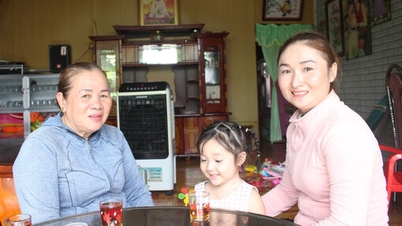
Regardless of the name, Long An or Tay Ninh is still my hometown. Changes aimed at development and better care for the people should be supported." Ms. Nguyen Thi Tham (Chau Thanh district) After July 1st, 2025, my place of residence will be Nhut Tao commune, Tay Ninh province. The names of the province, district, and commune where I live have all changed completely, which makes me feel a little sad. But clearly, this is a change for development, so we fully trust and support it, because "every homeland is part of the nation." Ms. Pham Thi Ngoc Nu (Tan Tru district) "Up until now, whenever I looked at a map of Long An province, I always pictured a bird in flight. Now, with the province merger, looking at the new map, I feel like the bird has been given wings. The fact that the province name is no longer there still makes me feel a little regretful, but it's okay. Whether it's Tay Ninh or Long An, we are still Vietnamese, living in Vietnam." Mr. Huynh Huy Hoang (Tan An City) |
Looking towards the future
Despite its glorious tradition of resisting foreign invaders, the land and people of Long An remain gentle and simple, just like its name, which means "Prosperous, Abundant, Good, and Peaceful"!
The Vam Co Dong and Vam Co Tay rivers of Long An province have been sweetly and emotionally immortalized in poetry and music . Many people throughout the country know Long An through songs like "Vam Co Dong," "You're at the beginning of the river, I'm at the end,"... or traditional folk songs such as "My Hometown River," "Beside the Vam Co River,"...



This rural area is also one of the origins of the intangible cultural heritage of Don Ca Tai Tu (traditional Southern Vietnamese folk music), being the birthplace of the talented musician Cao Van Lau and the place of worship for the renowned musician Nguyen Quang Dai. Long An has 5 national-level intangible cultural heritage sites, including many festivals with strong humanistic and traditional values that have been preserved for hundreds of years, such as the Lam Chay Festival, the Ba Ngu Hanh Festival, and the Ky Yen Grand Ceremony at Tan Phuoc Tay communal house,...
Currently, Long An is also proud to be one of the provinces with the most developed industries in the Mekong Delta region. The gross regional product (GRDP) growth rate in the province is estimated to increase by more than 8.3% in the first six months of 2025. This is the highest GRDP growth rate for the first six months of the year since 2021.
From July 1st, 2025, Long An province officially concludes its historical mission. The Party Committee, government, and people of Long An now, and Tay Ninh tomorrow, will continue to uphold the tradition of unity and work together to build their homeland. The new Tay Ninh province, built upon the foundation of Long An and the current Tay Ninh province, will continue to advance in the nation's "transformation" journey. The name Long An will forever remain a memorable landmark in the hearts of every citizen of Long An today and Tay Ninh in the future.
Guilin
Source: https://baolongan.vn/long-an-mot-dau-son-ky-niem--a197879.html



![[Photo] "Hanoi Lotus Festival" honors the lotus flower that has been associated with Vietnam for thousands of years.](https://vphoto.vietnam.vn/thumb/1200x675/vietnam/resource/IMAGE/2026/06/27/1782516943048_sen-ha-noi-2026-minh-duy-1-jpg.webp)