

There was a time when salt production was as essential to the lives of salt farmers in Hai Loc and Hoa Loc communes (Hau Loc district). However, after numerous setbacks with fluctuating prices, market mechanisms, and weather conditions, the traditional "seawater drying" profession is now facing the risk of extinction.
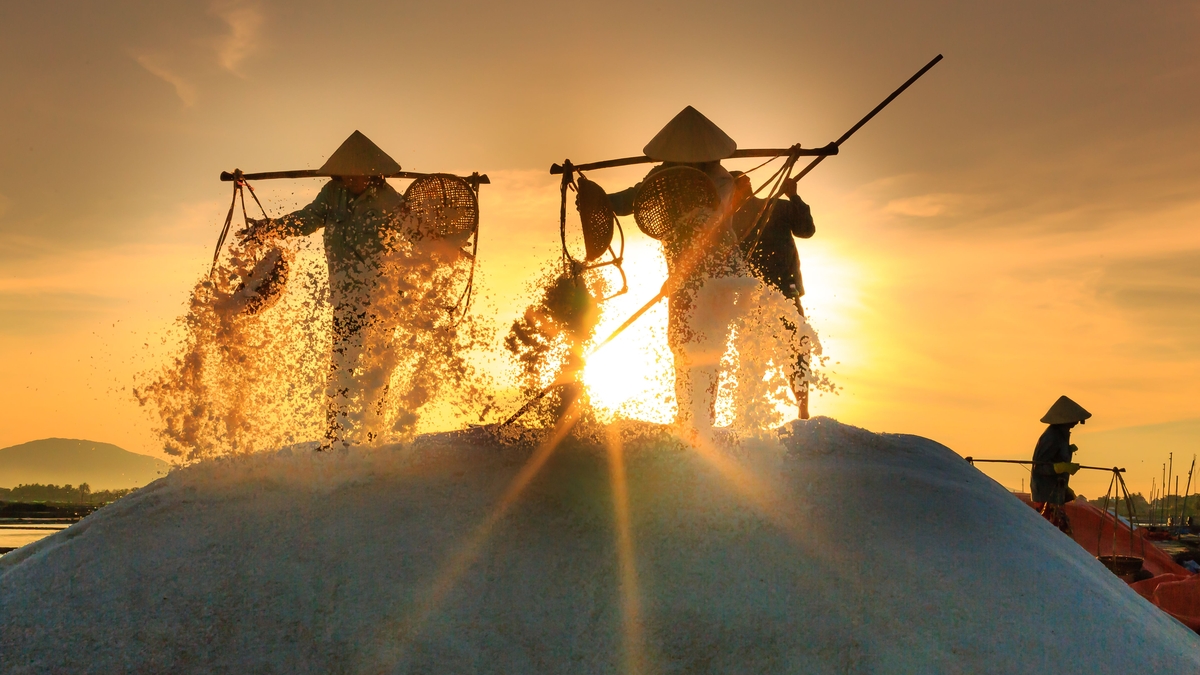
 Salt farmers still maintain the traditional, manual methods of salt production.
Bitter salt
On the Truong Xa salt fields (Hoa Loc commune) – a place full of sunshine and wind – dozens of salt farmers still "bury themselves" in the salty taste of the seawater, the white color of the salt, and the clear blue sky without a single cloud. To this day, most salt farmers in Hau Loc still maintain the traditional, manual salt-making process: drying the sand - filtering the sediment - crystallization. Thanks to this, the quality of the salt grains here is quite good. In 2020, the Thanh Hoa Department of Science and Technology took samples of salt from the Tam Hoa Salt Cooperative and sent them to the Ministry of Science and Technology for testing. The salt product was rated A for purity; the salt grains were not contaminated with metals.
However, due to artisanal production, salt prices cannot compete with the market, especially with salt producers in the South. This leads to low economic efficiency, preventing people from having the capital to reinvest in salt production infrastructure. Meanwhile, the dilapidated salt field infrastructure, lacking maintenance and renovation, causes the quality of salt to decline, resulting in low export value. This vicious cycle surrounding salt has led many salt farmers to abandon their fields, but there are still those who remain loyal to their ancestral profession for their own reasons. "Hoa Loc has two salt fields, Truong Xa and Nam Tien, with about 300 households currently involved in salt production, covering an area of over 30 hectares. The laborers working in the fields are mainly the elderly and women; while young, healthy people mostly go to work elsewhere or switch to other professions such as business, aquaculture, or factory work..." - Mr. Le Van Kien, Deputy Director of Tam Hoa Salt Cooperative, began the story.
Just about 10 years ago, Hoa Loc commune had nearly 100 hectares of land dedicated to salt production, but now only one-third remains. In 2023, 4,100 tons of salt produced in Hoa Loc commune were supplied to fish sauce processing companies in Hau Loc district and other areas such as Nga Son, Hoang Hoa, and other provinces like Hung Yen and Ha Nam... at an average selling price of 2,500 VND/kg. Thus, if divided equally among about 300 households, each household only earned about 3 million VND per month from salt production. "Salt production is arduous, completely dependent on the weather, and the income is low, so no one in Hoa Loc has ever gotten rich from salt production," said Mr. Kien.
Furthermore, businesses and cooperatives involved in salt processing and trading in the area have not yet played a core role in consuming the people's products. For the most part, salt farmers have to find their own outlets, and each sells independently, often leading to price manipulation by traders. The Deputy Director of Tam Hoa Salt Cooperative explained: “The Tam Hoa Salt Cooperative really wants to sign contracts to guarantee the purchase of the farmers' products, ensuring both an outlet and stable prices, but we are powerless due to a lack of capital. Even the option of borrowing from a bank has been discussed, but it couldn't be implemented because we lacked collateral. Therefore, the Tam Hoa Salt Cooperative only acts as a liaison between parties, handling irrigation and canal services for the farmers.”
Converting inefficient salt-producing land.
Unstable prices, lack of investment in infrastructure, shrinking salt fields, and declining enthusiasm for the profession among the local population... these are not just problems in Hoa Loc commune, but also in other localities still practicing salt production, such as Hai Loc commune (Hau Loc district); Hai Chau and Hai Binh wards (Nghi Son town). So, what is the way forward for salt and the salt fields? The challenge of transforming salt production into an aquaculture economic model and moving towards industrial clusters is being considered.
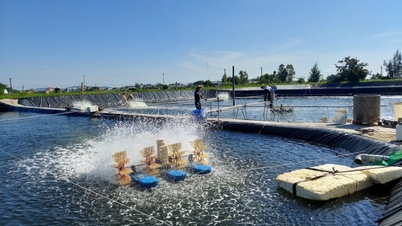
According to Mr. Le Van Kien, the locality has converted 30 hectares of inefficient salt-producing land, of which 18 hectares have been converted to industrial shrimp and goby fish farming, 8 hectares are for the construction of the Hoa Loc industrial cluster, and 3 hectares for a shoe factory. “The shift from salt to shrimp farming follows the natural course of development; profits from salt are low, while shrimp are very high. With the same 1 hectare of land, aquaculture can generate up to 1 billion VND per year, while salt production only yields nearly 100 million VND,” Mr. Kien shared.
As one of the households actively converting inefficient salt-producing land to shrimp farming, Mr. Dao Van Binh, from Tam Hoa village (Hoa Loc commune), shared: “The salt-producing land is only suitable for aquaculture, so I decided to convert 1,400 square meters of salt-producing land to whiteleg shrimp farming. Since my family's land wasn't enough for shrimp farming, I bought additional salt-producing land from neighboring households, increasing the total shrimp farming area to over 5,000 square meters. If the weather is favorable, we can harvest three shrimp crops a year, earning hundreds of millions of dong. Currently, the model provides regular employment for two permanent workers and many seasonal workers.”
The conversion of inefficient salt-producing land to aquaculture in Hoa Loc commune in particular and Hau Loc district in general has been yielding economic benefits, creating a shift in agricultural production, applying high technology in aquaculture, creating valuable commodities, and increasing people's income. This is a necessary direction for this region. However, shrimp farming, while providing high income, requires significant investment and carries many risks. Salt production is not a lucrative profession, but it offers a more sustainable source of livelihood compared to other occupations.
According to Hau Loc district's planning until 2030, Hoa Loc commune will retain 14 hectares of land for salt production to maintain the profession. This is truly good news for the salt farmers here, especially those who have a deep attachment to salt production. "Salt production – the 'sowing of seawater' profession – is considered one of the distinctive features of the production life of coastal people. Anyone who has experienced the arduous years on the salt fields will never forget the scorching sun, the dry wind, and the spirit of 'competing with rain, seizing the sun, and conquering nature.' Therefore, Tam Hoa salt production not only brings economic value but also cultural and spiritual value," affirmed Mr. Trinh Xuan Han, Chairman of the People's Committee of Hoa Loc commune.
Text and photos: Tang Thuy
Source: https://baothanhhoa.vn/loi-di-nao-cho-hat-muoi-que-bien-223366.htm















































![[Video] Sunset at Lap An Lagoon – Where the sun sets over the fishing nets](https://vphoto.vietnam.vn/thumb/1200x675/vietnam/resource/IMAGE/2026/05/31/1780192137701_beach-landscape-sea-water-nature-grass-745871-pxhere-com.jpeg)



































Comment (0)