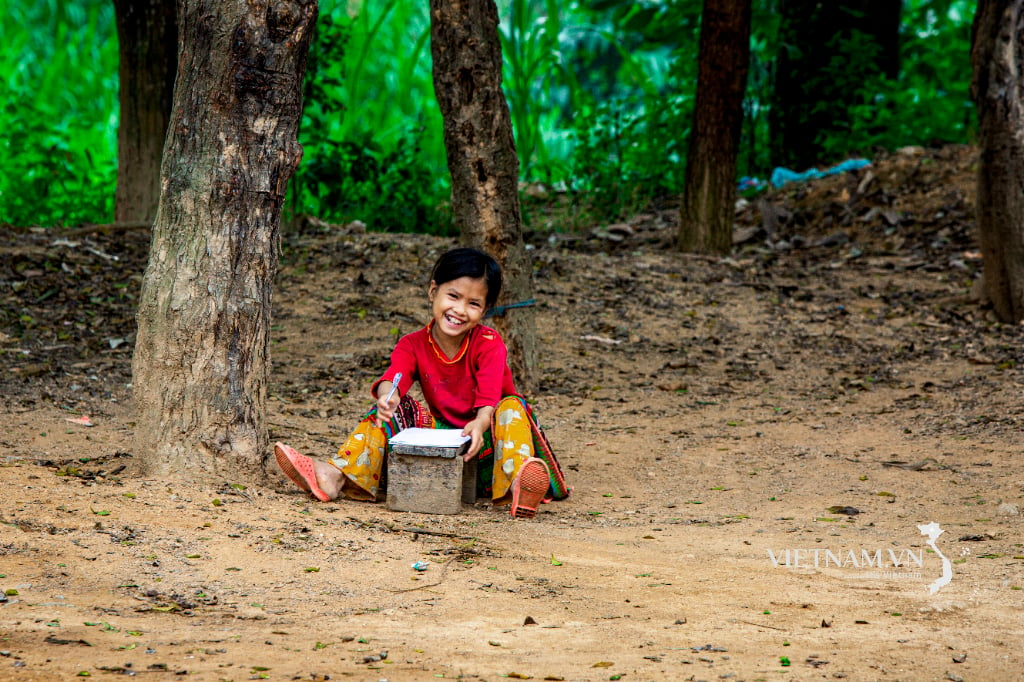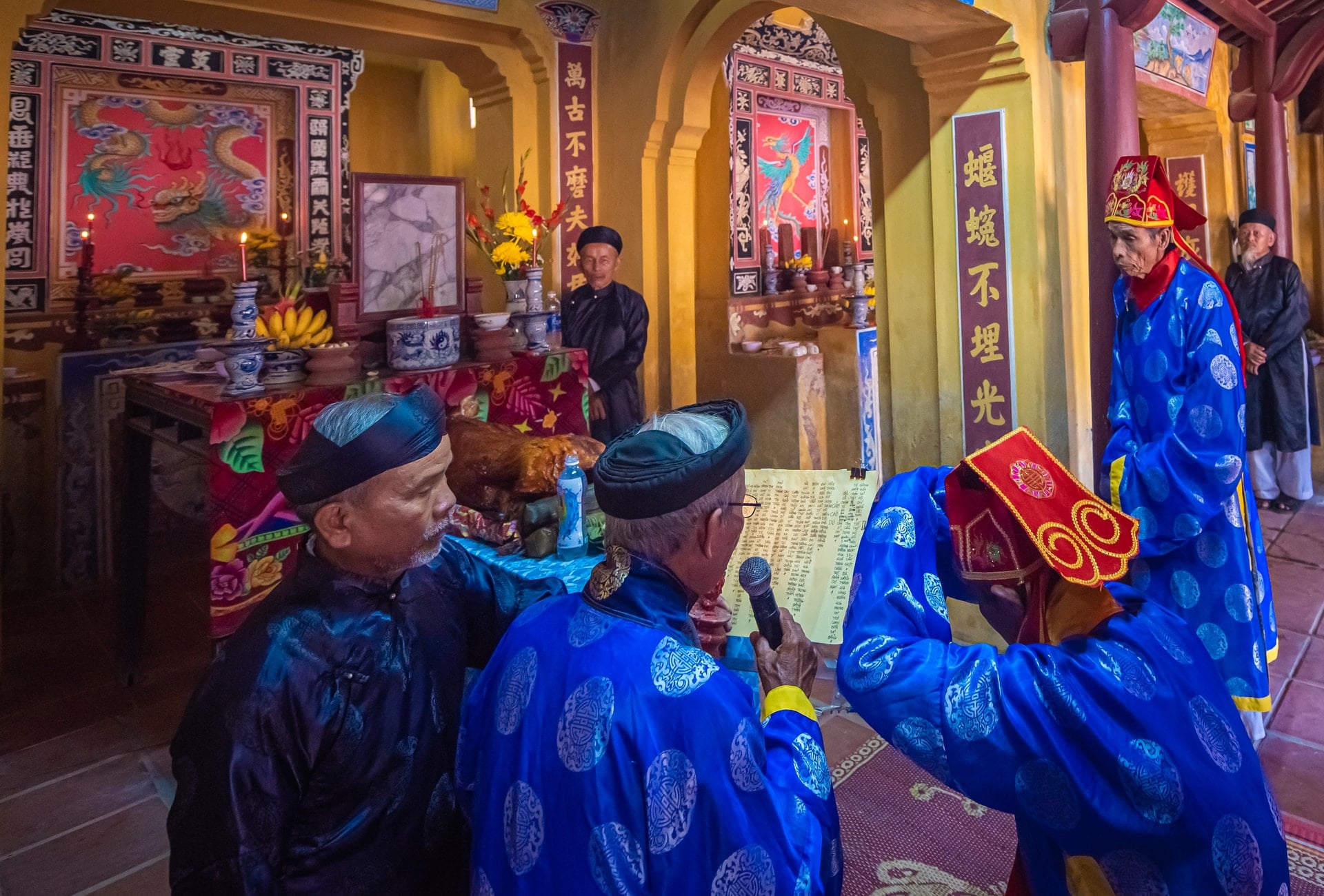
That journey is marked by prayers and incantations, where people's wishes for a better life are transformed into sacred rituals.
From the very beginning
The earliest prayers often stemmed from anxieties about nature and fate. They were pleas for peace, for protection amidst life's uncertainties. The nation's history records these prayers from the dawn of time.
The Complete Annals of Dai Viet record stories of prayers and funeral orations. In 257 BC, the Co Loa citadel "kept collapsing after being built," and King An Duong "was worried, so he fasted and prayed to heaven and earth and the gods of the mountains and rivers before starting to rebuild it."
By 186, a fervent prayer resounded: "May Heaven grant that a sage may soon be born for our Vietnam... so that we may not be plundered by the people of the North." These prayers did not stop at the fate of the nation. In 549, amidst the perilous situation before the Liang army, King Ly Nam De burned incense and prayed, and immediately a good omen appeared: "He received a helmet and a dragon-claw spear to use in battle."

In 1012, King Ly led his army to fight the enemy. While at sea, the sky suddenly darkened, and a fierce storm raged. The king burned incense and prayed to heaven, saying: "I am a man of little virtue, presumptuous in ruling over the people, constantly fearful as if about to fall into a deep abyss. I dare not rely on military might to recklessly suppress the rebellion (...) I beg heaven to examine my case." Indeed, the waves calmed and the sea became still.
In particular, the year 1282 marked a significant milestone when Nguyen Thuyen, the Minister of Justice, wrote a eulogy for the crocodile on the Lo River – a work considered the beginning of written eulogies in Vietnam. Also in that year, King Tran personally wrote a eulogy mourning Tran Quoc Toan, showing that the initial vows were gradually taking shape into a formal literary genre.
"Văn cúng" is a special literary genre, a general term encompassing various types such as funeral orations, prayers, petitions, and official documents (in Vietnamese), as well as sacrificial texts, hymns, congratulatory texts, and ceremonial texts (in Chinese)... used to inform the deceased or deities.
The diversity in naming conventions and the standardized practices demonstrate that ritual texts are a "witness," a cultural testament, contributing to the enrichment of religious life; they are not only literary products but also a unique spiritual and cultural heritage.
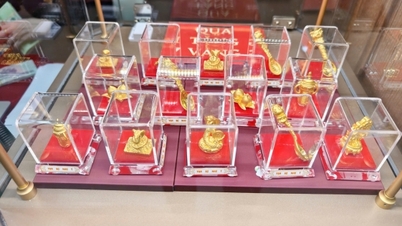
The ancient practice of turning things into gold.
The spiritual and cultural landscape of the Nguyen Dynasty in the 19th century is vividly depicted through the 42 prayers of the renowned official Pham Phu Thu in the collection "Ky Te Van" . These are not merely empty prayers, but a microcosm of society with all its worries and aspirations. Through them, future generations can witness an entire ancient society "looking up to the heavens" to entrust all its wishes.
He wrote prayers for agriculture , praying for favorable weather and abundant rain , and for the dikes to be strong against natural disasters ( Prayer for the stability of dikes and embankments ). When epidemics raged, he composed a prayer for the Quan Thanh Temple on the island , asking the deities to protect the people from cholera. And when the disease passed, he wrote a prayer of thanksgiving ( Prayer of thanksgiving for the illness at Quan Thanh Temple ).
Besides focusing on agriculture and favorable weather (with as many as 11 prayers), political security was also a priority. He wrote prayers at the Van An Temple, asking the tutelary deity to assist in resolving the unrest caused by migrants on Cat Ba Island.
Each prayer, when burned as offerings, serves as a message, a small act of entrustment from a humble human being to the sacred spiritual world , closing a story and opening a belief in blessings and protection.
Source: https://baodanang.vn/loi-nguyen-hoa-vang-3339610.html
![[Image] Schools organize meetings and introduce teaching models to students admitted to grade 10.](https://vphoto.vietnam.vn/thumb/1200x675/vietnam/resource/IMAGE/2026/06/25/1782368077271_ndo_br_z7970052192242-1ec8daeb77a6eed1a4e9f58c564ddd3e-jpg.webp)
![[Image] Ho Chi Minh City: Ma Lang area, Chicken-Rice Market about to change its appearance](https://vphoto.vietnam.vn/thumb/1200x675/vietnam/resource/IMAGE/2026/06/25/1782377698627_ndo_br_m1-jpg.webp)
![[Photo] General Secretary and President To Lam receives Palestinian Ambassador Saadi Salama](https://vphoto.vietnam.vn/thumb/1200x675/vietnam/resource/IMAGE/2026/06/25/1782365384740_a1-bnd-9423-8322-jpg.webp)