

According to ancient legend, when King An Duong Vuong ascended the throne and established his capital in Co Loa, he named the country Au Lac. To govern the country and ensure the people's peace, the king ordered the construction of ramparts and fortifications. However, the ramparts would collapse after being built, and the fortifications would be filled again after being dug. The king then erected an altar to pray to heaven and earth, and the Thanh Giang messenger (the golden turtle) appeared, revealing that a white rooster spirit was hiding on That Dieu Son mountain (now Sai mountain) and disrupting the king's construction. The king and his entourage, including high-ranking officials, went to That Dieu Son mountain to perform the ritual. After some time, the ramparts were completed, contributing to the solid foundation of the Au Lac kingdom during that period.
Every year, in the spring, the king and his officials would personally come here to pay their respects. Later, seeing that the travel was costly and time-consuming for the people, the king granted the villagers of Thuy Loi - Thuy Lam commune the right to perform the royal procession, using their titles and paying their respects to him. From then on, the procession of the king gradually formed and became a unique cultural activity and festival of the Northern Delta region.
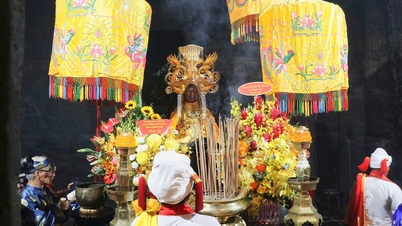
During the "royal procession" festival, all the actions and events are intended to reenact ancient stories, such as the king and his entourage paying homage to the sacred deity Huyền Thiên Trấn Vũ. When the royal palanquin arrives at the Upper Temple, the king dismounts to perform a sword-testing ceremony, striking three blows on an old stone, causing red ink to spill out. Legend says this is the act of beheading a white rooster (the white rooster spirit). After the worship ceremony, the king and his officials return to the communal hall to perform other rituals.
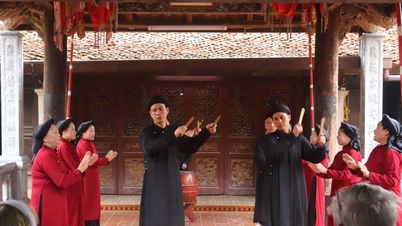
This year, the ceremonial part was held solemnly with traditional rituals of offering incense, performing sacrifices, carrying palanquins, and reading eulogies praising the merits of our ancestors. Meanwhile, the festive part was lively with folk games and traditional cultural performances, creating a vibrant atmosphere while still maintaining the inherent solemnity.
Many first-time visitors shared that they were truly impressed by the solemn atmosphere of the "mock king procession" ceremony. The sound of drums and gongs echoing through the mountains made the space seem to slow down, evoking a sense of reverence and sacredness. Witnessing the solemn reenactment of the ritual of beheading the white rooster spirit, many clearly felt the interplay between legend and life, between history and spirituality. Mr. Hong Truong (Cau Giay, Hanoi ) emotionally said: "I had heard many stories about the mock king procession festival, but only when I witnessed it firsthand did I fully appreciate the meticulousness and reverence of the people here. Each ritual carries cultural depth, not only reenacting ancient tales but also a way for the people to preserve historical memories."

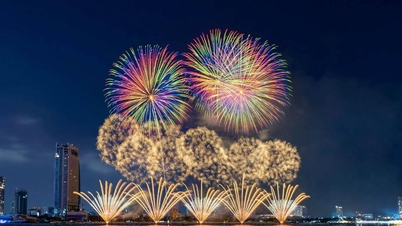
![[Photo] The heat at the fireworks display site on the opening night of the Da Nang International Fireworks Festival 2026](https://vphoto.vietnam.vn/thumb/1200x675/vietnam/resource/IMAGE/2026/05/27/1779889741485_ndo_br_z7872039145157-fecaba5112f39e8352544099d7ef4738-5140-jpg.webp)
![[Photo] The courage of new recruits of Brigade 144 on the training ground.](https://vphoto.vietnam.vn/thumb/1200x675/vietnam/resource/IMAGE/2026/05/27/1779881651341_anh-man-hinh-2026-05-27-luc-18-32-52.png)


































































Comment (0)