A series of "trump cards" are being put into rapid operation.
By 2030, approximately 200 km of urban railway (metro) will be completed, meaning Ho Chi Minh City has nearly four years to connect over 180 km of metro lines. Considering the nearly 20-year struggle to complete just 19.7 km of Line 1, this goal seems almost impossible. However, in just the past year, the rapid progress of lines that have already started or are about to begin construction has rekindled the feasibility of the metro "dream" for the people of Ho Chi Minh City.
A prime example is the Ben Thanh - Can Gio metro line, invested in and developed by Vinspeed High-Speed Railway Investment and Development Joint Stock Company. As the first urban railway line in the country entirely invested in and implemented by a private enterprise, the Ben Thanh - Can Gio metro line not only avoided the challenges typical of pioneers but is also recognized as the fastest line in history.
From the initial concept to the proposed investment plan, approval, and commencement of construction on December 19, 2025, the project took less than a year, equivalent to 1/6 of the preparation time for Ho Chi Minh City's Metro Line 1, 1/16 of Ho Chi Minh City's Metro Line 2, and 1/3 of Hanoi 's Cat Linh - Ha Dong Metro Line. Initially, this metro line was planned to be approximately 48.7 km long; however, after the Ho Chi Minh City People's Committee decided to adjust the route, the Ben Thanh - Can Gio metro line increased its total length to approximately 53.8 km.

Perspective view of the Ben Thanh - Can Gio metro station.
PHOTO: VG
Currently, Vinspeed High-Speed Railway Investment and Development Joint Stock Company is organizing the selection of architectural designs for the station buildings, railway bridges, and related project components (subject to architectural design competition as stipulated by the Architecture Law). The Ho Chi Minh City People's Committee has also set a deadline for land handover for this railway line, requiring completion before the fourth quarter, and has requested relevant departments to finalize the relocation of technical infrastructure to ensure the project is operational by 2028. Thus, within the next two years, Ho Chi Minh City will have nearly 54 km of metro running at 350 km/h, connecting directly from the city center to Can Gio beach.
As the second metro project in Ho Chi Minh City invested in by a private enterprise, and further pressured by the urgent need to connect to the Long Thanh International Airport, the Ben Thanh - Thu Thiem section of Metro Line 2 was also placed under emergency status by the Ho Chi Minh City People's Committee from the very beginning. Specific tasks with deadlines for each item were continuously assigned to each unit by the City People's Committee leadership. Identified as a key project with urgent requirements, the units were given maximum autonomy to utilize special mechanisms and policies, especially within their authority, to accelerate progress. As a result, the more than 6 km Ben Thanh - Thu Thiem metro line officially completed its groundbreaking goal on the morning of April 29th. The investor, THACO Group, stated that this first metro line in Vietnam to run underground across a river will apply the most modern construction technologies and is expected to be completed by 2030.
Following the Thu Thiem project, the 47.7 km Thu Thiem - Long Thanh metro line is also being urgently implemented by Ho Chi Minh City, with a requirement to start construction before July 2nd and complete it by 2030.
Meanwhile, the 11.3 km section of Metro Line 2 (Ben Thanh - Tham Luong), which commenced construction in January, is experiencing strong progress on the construction site. On the day of the groundbreaking ceremony, Vice Chairman of the Ho Chi Minh City People's Committee Bui Xuan Cuong affirmed that the project has many favorable conditions, including completed land clearance; sufficient funding; and the application of special mechanisms and policies to resolve long-standing obstacles related to investment procedures, funding, design standards, and contractor selection. All these factors facilitate accelerated progress, meeting the completion deadline in the fourth quarter of 2030.
This year, Ho Chi Minh City also plans to start construction on Metro Line 6 (Phase 1: Tan Son Nhat Airport - Phu Huu), a 22 km long line, and extend Metro Line 1 from Suoi Tien to Binh Duong New City, a length of over 31 km. Both lines are expected to be constructed within approximately 4 years and put into operation in 2030.
Thus, if the above plans maintain their progress, in the next four years, Ho Chi Minh City will have approximately 190 km of urban railway lines connected, creating momentum to increase the total to 14 lines, approximately 462 km long, by 2035. Between 2035 and 2045, Ho Chi Minh City will build an additional five metro lines totaling approximately 239 km, reaching a total of 19 metro lines with a length of approximately 700 km.
The funding solution and the TOD revolution.
To realize the dream of a massive construction project and bring the entire colossal railway network to completion on schedule by 2030, Ho Chi Minh City is aggressively implementing a revolutionary capital mobilization and construction strategy. In the recently released list of investment projects for the 2026-2030 period, Ho Chi Minh City is calling for investment in 9 metro lines with a total length of over 374 km and a preliminary total capital of over 981,000 billion VND.
It can be said that Ho Chi Minh City has never had such an opportunity to attract massive investment in the metro system as it does now. Since the "four pillar resolutions" were issued, absolutely supporting the participation of private enterprises in key national projects, along with special railway mechanisms that "open the door wide," a series of proposals from USD billionaires have poured into the city.
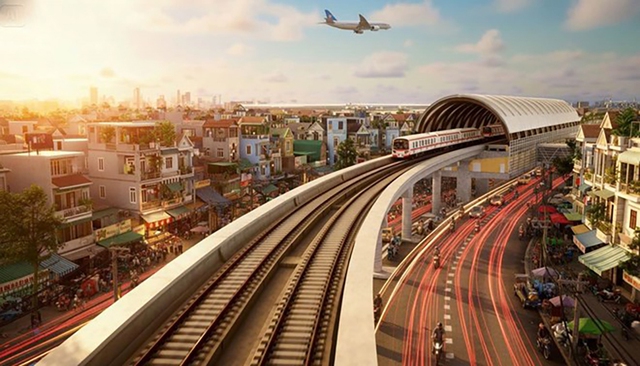
Perspective view of Ho Chi Minh City Metro Line 2.
PHOTO: MAUR
Alongside diversifying funding sources, Ho Chi Minh City is fully utilizing specific policy mechanisms from the National Assembly 's Resolution to apply the Transport-Oriented Development (TOD) model as a core financial leverage. According to the city's People's Committee leaders, by planning and auctioning land use rights around metro stations and adjacent areas along the route, the city will recover the surplus value from land value increased by transportation infrastructure, generating a huge revenue stream for direct reinvestment in subsequent metro lines without putting pressure on public debt.
The next steps are clearly being defined according to a strict phased roadmap: clearing the land first by accelerating land acquisition in the relevant wards and communes this year; unifying technical standards across the entire network to ensure seamless connectivity between trains; and promoting the organization of architectural design competitions for metro stations and bridges to ensure modern aesthetics.
With financial self-sufficiency through TOD (Transit-Oriented Development), optimized investment procedures, and strong domestic private capital inflows, Ho Chi Minh City is confidently taking steps to realize the transformation of its metro network from a planning concept into a driving force for economic breakthroughs, shaping a leading sustainable and prosperous megacity in the region.
Ho Chi Minh City has identified the development of a metro network as a key solution to building a modern public transportation system, reducing traffic congestion and environmental pollution.
Ho Chi Minh City is piloting specific mechanisms and policies, aiming for the metro system to meet 20-30% of people's transportation needs by 2030. This rate is expected to increase to 35-50% by 2035 and reach 50-60% by 2045.
Source: https://thanhnien.vn/tphcm-chay-dua-phu-200-km-metro-185260527204812652.htm




![[Photo] The heat at the fireworks display site on the opening night of the Da Nang International Fireworks Festival 2026](https://vphoto.vietnam.vn/thumb/1200x675/vietnam/resource/IMAGE/2026/05/27/1779889741485_ndo_br_z7872039145157-fecaba5112f39e8352544099d7ef4738-5140-jpg.webp)
![[Photo] The courage of new recruits of Brigade 144 on the training ground.](https://vphoto.vietnam.vn/thumb/1200x675/vietnam/resource/IMAGE/2026/05/27/1779881651341_anh-man-hinh-2026-05-27-luc-18-32-52.png)












































































Comment (0)