

40,000 homes will be relocated.
In reality, the relocation of houses on and along canals and waterways has slowed down over time. Specifically, in the period 1993-2000, the city relocated 9,266 houses; in the period 2001-2005, 15,548 houses; in the period 2006-2010, 7,542 houses; in the period 2011-2015, 3,350 houses; and in the period 2016-2020, 2,479 houses. The most notable projects include the renovation of the Nhieu Loc - Thi Nghe canal, Tan Hoa - Lo Gom canal, Xuyen Tam canal, and Doi canal. However, in recent years, the number of relocated houses has been very small. This situation is due to the fact that previously, projects to relocate and renovate houses on and along canals and waterways were implemented using budget funds, and later through public-private partnerships (PPP). However, due to limited budget and a lack of enthusiasm from businesses, the program has been struggling to find a solution.
Recently, the Chairman of the People's Committee of Ho Chi Minh City signed Directive No. 45, urgently implementing key tasks and solutions to carry out the Central Committee's conclusions and ensure double-digit economic growth by 2026. This includes specifically implementing the directives of General Secretary and President To Lam, such as accelerating measures to reduce traffic congestion, reorganizing traffic, developing public passenger transport, implementing a free bus fare policy to reduce the use of private vehicles; addressing key flood-prone areas, improving the drainage system, and controlling tides. Simultaneously, it mandates an urgent review and development of a roadmap for relocating houses on and along canals and waterways, adjusting the relocation target from 20,000 to 40,000 houses, linked to urban beautification and environmental improvement.
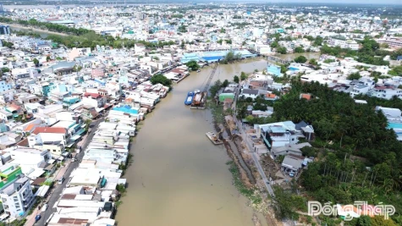
To achieve the above objective, the Department of Construction has compiled a list of 349 rivers, canals, and waterways in Ho Chi Minh City that require the continued relocation of houses located on and along these waterways before the administrative merger. These routes are spread across many inner-city and suburban areas where dense clusters of spontaneously built houses along the canals still exist, significantly impacting the landscape, environment, and urban drainage system.
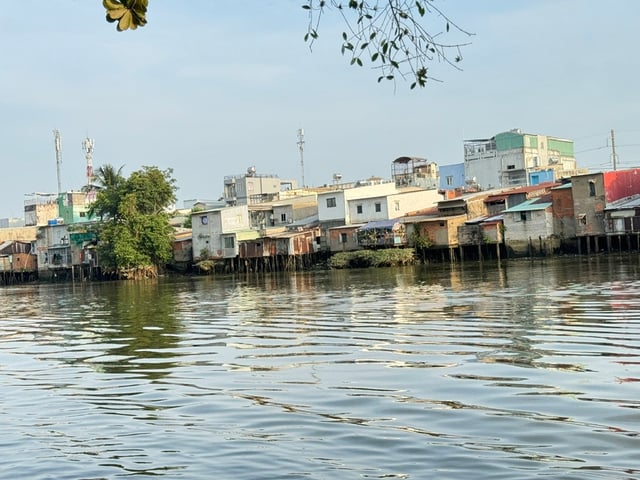
Currently, a large number of houses remain located on and along canals and waterways in the former Ho Chi Minh City area.
PHOTO: DINH SON
Local authorities are required to review the entire list of 349 canal routes, update project route plans on the digital map system, and propose a list of projects for renovation, upgrading, and relocation of housing. Along with this, they must prepare estimates of total investment, compensation and resettlement costs, construction costs, and prioritize projects. This initiative aims not only to address the dilapidated housing along the canals but also to restructure urban space. In recent years, the encroachment of housing along rivers and canals has become one of the causes of environmental pollution and hinders the city's drainage capacity.
It is possible to plan for them to become floating markets.
Dr. Pham Viet Thuan, Director of the Institute of Resource and Environmental Economics in Ho Chi Minh City, commented that the majority of houses are undocumented and small, making relocation and demolition very difficult. This is the main reason why the project is progressing slowly. Therefore, to achieve the city's goals, it is necessary to classify houses into those with documents, those without documents, those with house numbers, and those with temporary residence permits, in order to develop appropriate compensation and support policies. For houses without documents, a support policy equivalent to 70% of the compensation price is needed to encourage people to relocate.
Regarding funding, according to Mr. Thuan, the budget is currently facing difficulties due to the need to focus on many different key projects. However, Ho Chi Minh City has the advantage of Resolution No. 260/2025 amending and supplementing Resolution No. 98/2023 of the National Assembly on piloting special mechanisms and policies for the development of Ho Chi Minh City, which has been issued. The city can utilize this mechanism to propose funding for projects. This is a new direction to expand the ability to mobilize social resources for large-scale urban renovation programs. The city has planned to implement 40 projects using budget funds and 4 projects using socialized capital, with the relocation of approximately 23,429 houses between now and 2030. Of these, the Ho Chi Minh City Urban Infrastructure Investment and Construction Project Management Board is implementing 38 out of 44 projects.
"The National Assembly's resolution allows the Ho Chi Minh City People's Council to decide on the use of local budget funds to implement independent public investment projects for compensation, support, and resettlement. The city is also allowed to create land funds for auction to recover capital for urban development, commercial, and service investment projects. For projects to renovate and relocate houses on and along rivers, and houses on and along canals with an investment capital of 6,000 billion VND or more, they will be included in the priority list and policies to attract strategic investors. This is a great opportunity for Ho Chi Minh City to accelerate the plan to relocate houses on and along canals," Dr. Pham Viet Thuan expected.
Meanwhile, according to Ms. Chau My Anh (Ho Chi Minh City Development Research Institute), over 300 years of formation and development, the image of houses along and on the banks of rivers and canals has become a familiar memory for the people of Ho Chi Minh City. The image of bustling docks and boats carrying goods from all over for trade is also deeply ingrained in the city's soul.
Therefore, Ms. Chau My Anh proposed adopting the model from Thailand, which involves not resorting to forced eviction or land clearance, but instead planning for floating markets. This would both improve urban planning and create livelihoods for residents, as well as attract international tourists. Initially, due to limited resources, it is necessary to focus on key projects and areas, avoiding scattered investments. Simultaneously, it is crucial to assess the suitability of financial and human resources; refine specific policies and mechanisms to encourage the socialization of capital; and enhance access to loans from credit institutions and international financial institutions such as ODA, the Asian Development Bank (ADB), and the International Development Association (IDA)...
Review of resettlement housing across the city.
The Chairman of the People's Committee of Ho Chi Minh City has directed the People's Committees of wards, communes, and special zones to urgently review, update, and fully report on the current status of resettlement housing and land funds in their managed areas, including housing and land funds allocated for projects but not yet used; and housing and land funds under management but not yet allocated to projects. They are also to compile a complete list of resettlement needs and the ability to balance resettlement housing and land funds to serve local projects.
The Department of Construction is tasked with leading and coordinating with relevant departments, agencies, and units to comprehensively review and assess the resettlement housing and land fund in Ho Chi Minh City. Based on this, it will research and advise the Ho Chi Minh City People's Committee on a unified management, allocation, and coordination plan for resettlement housing and land, tailored to the actual needs of each locality and the requirements of implementing public investment projects and key projects. Priority will be given to flexibly coordinating resettlement housing and land funds among localities to minimize the situation where surplus housing and land are underutilized or remain vacant for extended periods, while some localities lack resettlement housing and land to serve compensation and land clearance for key and urgent projects.
Source: https://thanhnien.vn/don-suc-di-doi-nha-tren-va-ven-kenh-rach-185260527210652996.htm
![[Image] Nearly 125,000 Hanoi students completed the Literature exam for the 10th grade entrance exam.](https://vphoto.vietnam.vn/thumb/1200x675/vietnam/resource/IMAGE/2026/05/30/1780117233041_ndo_br_thiet-ke-chua-co-ten-2-png.webp)
































































































Comment (0)