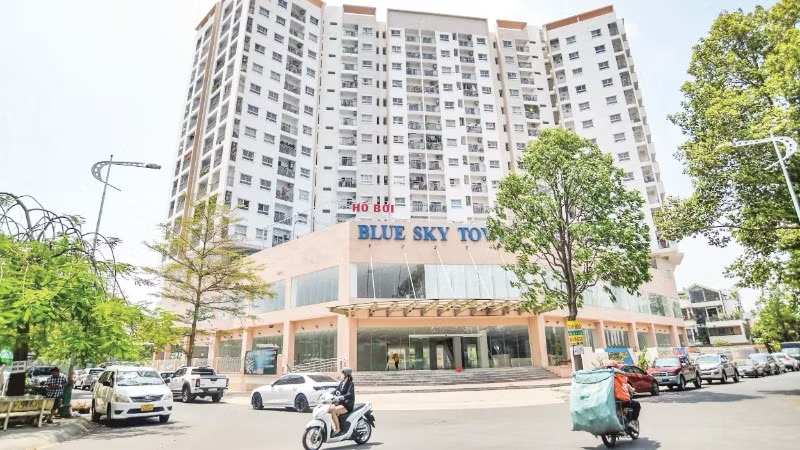
A social housing project in Binh Trung Ward, Ho Chi Minh City. (Photo: QUANG DINH)
The urgent need of megacities
After more than 10 years and numerous moves between rented accommodations, Mr. Ngo Dinh Quan and Ms. Tran Thi Tram, residents of Binh Hung Hoa ward, still haven't been able to own an apartment to settle down. Both are accountants at a company, with a combined monthly income of approximately 25 million VND. After deducting living expenses, they only have about 7 million VND left to save. Before having children, life was manageable, but since having two young children, the pressure has increased significantly, while housing prices continue to rise. Their dream of owning an apartment is becoming increasingly distant.
Millions of workers in Ho Chi Minh City are facing a similar situation to Mr. Quan and Ms. Tram. Mr. Nguyen Van Hai, a member of the Standing Committee of the Ho Chi Minh City Federation of Labor, stated that a survey of 200,000 workers revealed that 95% expressed a desire to purchase social housing. However, with incomes ranging from 10-15 million VND per month, it would take them an average of 20 years of saving to afford an apartment, not including other potential fluctuations.
According to Pham Binh An, Deputy Director of the Ho Chi Minh City Development Research Institute: Social housing not only has social welfare significance but is also an important condition in urban governance and labor market stability. It is also an inseparable component of the city's sustainable urban development strategy. Statistics show that in the period 2021-2025, the city completed nearly 18,000 social housing units. However, compared to the actual needs of workers, this result is still very small.
Social housing not only has social welfare significance but is also a crucial condition for urban governance and labor market stability. It is also an inseparable component of the city's sustainable urban development strategy. According to statistics, in the period 2021-2025, the city completed nearly 18,000 social housing units. However, compared to the actual needs of workers, this result is still very small.
Pham Binh An, Deputy Director of the Ho Chi Minh City Institute for Development Research
According to the government 's plan to build one million social housing units in the 2025-2030 period, Ho Chi Minh City was assigned a target of building 199,400 units, accounting for 20% of the national target. However, by the end of 2025, the city had only completed over 13,000 units. Therefore, in the 2026-2030 period, the city needs to develop more than 164,000 units to achieve the set goal. This presents a significant challenge amidst numerous unresolved difficulties and obstacles.
Remove bottlenecks to create breakthroughs.
As a long-time investor in social housing, Mr. Le Huu Nghia, Director of Le Thanh Company and Vice President of the Ho Chi Minh City Real Estate Association, highlighted the difficulties and obstacles encountered during project implementation. For example, businesses are hesitant due to numerous potential risks in the project deployment process. These include lengthy procedures, high capital costs, and the lack of readily available clean land, leading many projects to face financial risks.
Citing administrative procedures as an example, Mr. Nghia stated that although the city has standardized the process for social housing projects to consist of seven steps, to be completed within 132 days, in reality, projects are very difficult to implement within this timeframe. Even under favorable conditions, completing all procedural steps still takes more than 700 days.
Similarly, regarding funding, although social housing has a 145,000 billion VND credit package with a preferential interest rate of 6.1%, the actual deposit interest rates in the market are very high; due to concerns about losses, many banks have refused to lend. Even businesses requesting loans at commercial interest rates are not approved because banks fear being penalized for lending to the wrong recipients. Businesses are very willing to cooperate with the City in building social housing, but they need a transparent and open mechanism. This is a crucial policy foundation to ensure businesses can confidently implement their projects.
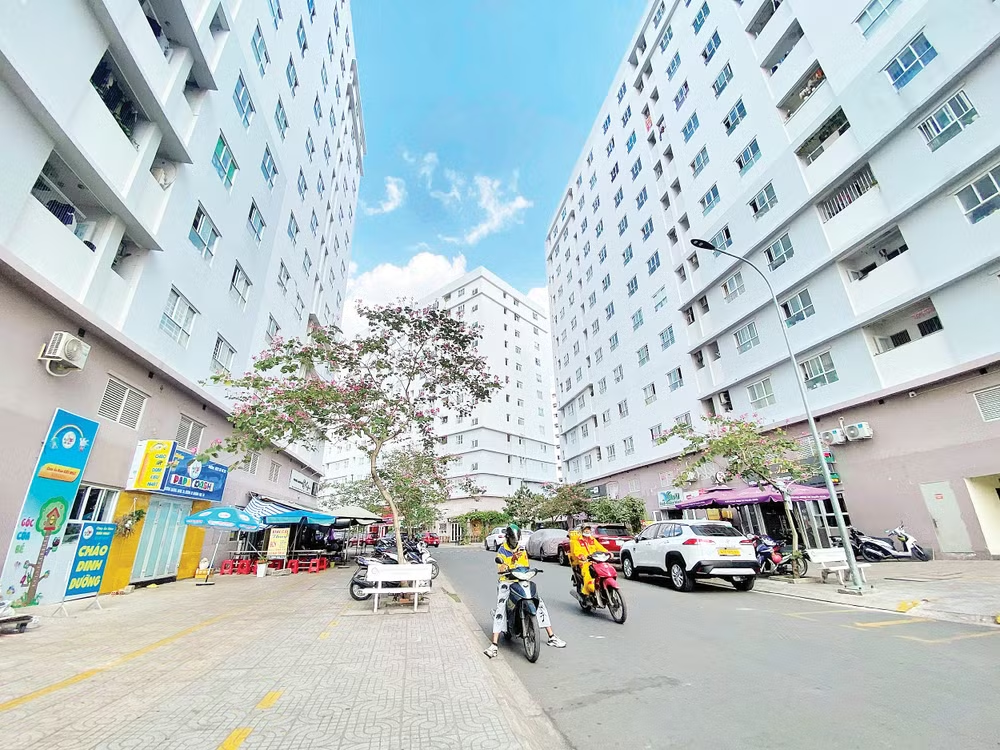
Chuong Duong Home social housing complex, Thu Duc ward. (Photo: QUANG QUY)
To achieve the goal of developing nearly 200,000 social housing units by 2030, Ho Chi Minh City is implementing a series of strong measures. Deputy Director of the Department of Construction Pham Minh Man affirmed that the city will finalize the land use plan for social housing construction by 2040, allocating approximately 2,000 hectares to meet the target of 28,500 units in 2026 and subsequent years. The city is also researching a housing savings fund model, allowing workers to deduct a portion of their regular salaries to purchase housing. Regarding penalties, social housing projects that are slow to develop will not be allowed to proceed with commercial sales; further delays may even result in the revocation of the project and land fund. In addition, administrative reforms to facilitate business investment will continue to be studied and improved towards a more streamlined and efficient system.
Besides developing social housing for sale, the city is also researching and implementing Directive No. 34-CT/TW, dated May 24, 2024, of the Party Central Committee on social housing and the orientation for housing development in the coming period.
According to Le Hoang Chau, Chairman of the Ho Chi Minh City Real Estate Association, the mindset for housing development needs to change towards diversifying models, especially rental housing. The government needs to have policies to support the development of rental housing, viewing it as a source of affordable housing for workers. To leverage resources, the City's Labor Federation has been tasked with leading and connecting social resources to develop housing in the form of rent-to-own, with a focus on rent-to-own options. City leaders have also requested relevant agencies to conduct surveys on the needs for buying and renting to develop appropriate support plans for each target group.
For social housing to develop sustainably, Vietnam needs a specialized agency with the full participation of ministries and sectors to focus on developing this type of housing. The implementation process also needs to be standardized to ensure consistency, fairness in legal aspects, timelines, and costs. The Ministry of Construction could issue model houses and apartments to help reduce approval and design costs, etc. Furthermore, financial resources and support policies for beneficiaries and investors need to be readily available through appropriate incentive policies.
Architect Nguyen Hong Hai, Director of Development and Technology Joint Stock Company
Citing Singapore's experience, architect Nguyen Hong Hai, Director of the Development and Technology Joint Stock Company, stated that over 80% of Singapore's population lives in buildings constructed by the Housing Development Council. Singapore's success in social housing development is the result of a long-term, comprehensive, and consistent strategy. These are well-planned housing complexes with integrated amenities and convenient financial access mechanisms for those in need.
For social housing to develop sustainably, Vietnam needs a specialized agency with the full participation of ministries and sectors to focus on developing this type of housing. The implementation process also needs to be standardized to ensure consistency, fairness in legal aspects, timelines, and costs. The Ministry of Construction could issue model houses and apartments to help reduce approval and design costs, etc. Furthermore, financial resources and support policies for beneficiaries and investors need to be readily available through appropriate incentive policies.
Social housing is a strategic challenge for Ho Chi Minh City, especially in its current stage of development as a megacity. This need not only ensures sustainable social welfare policies but also serves as a condition for maintaining and improving labor productivity, attracting investment, and creating a foundation for double-digit growth targets.
QUANG QUY
Source: https://nhandan.vn/thao-go-nut-that-phat-develop-social-housing-post965163.html



![[Image] Checking the security conditions at the exam site, ready for the 10th grade exam.](https://vphoto.vietnam.vn/thumb/1200x675/vietnam/resource/IMAGE/2026/05/28/1779943458889_z7872507660648-d764421a26e8cd7b61d70d142a48a685-jpg.webp)

![[Photo] Opening Ceremony of the National People's Council Conference on the Implementation of Directions and Tasks for the 2026-2031 Term](https://vphoto.vietnam.vn/thumb/1200x675/vietnam/resource/IMAGE/2026/05/28/1779939257690_ndo_br_bnd-1991-jpg.webp)































































































Comment (0)