

The goal of the class is not to focus too much on specific knowledge but to foster children's intellectual potential and exploration , helping them become more confident in their own strengths.
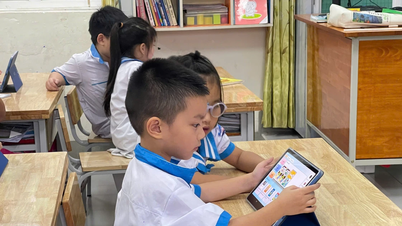
 A lively lesson in the Smart Classroom - Photo: Provided by the Club A lively lesson in the Smart Classroom - Photo: Provided by the Club |
The Vietnam Dream Club has implemented the iTeach (Intelligence Teaching) Smart Classroom project for children in mountainous areas through extracurricular learning, attracting the attention of many people.
The project was first piloted at Yen Lap Ethnic Boarding Primary School, Yen Lap commune, Cao Phong district (Hoa Binh province) in February 2015, with a budget of 5,000 USD.
Teaching creative skills and methods
Why is it called a smart classroom? How is it different from a regular classroom? Nguyen Hoang Viet, Head of the Vietnam Dream Club, explains: “This classroom applies the theory of multiple intelligences by Professor Howard Gardner, a famous American psychologist. The theory identifies eight different types of intelligence in humans: logical-mathematical, physical, spatial, interpersonal, intrapersonal, musical , naturalistic, and linguistic. Learning according to this theory will help students become more confident, enhance their communication skills, foster a passion for learning, and develop their creativity.”
The project attracted over 30 volunteers from Vietnam and the Philippines, with the primary criteria being a love for children and a passion for teaching. Before teaching, the volunteers had to participate in a training course on pedagogical skills. The volunteers from the Philippines were assigned by the club to focus on linguistic intelligence, meaning they guided the children in learning English.
The classes are completely free. Each week, the children attend two sessions on Sundays, each lasting two and a half hours. All learning materials are prepared by volunteers, making each lesson very engaging.
Each class is limited to about 20 students, allowing volunteers to closely monitor each student's progress. The curriculum is diverse, covering topics such as plants, space, life skills, children's rights, problem-solving skills, and survival skills. These topics include numerous smaller lessons accompanied by corresponding activities designed to stimulate students' intelligence. "For example, when learning about plants, students will draw pictures and make crafts to develop spatial intelligence, and visit gardens to develop naturalistic intelligence. When learning about language, they will act out scenarios to develop social interaction intelligence. And when learning about space, they will conduct hands-on experiments using telescopes to explore distant stars," Hoang Viet explained.
When attending class, each student will have a learning journal to record their impressions of each lesson. Volunteers will help students explore a particular topic independently through activities such as: group work, presentations, experiments, quizzes, physical games, singing, sharing feelings, etc.
Children become more confident.
Ms. Bui Thi Bien, mother of Bui Hoang Thai Son, a 4th grade student at Yen Lap Ethnic Boarding Primary School, happily shared: “My son has never studied English at school, but thanks to this class, he now knows how to greet, count, and invite his parents to eat in English. Not only my son, but our neighbor Lan Huong, who is in the same class, has also changed a lot, becoming more confident and no longer shy like before.”
Commenting on this classroom model, Ms. Dinh Thi Hanh Quyen, Principal of Yen Lap Ethnic Boarding Primary School, said: “This is a very new but highly effective model, so it needs to be replicated, especially for ethnic minority students in mountainous areas. Through this class, we have seen significant progress in the students; they are more confident and outgoing, and especially, they have been able to develop their hidden potential and learn more social skills in school and life.”
Hoang Viet said the club also implemented the "Bookcase of Dreams" project with the message: "Let books nurture children's souls." Over the past three years, the club has built 50 bookshelves with nearly 20,000 books of various genres, donating them to children in 10 mountainous provinces, helping children access knowledge and narrowing the gap between students in mountainous and urban areas.
Source: https://thanhnien.vn/lop-hoc-thong-minh-185520172.htm
![[Photo] General Secretary and President To Lam presides over a working session with the Central Policy and Strategy Committee on the development of the materials industry.](https://vphoto.vietnam.vn/thumb/1200x675/vietnam/resource/IMAGE/2026/05/21/1779359935432_a3-bnd-3129-1412-jpg.webp)



![[Photo] National Assembly Chairman Tran Thanh Man working with the Standing Committee of the Law and Justice Committee](https://vphoto.vietnam.vn/thumb/1200x675/vietnam/resource/IMAGE/2026/05/21/1779378929214_ndo_br_1-4610-jpg.webp)










































































Comment (0)