

Sophisticated scams targeting OTP codes have emerged.
According to Kaspersky, between March 1st and May 31st, 2024, the company blocked 653,088 visits to websites created by phishing toolkits targeting banks.
During the same period, Kaspersky detected 4,721 phishing websites created with toolkits designed to bypass two-factor authentication.
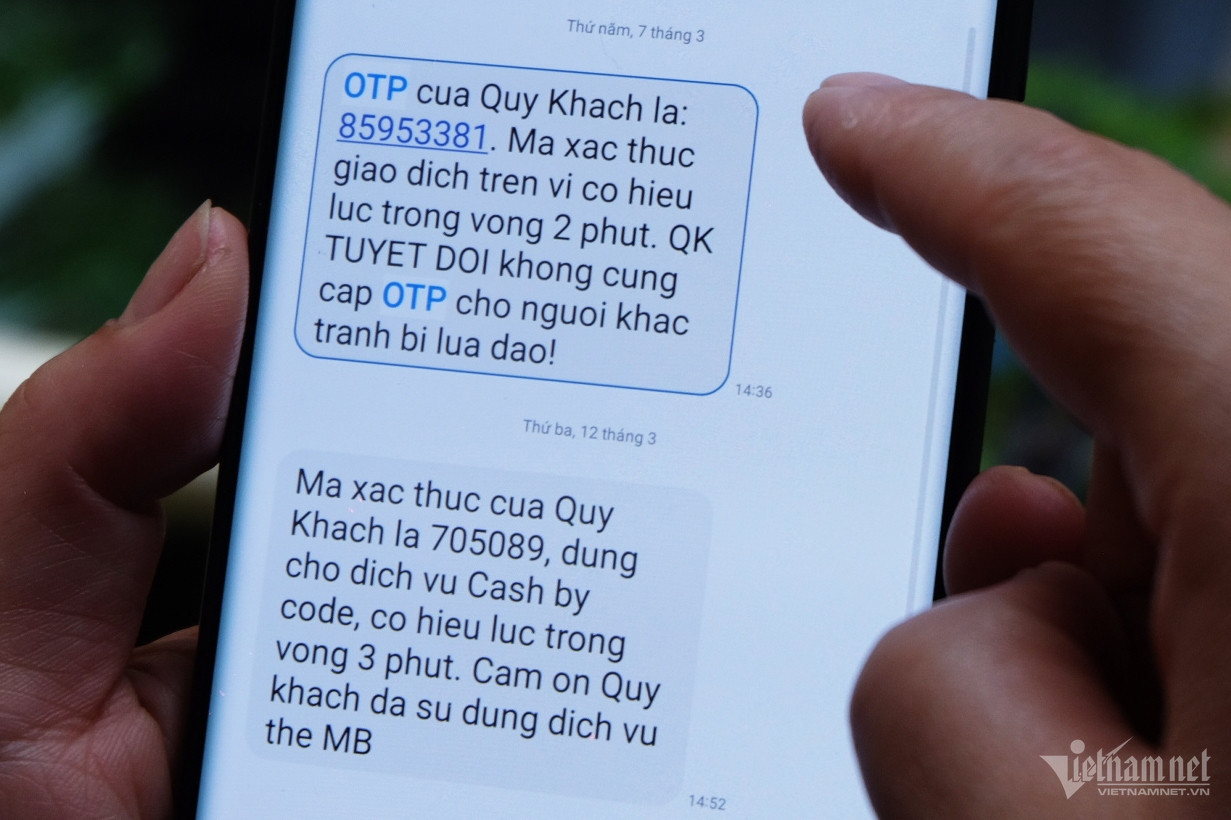
When the victim enters their username and password into the fake website, the scammers automatically collect the information in real time. They then log in and trigger the sending of an OTP code to the victim's phone.
Normally, even if a password is leaked, a user's account is protected by two-factor authentication. However, a new scam has emerged where fraudsters use OTP bots to trick users into revealing their OTP codes.
OTP bots automatically call victims, impersonating employees of a trusted organization. These bots use pre-programmed conversation scripts to persuade victims to reveal their OTP codes. Through this, hackers obtain the OTP code and use it to gain unauthorized access to accounts.
Scammers prefer using voice calls over text messages because victims tend to respond more quickly when using this method.
Under no circumstances should users provide their OTP code to others, especially via calls or text messages, no matter how convincing the information may seem.
Two-factor authentication (2FA) is a standard security feature in cybersecurity. It requires users to verify their identity with a second authentication step, usually a one-time password (OTP) sent via text message, email, or app.
Vietnam will have 10 more undersea fiber optic cables.
On June 14th, the Ministry of Information and Communications issued a decision approving the "Strategy for the Development of Vietnam's International Fiber Optic Cable System until 2030, with a vision to 2035".
Vietnam's strategy for developing its international fiber optic cable system aims to put at least 10 new submarine fiber optic cables into operation by 2030, bringing the total number of submarine fiber optic cables in Vietnam to at least 15.

Specifically, according to the roadmap, by 2027, Vietnam will deploy and put into operation four new submarine fiber optic cables, raising the total capacity to at least 134 Tbps; continue to maintain Singapore, Hong Kong (China), and Japan as the main Digital Hubs; periodically review and evaluate the Digital Hubs to develop plans for maintaining, relocating, and adding connection points as appropriate in each period.
Of the four new submarine cable routes to be deployed in the period up to 2027, at least one will be owned and operated by Vietnam.
Between 2028 and 2030, at least six new submarine fiber optic cables, including one owned by Vietnam, will be deployed and put into operation, raising Vietnam's total designed submarine fiber optic cable capacity to at least 350 Tbps.
During this phase, Vietnam will also deploy and put into operation at least one more international terrestrial fiber optic cable. Simultaneously, it will maintain a maximum of 90% of its undersea fiber optic cable capacity connected to at least four major nearby Digital Hubs in the Asian region; and maintain a minimum of 10% backup connection of its undersea fiber optic cable capacity to at least two major Digital Hubs in the Americas and Europe.
According to the Vietnam Telecommunications Authority, in addition to the two terrestrial cable lines connecting to Hong Kong (China) and Singapore with a total capacity of 5 Tbps, Vietnam currently has five international submarine fiber optic cables with a total capacity of over 20 Tbps in use and a total available capacity of 34 Tbps. Statistics show that an average of 15 submarine fiber optic cable incidents occur annually, with repair times before 2022 ranging from 1-2 months per incident, and after 2022, from 1-3 months per incident. Therefore, there have been times when Vietnam experienced incidents on all five submarine fiber optic cables in use, resulting in a loss of approximately 60% of international internet connectivity for nearly two months.
Hackers are increasing the speed at which they exploit new vulnerabilities.
Hackers are increasingly exploiting newly disclosed vulnerabilities to launch cyberattacks on the systems of agencies and organizations.
This statement was shared by Mr. Nguyen Gia Duc, Country Director of Fortinet Vietnam, with a VietNamNet reporter on the sidelines of the annual Fortinet Accelerate Vietnam 2024 security event held recently in Hanoi .
To substantiate his claim, Mr. Nguyen Gia Duc stated that the FortiGuard Labs research team sought to determine the time it takes for a security vulnerability to transition from the initial release phase to exploitation, whether vulnerabilities with high scores on the Exploitation Prediction Scoring System (EPSS) are exploited faster, and whether it is possible to predict the average exploitation time by hackers using data from the EPSS system.

Based on this analysis, Fortinet experts pointed out that in the second half of last year, hackers accelerated their exploitation of newly disclosed vulnerabilities, 43% faster than in the first half of 2023. This highlights the importance of vendors committing to internally discovering vulnerabilities and developing patches before exploitation can occur, minimizing instances of zero-day vulnerability exposure.
According to experts, exploiting security vulnerabilities, especially those with high impact and severity present in common technology solutions, to infiltrate systems and subsequently gain control and steal organizational information is one of the prominent cyberattack trends in recent years.
Ho Chi Minh City has allocated 1,800 billion VND for digital transformation but has not used a single penny.
On the morning of June 14th, during the second day of the 31st Conference of the Ho Chi Minh City Party Committee, Vice Chairman of the Ho Chi Minh City People's Committee Vo Van Hoan presented a report on the results of the city's digital transformation. According to Mr. Hoan, promoting digital transformation is also a key theme for Ho Chi Minh City in 2024.
According to the Vice Chairman of the Ho Chi Minh City People's Committee, in implementing digital transformation, the city has identified five main pillars: digital platforms, digital economy , digital society, digital government, and digital safety and security.
According to Mr. Hoan, in 2024, Ho Chi Minh City approved a regular budget of over 1,800 billion VND for investment in information technology applications and digital transformation in the city (reaching 1.22% of the total 2024 budget).
However, the disbursement rate for digital transformation is currently 0%. This is because the Ho Chi Minh City Department of Finance only allocated the budget on May 3, 2024.
"The city has allocated over 1.8 trillion VND for digital transformation, but not a single penny has been used. The reason is that the procurement process for equipment, bidding, and auctions involves many stages that we haven't been able to complete yet," the Vice Chairman of the City People's Committee stated.
Units have not yet achieved 100% completion of receiving, digitizing, and processing administrative procedures on the information system due to the parallel use of two public service portal systems. Furthermore, while digital signatures have been implemented, they are only on a pilot basis internally and have not been widely adopted; implementation remains hesitant.

Source: https://vietnamnet.vn/lua-dao-danh-cap-ma-otp-tinh-vi-tan-cong-mang-tan-dung-lo-hong-moi-2291889.html








































































































Comment (0)