


For generations, this ritual has not only marked the transition between the old and new year but also provided an opportunity for each member to join hands in preserving and passing on cultural values, hoping for a new year filled with prosperity and happiness, illuminated by the sacred flame.

Faith and hope on this sacred night.
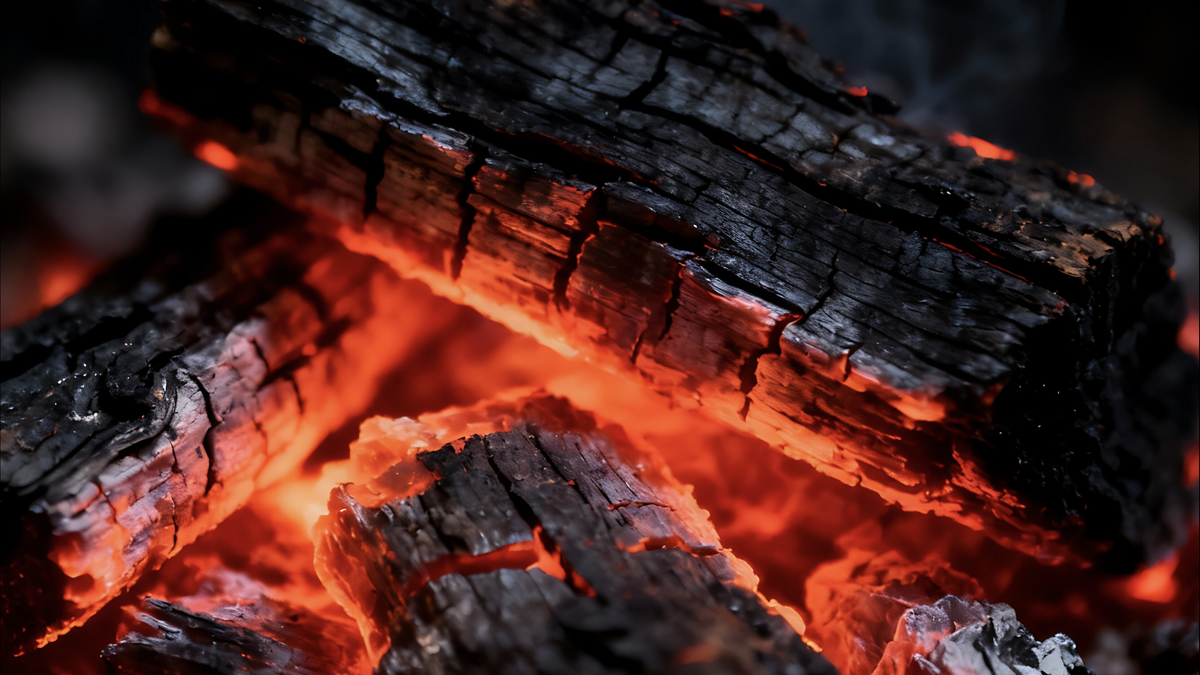
In the final days of the year, as the biting cold wind sweeps across the low-lying plains, Dong Bong ( Thanh Hoa ) enters the season of preparation for the most important ceremony of the year: the burning of the communal house. According to the elders, from the twelfth lunar month, strong and agile young men are sent to the mountains in the region to cut reeds, a type of reed with a hollow, segmented stem containing a lot of oil, making it very easy to ignite. Bundles of reeds are carried back to the village, dried, and await the day to be used to build the communal house.
After the Kitchen God's farewell ceremony, on the 25th day of the 12th lunar month, under the guidance of the village elders, the young men gather dried kindling sticks, arrange them into a large bundle, about 65cm in diameter and up to 25m long, and then bend them into the shape of a "sacred dragon".
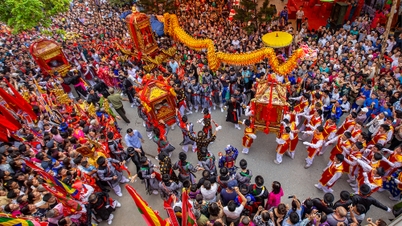
On the afternoon of the 30th day of the Lunar New Year, with the permission of the village elder, the young men of the village together moved the "fire dragon" from inside the temple to the middle of the courtyard. They used supports to gradually raise it, positioning the dragon's head high and its body low, creating a posture that was both graceful and majestic, waiting for the moment of New Year's Eve to transform into a sacred flame.
Before the transition from the old year to the new, the villagers gathered in large numbers at the communal courtyard. A solemn ceremony was held to worship heaven, earth, and the deities. Inside the inner sanctuary, the elders performed a ritual to ask permission from the village guardian deity to carry the fire to light the communal house. When the fire was brought out, the deep, resonant sound of the large drum, the rhythmic beat of the gongs, and the rapid drumming of the smaller drums, all blended with the lively footsteps of the fire procession, making the atmosphere in the courtyard sacred and bustling.
At the exact moment of New Year's Eve, tinder used to make the dragon's beard and mane caught fire, and the first flame flared up, spreading along the dragon's body. Cheers and drumbeats echoed from the temple courtyard, awakening the entire space. In that moment, the people of Dong Bong believed that the fire would dispel the cold and poverty, bringing warmth, happiness, and a harmonious new year.
After the ritual burning of the communal house, each family carries a small bundle of torches they have prepared, lights them with the sacred flame, and carries them home. This fire is used to light the stoves for cooking the New Year's offering meal. From New Year's Eve until the ceremony of taking down the New Year's pole (the 7th day of the Lunar New Year), the caretaker of the communal house and each family strives to keep the fire burning. They believe that a brightly burning fire signifies a bountiful harvest, prosperous business, and a thriving community.

Preserving the spirit of the village in the rhythm of modern life.
Not only is it the center of the ritual of burning the communal house, Dong Bong communal house is also a valuable architectural relic. According to local documents, the communal house was built in the 10th year of Gia Long's reign (1811), and is one of the largest communal houses in the area.
The structure features a five-bay, two-wing architectural style, supported by 36 columns of ironwood, and a curved roof adorned with dragon, unicorn, and other mythical creature motifs, creating a majestic yet graceful appearance. Viewed from afar, the temple resembles a giant lotus flower reflected in the water, both imposing and serene amidst the ancient village landscape. The temple is dedicated to two patron deities, Tô Hiến Thành and Tống Quốc Sư, historical figures embodying integrity, loyalty to the country, and devotion to the people.
For a long time, due to war and turbulent social circumstances, the custom of burning incense sticks in Dong Bong was interrupted. In recent years, this custom has been restored, albeit with adjustments to suit the reality: the kindling sticks are replaced with the flaming, easily combustible plant found in rocky mountains. However, the ritual sequence and spiritual significance remain unchanged according to the traditions of our ancestors.
Speaking to reporters, the Chairman of the People's Committee of Tong Son commune, Nguyen Van Thinh, said: "The custom of burning communal houses is both a religious activity and an intangible cultural heritage of the Dong Bong village community. In recent years, the local government has always coordinated with the people to organize the ceremony solemnly, safely, and in accordance with customs, while also incorporating the dissemination of information about preserving traditional culture to the younger generation."
According to Mr. Thinh, maintaining this custom is of significant importance in the strategy of preserving grassroots culture: "We believe that preserving traditional customs is not just about preserving the cultural space of the village, but also about preserving community memories. With the custom of burning communal houses, the local authorities encourage it to be organized in a civilized and economical way, ensuring fire safety, while still maintaining the sacred element."
Folklorists believe that burning communal houses carries multiple layers of meaning. On a religious level, it is a trace of fertility beliefs and agricultural faith, where fire is associated with the sun and the flourishing of all things. On a social level, the ritual reinforces community cohesion, an element that has helped Vietnamese villages withstand many historical upheavals.
From a cultural perspective, burning the communal house is a form of ritualistic "storytelling," where people convey folk knowledge, collective memories, and aspirations for the future. For the younger generation, this custom becomes a "living lesson" about their roots. Many young people, even those working far from home, try to return to their village for the commemoration of burning the communal house. For them, this is a link to childhood memories, to Tet holidays filled with the smell of burning straw, the sound of village drums, and the flickering firelight in the winter night.
Many tourists who witnessed the ceremony expressed their delight. They realized that behind the rustic appearance of the village temple lay a treasure trove of vibrant culture. In the development of rural cultural tourism , this custom could become a highlight if it is introduced systematically, linked to visits to village temples, ancient village spaces, and traditional Tet (Lunar New Year) celebrations.
However, cultural managers also emphasized that preserving the custom of burning communal houses must be linked to preserving the entire cultural space of the village, from communal houses and temples to fields and family and community life. Because if only the "festive part" is preserved while the "soul" is lost, the custom will easily be distorted and lose its original meaning.
Source: https://baovanhoa.vn/van-hoa/lua-thieng-dinh-lieu-and-khat-vong-mua-moi-207958.html

![[Photo] Procession of a giant "pig" weighing over 200kg at the La Phu Village Festival](https://vphoto.vietnam.vn/thumb/1200x675/vietnam/resource/IMAGE/2026/03/02/1772444501339_anh-man-hinh-2026-03-02-luc-16-40-20.png)

![[Image] Current situation of houses precariously balanced due to road leveling in Dong Nai.](https://vphoto.vietnam.vn/thumb/1200x675/vietnam/resource/IMAGE/2026/03/02/1772455749144_ndo_br_z7579763955585-6e80a60471e75768fa835d035eba45ea-6979-jpg.webp)

























![[Photo] National Assembly Chairman Tran Thanh Man receives the First Vice President of the Greek Parliament](https://vphoto.vietnam.vn/thumb/402x226/vietnam/resource/IMAGE/2026/03/02/1772444080600_anh-man-hinh-2026-03-02-luc-16-34-09.png)
















Comment (0)