

Create jobs for the people.
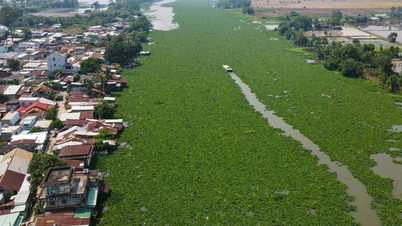
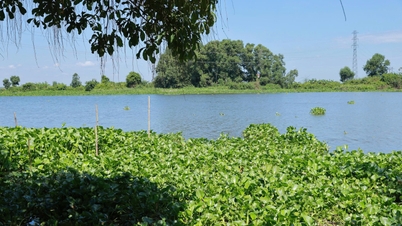
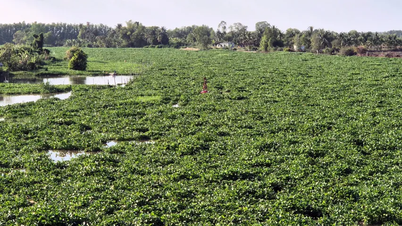
Cultivating and selling water hyacinth is becoming a supplementary occupation for many people in Xa Phien commune, Vinh Thuan Dong commune, Can Tho city. Some households utilize their riverside land to fence off and cultivate water hyacinth, waiting for harvest and drying before selling it. Some rent land to cultivate it, while others work as laborers cutting water hyacinth, providing a stable source of income.

Water hyacinth is considered a plant that helps alleviate poverty for people in rural areas.
Ms. Nguyen Thi Huong from Vinh Thuan Dong commune said: “The land rental price for growing water hyacinth is 2 million VND/hectare/year. Water hyacinth can be harvested after 2-3 months of planting, with a yield of 200-300 kg of dried water hyacinth per hectare per harvest. With careful cultivation, growers can harvest 4-5 times a year. Compared to rice cultivation, water hyacinth cultivation yields similar profits, but at lower costs because it doesn't require as much care. Dried water hyacinth is currently purchased by traders at 15,000 VND/kg, and the market is always favorable.”
Fresh water hyacinth, after being cut, is sorted and then sun-dried for 5 days to dry naturally. Afterward, the villagers bundle it into large bunches and deliver it to businesses or traders. For mature, high-quality water hyacinth, approximately 10 kg of fresh material yields 1 kg of dried fiber; for lower-quality water hyacinth, 13-14 kg of fresh material is needed to produce 1 kg of dried fiber.
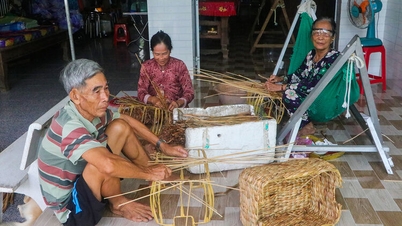
For local unemployed people, cutting fresh water hyacinths earns them 400-500 VND/kg, with those who are diligent earning even more. In addition, skilled individuals can take on weaving projects for handicraft companies and cooperatives, earning a stable income of 3-6 million VND/month – a relatively good standard of living in rural areas.
Ms. Truong Kim Chi from Vinh Thuan Dong commune said: “Before, I only worked in the fields and gardens, and I didn't know what else to do in my free time. But since learning the craft of weaving water hyacinth, I have a job and a stable income of about 6 million VND per month. It was difficult at first, but now that I'm used to it, I can do any design.”
Preserving traditional crafts
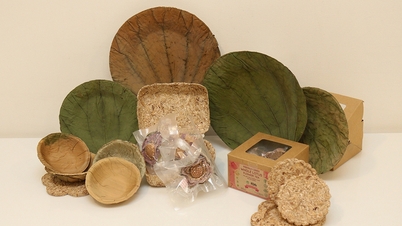
Hau Giang (formerly), now Can Tho city, has many large rivers such as the Cai Lon River, Nuoc Duc River, and Nuoc Trong River... These rivers have a considerable amount of water hyacinth, providing a rich source of fiber from water hyacinth stems for weaving and creating many environmentally friendly handicraft products. According to weaving cooperatives, the length of water hyacinth stems elsewhere usually ranges from 50-60cm, but in these rivers, thanks to the fertile alluvial soil, they are 80-90cm long, uniform in color, and very suitable for making handicrafts.

Handicrafts made from water hyacinth are the culmination of creativity and dedication to preserving traditional crafts.
The water hyacinth weaving cooperative of Mr. Tran Quang Thoai in Vinh Thuan Dong commune currently has 12 official members. The cooperative produces approximately 300 handcrafted products from water hyacinth, generating over 1.5 billion VND in revenue annually. The cooperative has partnered with several companies to create markets for its products, providing employment for 500 unemployed local workers. The cooperative's products are sold domestically and exported. On average, each finished product sells for between 30,000 and 2 million VND, depending on the design: hats, handbags, storage containers, boxes, baskets, decorative items, cabinets, beds, etc.
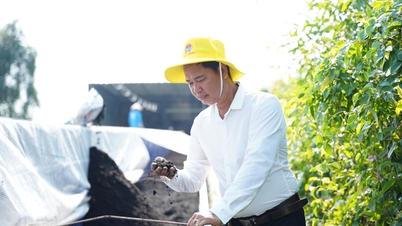
Mr. Tran Quang Thoai, Director of Quang Thoai Water Hyacinth Weaving Cooperative, shared: “Through handcrafted products made from water hyacinth, we hope to convey the message 'Vietnamese people prioritize using Vietnamese goods,' while encouraging green consumption with environmentally friendly products. This is not only a sustainable approach, but also contributes to creating jobs and increasing income for rural workers. We expect our products to be more widely accepted by the market, so that this traditional craft can continue to be preserved and developed.”
Text and photos: MONG TOAN
Source: https://baocantho.com.vn/luc-binh-len-doi--a189380.html

![[Photo] General Secretary and President To Lam presides over a working session with the Central Policy and Strategy Committee on the development of the materials industry.](https://vphoto.vietnam.vn/thumb/1200x675/vietnam/resource/IMAGE/2026/05/21/1779359935432_a3-bnd-3129-1412-jpg.webp)
























































Comment (0)