Later, he was transferred to many units, fighting bravely and courageously. He was captured by the enemy and imprisoned in the hellish solitary confinement area – Cay Dua Prison (Phu Quoc). Upon returning, he fought until the reunification of the country and continued to serve in the army until 1980. Returning to civilian life, the wounded soldier, 2/4 Ngo Minh Tho, continued to achieve success on the economic front...
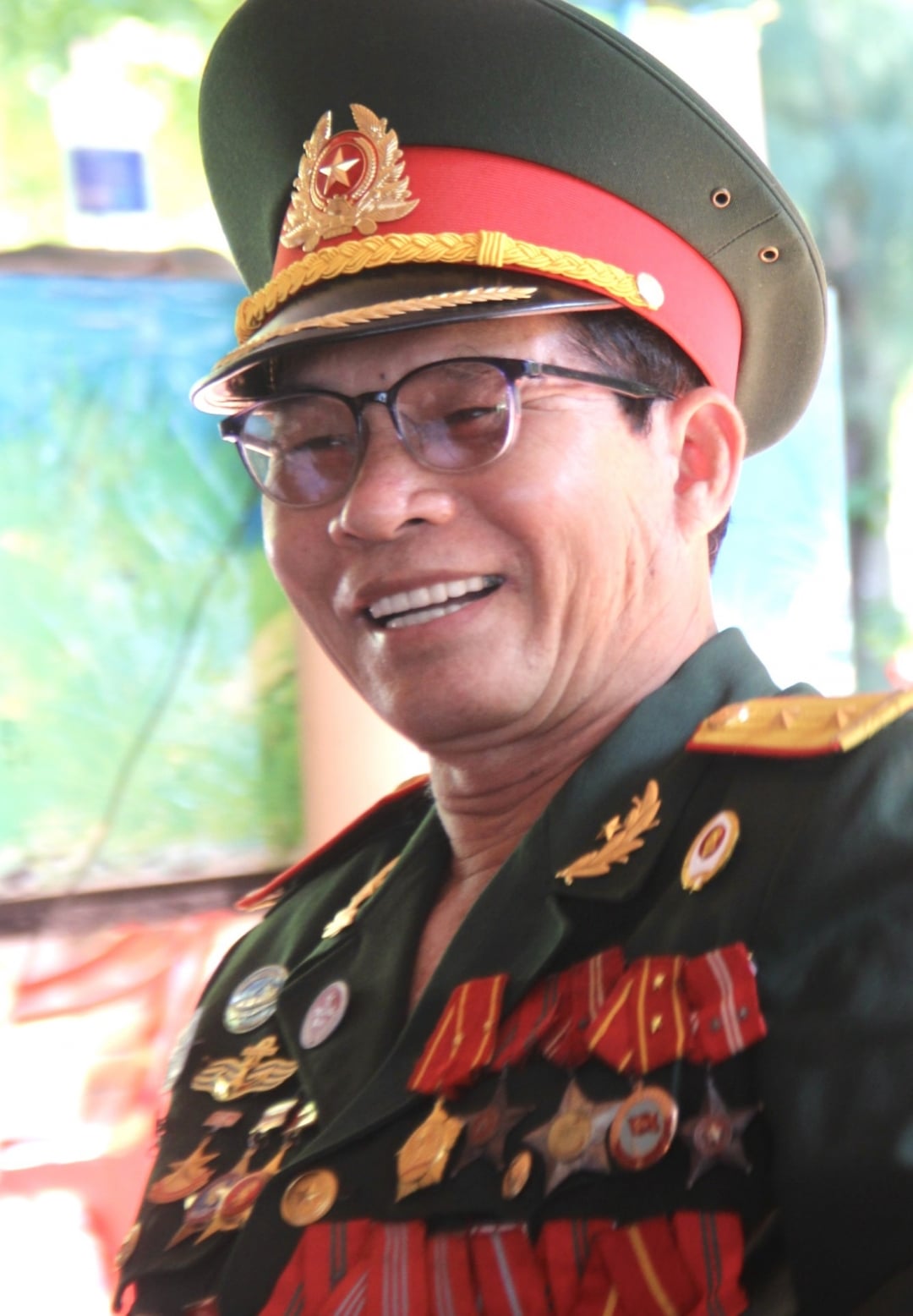
|
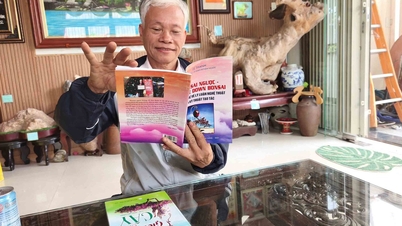
Mr. Ngo Minh Tho. |
At 77, old wounds tormented him, leaving him bedridden and then struggling to use a wheelchair, but his mind remained sharp. He remembered and recounted, completing and publishing a book with many autobiographical and memoir elements, as a vivid memento for himself, his comrades, and future generations about the bloody, steadfast, and indomitable journey of a soldier.
The book "The Soldier Who Departed from Cat Village" was published by Hong Duc Publishing House; the Phu Yen (formerly) Literature and Arts Association and the Vung Ro No-Number Ship Terminal Liaison Committee organized a solemn introduction on the occasion of the 50th anniversary of the Liberation of Southern Vietnam and National Reunification Day, April 30, 2025.
To commemorate the 78th anniversary of the Day of War Invalids and Martyrs (July 27, 1947 - July 27, 2025) this year, war invalid Ngo Minh Tho had the opportunity to reunite with his comrades to present them with books, as a final memento of a soldier who experienced life, bullets, and his youth on fierce battlefields, and also as a source of spiritual strength to help him continue to fight and overcome the illnesses caused by his wounds.
Ngo Minh Tho (1948) was born into a family with a rich tradition of patriotism (his father was a martyr, his older brother was also a martyr) in Cat village - Hoa Hiep, now Hoa Hiep ward, Dak Lak province.
“In February 1964, when there was an order to mobilize young people and guerrillas in Hoa Hiep to join the army to form Company K60 at the Eastern Base, I immediately volunteered. I was assigned to be a liaison for the Command Board of Company K60. Ho Thanh Binh was the Company Commander, Pham An was the Political Commissar , and Nguyen Ngoc Canh was the Deputy Company Commander. In addition to my liaison duties, I participated in protecting the docks and delivering goods to each unit for civilian workers to transport to the rear base warehouse…,” Mr. Tho recalled the years 1964-1965.
The battle against enemy raids to protect the ships and the docks, following the incident where ship 143 was exposed on February 16, 1965, was the first battle for Mr. Tho and the young men from Hoa Hiep commune who had just enlisted in unit K60.
When ship 143 was exposed, enemy aircraft circled and fired rockets directly at Chua Beach, where the ship was camouflaged. At sea, the ship fired its naval guns. In the evening, the enemy fired bright lights, illuminating the area as brightly as day to prevent our troops from moving. On the second day, our troops hid in the rocky outcrops, fighting the enemy, using DKZ 75 and DK 57 guns and mortars to fire back at the enemy ship, preventing the infantry from landing. Many soldiers from the units defending the harbor were wounded by bombing raids.
"I truly admire the life of Ngo Minh Tho - a true soldier of Uncle Ho on the battlefields. At the age of 77, in a wheelchair and on a hospital bed, he remembers and diligently records the memories of his life as a soldier to publish his memoir 'The Soldier Who Left from Cat Village' - as a heartfelt tribute to his comrades and homeland, and as a spiritual legacy for future generations" - Hero of the People's Armed Forces, former captain of the No. 41 ship. |
“On the third day of the battle to defend the harbor, I was wounded in my right leg. Nguyen An carried me to the infirmary at the Eastern Base to get it bandaged. The wound was serious, so I was transferred to the infirmary in Hoa Thinh, then to the Y13 district hospital. During my time there, while receiving treatment, I also learned nursing. After recovering, from 1967 I was transferred to the 30th Special Forces Battalion and immediately distinguished myself, so I was admitted to the Party on October 17, 1967,” Mr. Tho recounted.
One of the most memorable battles of his life was the Battle of Dong Tac Airfield in 1972. This was a major battle involving many units. The 30th Special Forces Battalion was tasked with clearing a path and breaching the barbed wire fences for the infantry to land. At that time, Mr. Tho was the platoon leader of Platoon 3, tasked with spearheading the barbed wire cutting. He and his comrades cut through 5-7 layers of barbed wire, signaled "50" and flashed white lights, and all our firepower—B40s, B41s, and DKZs—opened simultaneously. In this battle, Mr. Tho couldn't retreat in time and was hit by shrapnel in his left thigh and head. Blood gushed out, and after being carried a short distance by his comrades, he fainted. When he woke up, he found himself in a US-backed South Vietnamese hospital.
During the interrogation, Mr. Tho only ever confessed: "I was a civilian worker carrying ammunition." After receiving emergency treatment, the enemy airlifted him to a hospital in Tuy Phuoc (Binh Dinh province) before transferring him to Phu Quoc prison camp.
At Phu Quoc prison camp, Ngo Minh Tho was confined to the C8 isolation area. This was where "hardcore communists" were held. "They beat us at all hours, interrogating us in every way possible. We just told them what we knew. In the 'tiger cage' – a small compartment just big enough for one person to lie in, surrounded by barbed wire – all activities took place inside the 'cage.' The prisoners were handcuffed and shackled. They interrogated and beat us with clubs and electric batons, regardless of whether we lived or died. They were brutal, trying to force us to surrender or defect. But the brothers in the C8 area always remained steadfast," Mr. Tho recalled.
On March 12, 1973, Ngo Minh Tho was released at the Thach Han River (Quang Tri) in the first wave of repatriation. Halfway across the river, Tho and his comrades stripped off their clothes, threw them into the water, and put on their military uniforms. At that moment, everyone felt as if they had returned from the dead, knowing they were alive, as if in a dream. At the end of 1973, Tho returned to Battalion 30 and continued fighting.
After the liberation of South Vietnam and the reunification of the country, Mr. Tho was assigned to be the Battalion Commander of Battalion 8 (Regiment 860), tasked with training new recruits for the Cambodian battlefield. His wounds recurred, and he was discharged from the army in 1980 with the rank of Lieutenant.
Lieutenant Ngo Minh Tho's more than 16 years of combat (1964-1980) have many things to be proud of for his descendants: Second-Class Resistance Medal, Third, Second, and First-Class Liberation Fighter Medal, Military Merit Medal (3 medals), Second-Class Victory Medal, Glorious Soldier Medal…

|
His teammates congratulated Ngo Minh Tho on the release of his memoir. |
Returning to civilian life, he and his wife, Nguyen Thi Hoa, worked various jobs to raise their children: opening a maternity clinic, learning the jewelry trade, opening a gold and silver shop, raising shrimp… Finally, he found his calling in tiger shrimp farming. After 25 years working in shrimp farming from the lower reaches of the Ban Thach River to the lower reaches of the Da Rang River, and throughout the shrimp farming areas of Ninh Tho and Van Tho communes (Khanh Hoa province), Mr. Tho owns several tens of hectares of ponds with river frontage.
Mr. Tho's greatest joy in his later years was publishing his life story and reuniting with his comrades. His three children are now grown up; his two daughters live in Germany and Switzerland, while his son has moved to Singapore and Vietnam to run a business.
Source: https://baodaklak.vn/xa-hoi/202507/ly-ky-cuoc-doi-cua-mot-thuong-binh-10319a2/








































































Comment (0)