

A 39-year-old male patient from Son La province had phimosis since childhood but did not seek treatment. More than a year ago, he developed inflammation and persistent ulcers, along with papules and discolored nodules in the foreskin area. After reading online that the symptoms resembled genital warts, he suspected he had a sexually transmitted disease.
However, instead of going to the hospital for examination and treatment, he self-medicated by applying ointments and remedies suggested by friends. Only when his penis became painful, discharging fluid, and he experienced burning urination did he return to the hospital.
According to Dr. Nguyen Huu Quang, Deputy Head of the Department of Plastic and Reconstructive Surgery at the Central Dermatology Hospital, at the time of admission, the patient's penis was swollen and ulcerated, leading to urinary retention and difficulty urinating.
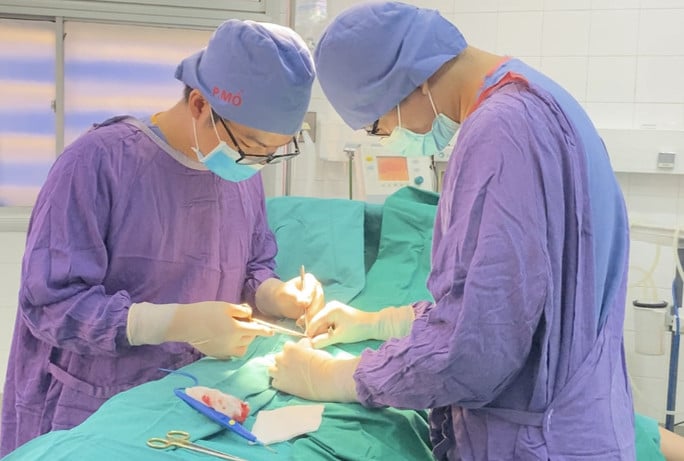
Surgery for patients with penile cancer.
The patient was diagnosed with penile cancer and had inguinal lymph nodes, but because he came in late, the foreskin had already become severely ulcerated. After a biopsy, the doctor was forced to remove part of the penis and drain the lymph nodes.
Dr. Quang said that most patients come to the hospital at a late stage, so most require partial removal of the penis. In the most severe cases, the entire genitalia, including the penis, scrotum, and testicles, must be removed.
For patients who have had part of their penis removed, there will be many obstacles in their normal daily lives as well as in their sexual activities. The loss of the foreskin – a sensitive part that affects sexual function – will reduce pleasure, and urination will be involuntary because the urethral opening can no longer open and close normally.
When the penis is completely removed, the patient will be unable to have normal sexual intercourse and will have to use assisted reproductive methods if they want to have children. Each time they need to urinate, the patient will have to sit or lie face down.
Symptoms of penile cancer manifest as sores, unusual inflammation, foul-smelling discharge or bleeding from the penis or under the foreskin, penile swelling and pain, swollen inguinal lymph nodes, etc.
Thu Hien
Source



































































































Comment (0)