

Forest Garden Coffee Spotlight
Leading us on a tour of his family's coffee plantation, which is over 20 years old, Mr. Le Duc Binh, Director of the Sa Ry Specialty Coffee Cooperative (Xa Ry village, Huong Phung commune), said that despite many years of cultivation, the coffee trees still yield stable productivity thanks to being planted under the shade of jackfruit, rosewood, and other flowering trees, creating natural shade.
According to Mr. Binh, the concept of "forest-grown coffee" has only been around for a few years, but in reality, many households had already been intercropping tall trees to provide shade for their coffee plants before that. Shade trees help retain moisture during the dry season, reduce erosion during the rainy season, and improve soil aeration. Coffee grown under the forest canopy also has a richer, more balanced flavor compared to monoculture. Therefore, Mr. Binh converted 3 hectares of his coffee plantation to organic farming, utilizing agricultural by-products for composting, thus reducing input costs.
 |
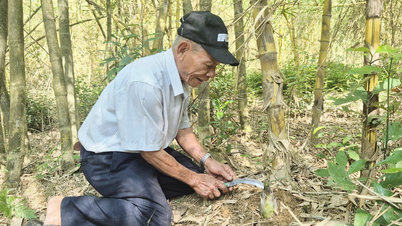
| The agroforestry coffee farming model implemented by the Provincial Agricultural Extension Center in Huong Phung commune - Photo: D.H |
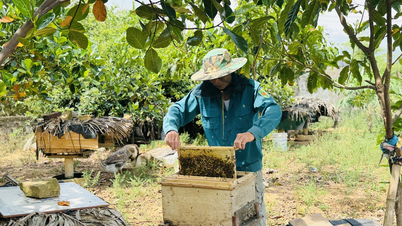
Sharing a common aspiration to recreate a sustainable coffee ecosystem, since 2021, Pun Coffee has initiated a larger-scale model of "bringing the forest to the coffee plantation." Ms. Luong Thi Ngoc Tram, Director of Pun Coffee, stated that instead of maintaining monoculture coffee plantations entirely dependent on seasons and market prices, the company collaborates with farmers to intercrop fruit trees, forestry trees, medicinal plants, and combine this with beekeeping to create a multi-layered ecological structure.
According to Ms. Tram, intercropping not only creates additional income but also retains moisture, reduces erosion, minimizes pests and diseases, restores fertility, and stabilizes productivity. More importantly, the model contributes to changing production mindsets, viewing land and ecosystems as "assets" that need to be preserved long-term. Currently, Pun Coffee has intercropped millions of large timber trees such as red sandalwood, mahogany, and rosewood into its coffee plantations, gradually regenerating the forest. Growers receive support in terms of seedlings, techniques, cultivation logs, and a commitment to purchase their produce at 5,000 VND/kg higher than the market price.
Towards a forest-garden coffee ecosystem.
The entire Huong Phung commune has approximately 2,000 hectares of coffee plantations with over 1,200 households involved in cultivation. From pioneering models, forest-based coffee plantations are gradually forming a new production ecosystem. This spread is supported by various projects, including the "Ecological Coffee Production and Natural Forest Improvement" (PFFP) project implemented by the World Wide Fund for Nature (WWF) in Vietnam and its partners since 2023. After more than two years, the project has provided 50,000 native and fruit tree saplings to households across 620 hectares, bringing the total area of agroforestry coffee plantations in Huong Phung to 870 hectares.
Mr. Phan Ngoc Dong, Deputy Director of the Provincial Agricultural Extension Center, said: With support from WWF, in 2025, the center implemented the PFFP project with models such as building a green corridor with a length of 517m; expanding an anti-encroachment corridor with a length of 850m in Chenh Venh village; building an anti-encroachment corridor with a length of 958m in Xa Ry village... with mixed tree species such as nutmeg, acacia, and jackfruit coffee; implementing an agroforestry coffee model for 4 households in Xa Ry, Doa Cu, and But Viet villages (belonging to Huong Phung commune) with a total area of 5.12 hectares. Currently, the models are growing and developing well and are being closely monitored to assess their impact and effectiveness.
According to Mr. Dong, technically, integrated coffee and forestry farming involves replanning the plantation, removing old, diseased trees, and intercropping with trees with dense canopies. However, if left to people to plant spontaneously, it could lead to situations where some plant densely while others plant sparsely, without proper rows, and people don't know which forestry or fruit trees are suitable. Since the province introduced technical procedures and the impact of several support projects, more and more people have registered to participate.
Building upon the foundation of the developing forest ecosystem, the "bringing the forest to the coffee plantations" initiative has unlocked the potential for developing low-emission coffee products in the province. This is not only an opportunity to enhance the value of Quang Tri coffee beans, but also a prerequisite for the locality to participate more deeply in the carbon credit market, moving towards low-emission agriculture in the area.
Dang Hien
Source: https://baoquangtri.vn/kinh-te/202603/mang-rung-ve-vuon-ca-phe-add311b/
![[Photo] National Assembly Chairman Tran Thanh Man working with the Standing Committee of the Law and Justice Committee](https://vphoto.vietnam.vn/thumb/1200x675/vietnam/resource/IMAGE/2026/05/21/1779378929214_ndo_br_1-4610-jpg.webp)
![[Photo] General Secretary and President To Lam presides over a working session with the Central Policy and Strategy Committee on the development of the materials industry.](https://vphoto.vietnam.vn/thumb/1200x675/vietnam/resource/IMAGE/2026/05/21/1779359935432_a3-bnd-3129-1412-jpg.webp)






























































Comment (0)