

The human eye and brain have mechanisms to self-adjust in a completely new environment, such as another planet, both in terms of color and intensity.
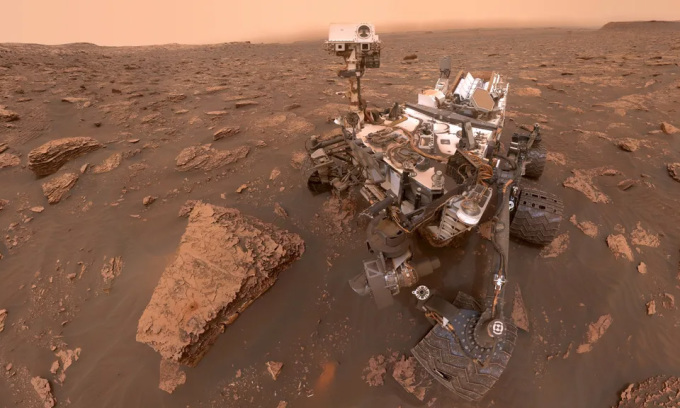
NASA's Curiosity rover takes a selfie on Mars. Photo: NASA/JPL-Caltech
The human brain is very adept at adjusting to different lighting conditions. For example, when wearing tinted sunglasses, the wearer will initially see the color clearly, but after a while, the colors begin to appear "normal" again. This also happens naturally as people age. The lenses of older people's eyes gradually become more yellow than they were in their youth. However, they won't see colors that way because the brain adjusts to the difference.
So how would the brain adjust to color in a completely new environment? Experts offer their opinions on what colors might look like on other planets.
The same mechanism that adjusts to yellowing lenses and colored sunglasses may work when astronauts travel to another planet, according to research by Michael Webster, a cognitive vision scientist at the University of Nevada. Depending on the dominant colors in the new environment, the astronaut's brain will readjust to perceive them more neutrally.
"My prediction is that by the time people get to Mars, the planet will no longer appear red to them over time," Webster said. Instead, Martian terrain will begin to look browner or grayer, and the Martian ochre-colored sky will appear bluer—not the blue of Earth, but significantly less orange than what humans see today.
However, not all alien skies appear bluer over time. This depends on the dominant colors of light passing through the atmosphere compared to the dominant colors of the landscape. Blue is the opposite of orange on the color wheel, so cooler tones might become more prominent as the astronaut's brain gradually moves toward neutrality. But if the astronaut lands on an exoplanet with purple vegetation and a yellow sky, the brain might adjust differently.
The human "filter" isn't limited to color; it also adjusts to intensity. On a planet with a limited natural color palette, the brain becomes accustomed to very subtle changes in hue. Over time, astronauts will see pale colors gradually become more vibrant, and vice versa.
What if, instead of waiting for astronauts' eyes and brains to adapt to a new planet, humans invented an automatic filtration device for that environment? Derya Akkaynak, an engineer and oceanographer at the University of Haifa, and her colleagues at the lab are researching a similar problem. But her research is being conducted with the marine environment instead of space.
Theoretically, knowing the atmospheric and oceanic composition of an exoplanet allows you to predict how light will interact with it. Experts could then use this information to create algorithmic filters that "correct" the colors of the environment. These filters could be installed in the visors of spacesuits.
Before humans actually travel to another planet, it's impossible to know exactly how the process of adjusting the color palette of extraterrestrial life will work. However, deep-sea research may provide a good approximation. Akkaynak once descended to a depth of 30 meters underwater, deep enough to filter out all red light. "Everything looked yellow, not blue, probably because I was trying to compensate for the lack of red. But overall, the sight was crazy," Live Science quoted Akkaynak as saying on September 27.
Thu Thao (According to Live Science )
Source link

![[Photo] Prime Minister Pham Minh Chinh presides over a meeting on private sector economic development.](/_next/image?url=https%3A%2F%2Fvphoto.vietnam.vn%2Fthumb%2F1200x675%2Fvietnam%2Fresource%2FIMAGE%2F2025%2F12%2F20%2F1766237501876_thiet-ke-chua-co-ten-40-png.webp&w=3840&q=75)





























































































Comment (0)