

However, nearshore aquaculture (also known as marine farming) poses challenges to the marine environment and the risk of disease transmission to aquatic life from nearshore waters. To address this issue, Khanh Hoa province has been and will continue to implement various mechanisms and policies to encourage and support the development of offshore aquaculture, promote the marine economy , and ensure livelihoods for coastal residents.
Offshore aquaculture helps protect the marine environment.
Welcoming us, Mr. Vo Van Cong, Deputy Director of the Department of Agriculture and Environment of Khanh Hoa province, enthusiastically said: "In 2025, the total aquatic product output of Khanh Hoa will reach 280,819 tons, of which the output from fishing will reach 239,068 tons, the output from aquaculture will reach 41,751 tons, and the value of aquatic product exports will reach 870 million USD, an increase of 2.9% compared to the same period in 2024; the export value of aquatic products will account for about 37.8% of the province's export value, making Khanh Hoa one of the top 5 aquatic product exporting localities in the country."
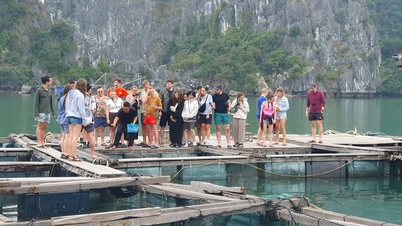
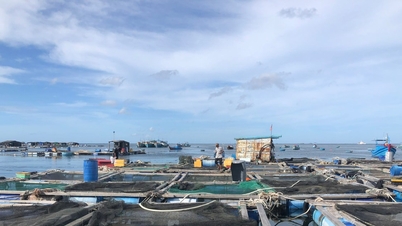
Despite achievements, marine aquaculture in Khanh Hoa is facing challenges and difficulties in sustainable development and adaptation to climate change. Fishermen mainly use traditional, rudimentary cage farming methods, farming near the shore on a small scale, which is causing environmental pollution and safety concerns during the rainy and stormy seasons. Furthermore, the overlapping use of water surface area with the activities of other economic sectors leads to low efficiency and directly impacts marine aquaculture activities.
 |
A model of marine aquaculture in Khanh Hoa province. Photo: NGOC KHANH |
To overcome limitations and unleash the potential of marine aquaculture, the Prime Minister signed Decision No. 231/QD-TTg on January 24, 2025, approving the pilot project for the development of high-tech marine aquaculture in Khanh Hoa. The project aims to develop the province's marine aquaculture industry on an industrial scale, expanding offshore, adapting to climate change, preserving the marine environment, generating high incomes for the people, and ensuring sustainable development. Immediately afterwards, the province implemented pilot models in several areas: Ninh Hoa, Dam Bay, Hon Noi, and Dai Lan.
The high-tech marine aquaculture project aims for two major transformations: from exploitation to aquaculture to reduce pressure on natural aquatic resources; and from traditional inshore, wooden cage farming to high-tech marine aquaculture for sustainable development.
Recently, many high-tech marine aquaculture models using HDPE and FRP (ferrous plastic) cages have been widely implemented in Van Phong, Cam Ranh, Nha Trang, and other areas of Khanh Hoa province. This has helped increase productivity, minimize environmental risks, and improve product quality. Key species such as lobsters, marine fish, and abalone have played a significant role in the province's aquaculture structure and created high added value.
According to Mr. Vo Van Cong, this transition is also not easy because people are accustomed to the old model and long-standing methods of aquaculture. Khanh Hoa province is actively removing legal obstacles, approving aquaculture zone plans, and implementing risk insurance policies to reassure people so they can confidently go out to sea for aquaculture and develop the marine economy.
The inevitable trend of marine aquaculture.
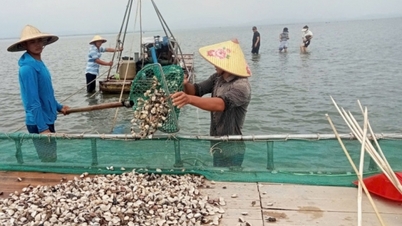
In fact, there have been quite successful offshore aquaculture models in Khanh Hoa province. A prime example is Australis Company, with its approximately 384-hectare offshore sea bass farm using HDPE cages with a circumference of 120m, achieving a yield of 300 tons per cage. Another example is the aquaculture model of the High-Tech Aquaculture Center (Vietnam Academy of Fisheries Science, Ministry of Agriculture and Environment) with yellowfin snapper. This facility operates 42 cages (including 20 round cages with a volume of 2,500m³ /cage and 22 square cages with a volume of 125m³ /cage), yielding approximately 200 tons per year. The current price of yellowfin snapper ranges from 130,000 to 140,000 VND/kg and is considered to have many outstanding advantages, including control over seed sources, feed, and market demand. The Provincial Department of Agriculture and Environment is currently coordinating with local authorities to continue providing financial support for the installation of fish cages for another 70 households in the area. To date, 27 households in Khanh Hoa province have completed the installation and launching of cages, with a total of 12 square cages and 50 round cages.
In addition, units such as Van Phong High-Tech Aquaculture Cooperative, Hon Noi Cam Ranh Aquaculture and Service Cooperative, and Hon Noi High-Tech Aquaculture Cooperative (Cam Lam) are also actively applying HDPE cage technology to adapt to climate change.
Ms. Nguyen Thi Le, former Deputy Head of the Fisheries and Marine Products Sub-Department (Khanh Hoa Provincial Department of Agriculture and Environment), stated: "The inevitable trend for offshore aquaculture is to expand further offshore to protect the coastal marine environment. The benefits of offshore aquaculture are faster and cleaner fish growth and environmental protection. However, not everyone can venture offshore for aquaculture because it requires significantly larger investment capital compared to inshore farming; along with a skilled workforce and well-trained technical staff."
In the coming period, Khanh Hoa province will focus on supporting the development of seafood consumption chains; processing capacity, and creating high value-added products. In particular, the province has been urgently developing and perfecting policies to support and encourage the development of marine aquaculture, including accident insurance policies for workers and policies supporting the conversion of traditional cages to new materials. With such policies and guidelines, it is hoped that in the near future, people and businesses in Khanh Hoa will successfully venture out to sea and engage in marine aquaculture, becoming a shining example for the whole country in the development of the marine economy.
Source: https://www.qdnd.vn/kinh-te/cac-van-de/mo-huong-lam-giau-tu-nuoi-bien-xa-bo-1040736
![[Image] Close-up view of the interchange connecting the two expressways and Long Thanh Airport.](https://vphoto.vietnam.vn/thumb/1200x675/vietnam/resource/IMAGE/2026/05/25/1779703378210_ndo_br_z7863716673926-224453a31600126cce10622af6290afd-4549-jpg.webp)




![[Image] Hanoi's urban life under the challenge of a "scorching hot" environment](https://vphoto.vietnam.vn/thumb/1200x675/vietnam/resource/IMAGE/2026/05/25/1779706979265_nang-nong-t5-2026-minh-duy-7-4636-jpg.webp)












































































Comment (0)