

This was a particularly important and fiercely contested campaign because the enemy reinforced their defenses and urged their soldiers to fight to the death. Here, we used a clever strategy to break through the "steel gate" of Xuan Loc, opening the way for the Ho Chi Minh Campaign. The Xuan Loc Campaign is considered a prime example of the art of using strategic maneuvering to defeat the enemy in the treasury of modern Vietnamese military history.
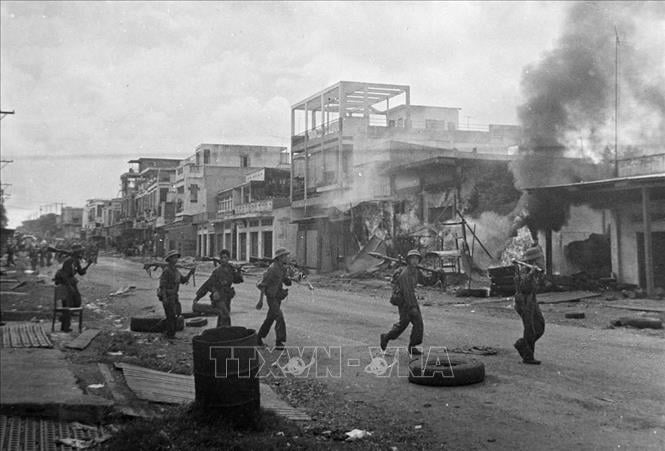
Xuan Loc was a town in Long Khanh province (now part of Dong Nai province), a crucial defensive area in the basic defense line of Saigon (comprising Bien Hoa-Xuan Loc-Ba Ria-Vung Tau). Xuan Loc guarded the eastern entrance to Saigon, with important transportation routes such as National Highway 1, National Highway 20, and National Highway 15; it offered the most favorable route for our troops to advance directly into the inner city of Saigon. This was the most important and best-built defensive line in the entire defense line towards Saigon – the capital of the puppet regime.
Here, the enemy deployed a very strong force with a system of fortified, multi-layered defensive fortifications, including: the 18th Infantry Division, the 8th Regiment/5th Infantry Division, the 3rd Cavalry Brigade (M41, M113, and M48 armored units), two Special Forces battalions, two Artillery battalions (105mm and 155mm artillery batteries), along with police and local militia forces. Reinforcements were ready to be deployed, including the 1st Parachute Brigade, the 81st Airborne Special Forces Group, and all the air force firepower from the Bien Hoa and Tan Son Nhat airfields.
For us, Xuan Loc became one of the important targets on the way to liberating Saigon. We decided to use a portion of the 4th Corps (including the 6th, 7th, and 341st Divisions) in coordination with local troops and the people of Long Khanh province to launch an offensive on Xuan Loc. The Central Military Commission instructed the armed forces of the Southern Liberation Army to quickly crush the enemy's outer defense lines, seize important areas, and create a strategic position and springboard for the main forces to advance into the city center. The urgent telegram dated April 2, 1975, from the Central Military Commission to the Southern Military Commission clearly stated: "An immediate plan is needed to concentrate heavy artillery, some tanks and infantry, taking advantage of the enemy's confusion, eliminate the retreating defeated troops, destroy a portion of the 18th Division, capture Xuan Loc, and approach Bien Hoa. Controlling Bien Hoa airport will render the enemy's air force ineffective, and the enemy in Saigon will be greatly confused."
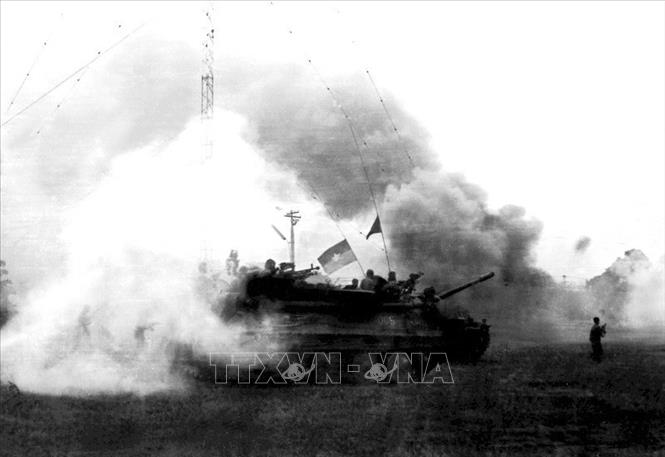
On the morning of April 9, 1975, our troops simultaneously opened fire and attacked selected targets within the town. On the main attack direction (east), the 165th Regiment of the 7th Infantry Division (4th Corps), reinforced with 8 tanks, attacked the enemy's 18th Infantry Division base. Due to fierce enemy resistance, we had to shift our attack to the enemy's 52nd Combat Group's rear base.
On the secondary front (north), the 266th Regiment of the 341st Infantry Division (4th Corps) attacked targets including communications centers, American advisors, police, and security forces... When we attacked the Governor's residence, the enemy concentrated their forces and launched a fierce counterattack.
Meanwhile, on the outer perimeter, the 270th Regiment (341st Infantry Division), in coordination with the 209th Regiment (7th Infantry Division), defeated two battalions from two combat groups (43, 48) that had come from Tan Phong and Thi Mountain to reinforce the enemy, capturing 174 enemy soldiers and liberating Bao Toan hamlet. At the same time, a battalion of local troops from Ba Ria province attacked the enemy at Cat Stream, and the 6th Infantry Division destroyed five outposts on National Highway 1, forcing the 1st Battalion (enemy's 52nd Combat Group) to retreat and defend itself at Dau Giay intersection.
Thus, on the first day, we captured half of the town, the entire sub-district administrative area, brought three battalions inside, and cut Highway 1 at the Dau Giay - Me Bong Con Pass intersection.
In another development, on April 9, 1975, upon discovering signs of enemy troop withdrawal from the islands of the Spratly Archipelago, the General Staff sent an "urgent" telegram to comrades Vo Chi Cong, Chu Huy Man, and Colonel Hoang Huu Thai, Deputy Commander of the Navy in Da Nang : "There is news that the South Vietnamese army is preparing to withdraw from the Spratly Islands. Immediately verify this and instruct our forces to act promptly according to the established plan. If we delay, foreign troops will occupy the islands first, as several foreign countries are currently planning to invade." The order to attack and liberate Song Tu Tay Island was then transmitted to the units participating in the island capture.
On the same day, April 9, 1975, the Party Central Committee issued Circular No. 312-TT/TƯ on disseminating information about the victory and encouraging emulation with the South to achieve many new victories. The circular emphasized: “…The rapid development of the revolution in the South poses many new demands that need to be addressed. The victories in the South are stirring up a fervent revolutionary spirit throughout the country. It is necessary to quickly and widely disseminate news of the victory, and to deeply mobilize political support throughout the Party, the army, and the people, making everyone clearly understand the significance of the victory and their responsibility in the new situation, contributing their greatest efforts to the common revolutionary cause of the nation.”
In the North, the Central Support Council worked urgently. People in the Northwest and Viet Bac regions submitted petitions to the Central Committee requesting a temporary halt to the transportation of goods and food to their localities, in order to focus on providing timely support for the Saigon-Gia Dinh liberation campaign. Factories and enterprises also mobilized 30-50% of their workforce to participate in supporting the battlefield.
---------------------------------
[Source: VNA; Historic Moments of the Ho Chi Minh Campaign, People's Army Publishing House, Hanoi 2005; Historical Events and Figures, People's Army Publishing House, Hanoi, 2015; From the Battles of Phai Khat and Na Ngan to the Ho Chi Minh Campaign, People's Army Publishing House, Hanoi 2024]
VNA
Source: https://baohanam.com.vn/chinh-polit/ngay-9-4-1975-mo-man-chien-dich-xuan-loc-155989.html
























































































Comment (0)