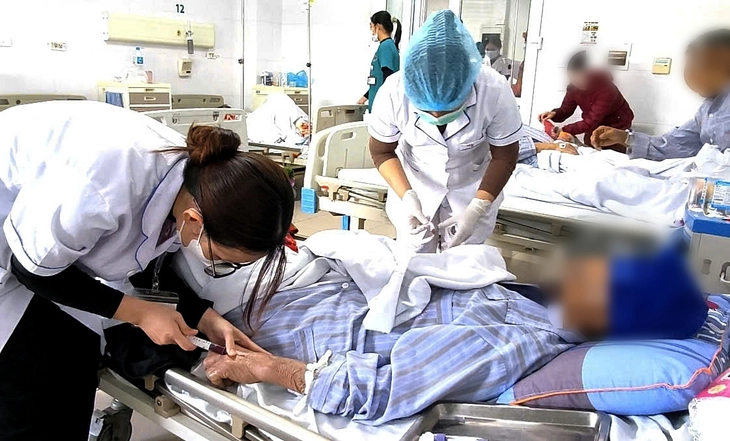
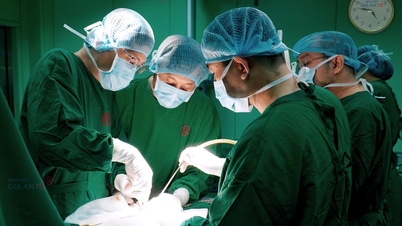
Doctors and nurses caring for patients - Photo: Hospital provided.
On November 28th, the Central Hospital for Tropical Diseases ( Hanoi ) announced that it had recently admitted a male patient with neurosyphilis for treatment.
The patient is Mr. NBĐ (65 years old, Hanoi). Two months ago, he suddenly experienced headaches, pain in both eye sockets, and blurred vision.
His family took him to an ophthalmology hospital, where doctors suspected an infection and transferred him to a specialized hospital for treatment.
The examination results showed that he had neurosyphilis, meningitis, and uveitis. After a month of treatment with no improvement in symptoms, he requested a transfer to the National Hospital for Tropical Diseases.
At the hospital's infectious disease department, Dr. Kim Ngoc Hao stated that the patient was admitted in a state of shock, with severe headaches and blurred vision. Tests confirmed he was positive for Treponema pallidum, the bacteria that causes syphilis.
The patient was diagnosed with syphilis-induced meningitis and type 2 diabetes.
Patient D. is currently receiving antibiotic treatment according to the prescribed protocol and his health has gradually stabilized. However, the treatment process for neurosyphilis is often lengthy and challenging because the Treponema pallidum bacteria can penetrate deep into the central nervous system.
The patient also has underlying type 2 diabetes, which slows down the response to medication and increases the risk of complications.
Furthermore, eye and nerve damage requires close monitoring and continuous medication adjustments to both control infection and minimize long-term effects on vision and neurological function.
Therefore, patients need to strictly adhere to the treatment regimen and receive comprehensive, multidisciplinary care throughout the treatment process.
Dr. Nguyen Kim Thu, Head of the General Infectious Diseases Department at the hospital, added that neurosyphilis is one of the severe manifestations of syphilis.
Syphilis is an infectious disease caused by the bacterium Treponema pallidum. It is transmitted through unsafe sexual contact, blood transfusions, and from mother to child.
Syphilis progresses through three stages: the latent stage, the stage where skin and mucous membrane lesions appear, and the stage where the spirochetes have invaded and colonized the internal organs.
When the bacteria Treponema pallidum attack the brain or spinal cord, they damage the central nervous system, leading to many dangerous symptoms that impair health and quality of life, and can even be life-threatening if not treated promptly. Neurosyphilis occurs in stage 3 of syphilis.
Ways to prevent syphilis
To reduce the risk of disease and avoid dangerous complications, doctors recommend that everyone maintain a safe sexual lifestyle, always use condoms during sexual intercourse, be faithful to one partner, and not share personal items that may be contaminated with bodily fluids.
Alcohol and stimulants should be limited to avoid unsafe sexual practices; pregnant women who are diagnosed with syphilis should immediately inform their doctor for guidance on treatment and prevention of transmission to the child.
Everyone should have a health check-up every six months or as scheduled by their doctor, combined with a healthy diet and regular exercise to boost immunity. Even after treatment, the risk of reinfection still exists, so patients need to strictly adhere to the treatment regimen and preventive measures.
If you experience suspicious symptoms or have had high-risk exposure, go to the hospital for testing and inform your partner so they can also be screened, to prevent the disease from progressing to neurosyphilis.
WILLOW
Source: https://tuoitre.vn/mo-mat-dot-ngot-vi-mac-giang-mai-than-kinh-20251128143022778.htm



![[Photo] The heat at the fireworks display site on the opening night of the Da Nang International Fireworks Festival 2026](https://vphoto.vietnam.vn/thumb/1200x675/vietnam/resource/IMAGE/2026/05/27/1779889741485_ndo_br_z7872039145157-fecaba5112f39e8352544099d7ef4738-5140-jpg.webp)
![[Photo] The courage of new recruits of Brigade 144 on the training ground.](https://vphoto.vietnam.vn/thumb/1200x675/vietnam/resource/IMAGE/2026/05/27/1779881651341_anh-man-hinh-2026-05-27-luc-18-32-52.png)

























































![[Photo] The courage of new recruits of Brigade 144 on the training ground.](https://vphoto.vietnam.vn/thumb/402x226/vietnam/resource/IMAGE/2026/05/27/1779881651341_anh-man-hinh-2026-05-27-luc-18-32-52.png)





























Comment (0)