

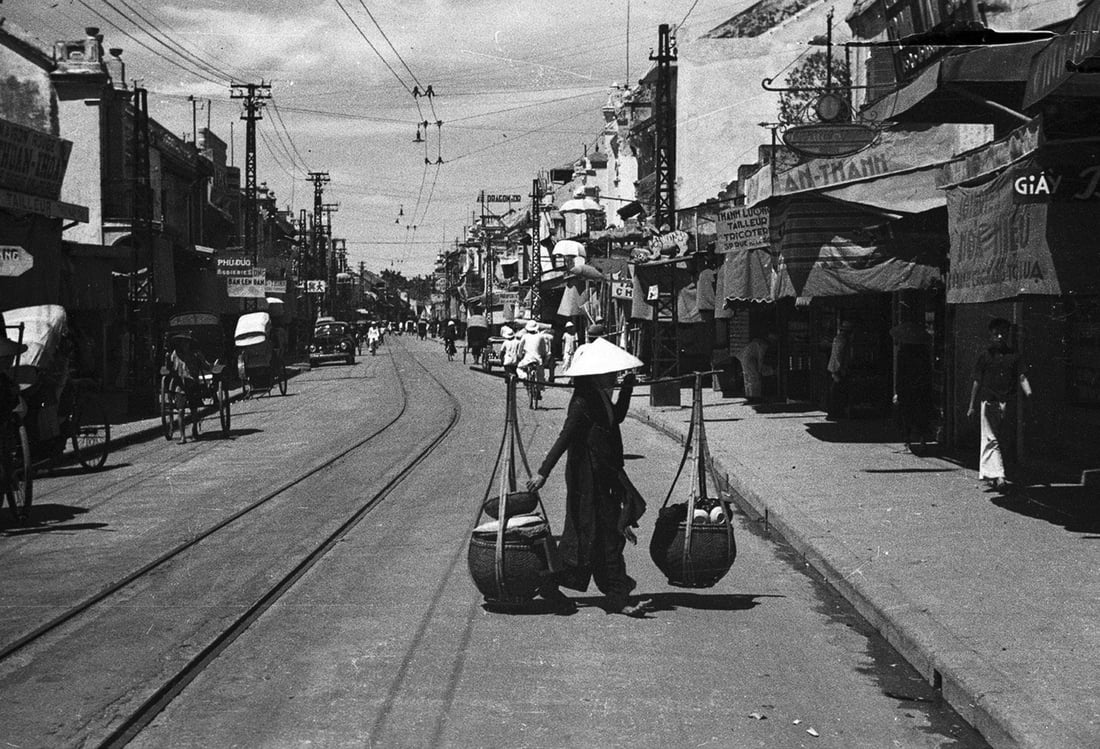
A street vendor selling snail noodle soup walks past Hang Dao Street, 1940. Photo: Harrison Forman
After observing for a while, you'll notice that people tend to choose either dishes that are just the "solids" or dishes that have both the "solids" and the "liquid." This is how Hanoi cuisine has developed a dualistic system: dry dishes and wet dishes.
Located at the crossroads of chopstick and finger-eating cultures, Vietnam boasts a diverse culinary tradition. As a melting pot of centuries-old customs, Hanoi is a vibrant center that exemplifies this, evident in both its street food stalls and traditional banquets.
While meals are typically eaten with chopsticks, drinking establishments often prefer using "five pieces" (a Vietnamese idiom meaning "five pieces of paper"), both to hold a glass of draft beer or wine, and to nibble on boiled peanuts, fermented pork sausage, or seasoned pork sausage wrapped in fig leaves and dipped in spicy fish sauce.
Ordering dishes: dry guy, wet girl
Typically, wet dishes, such as vermicelli, pho, or rice noodles, or sticky, runny cakes like banh gio (pork sausage), or crispy fried dishes in oil or fat that need to be picked up and dipped into a sweet and sour sauce like banh goi (pillow-shaped dumplings) or banh tom (shrimp cakes), are served with chopsticks or a spoon.
However, dry dishes like sticky rice can also be eaten with a spoon, while the fermented pork rolls from Bui village ( Bac Ninh ) or Phung village (Dan Phuong) are more convenient to eat with chopsticks or wrapped in fig leaves. Therefore, saying whether to eat with chopsticks or with your hands when enjoying Hanoi's delicacies is not a clear distinction; in reality, it's very flexible.
However, the distinction between dry and wet dishes primarily stems from the soil and climate conditions. The weather in the Northern Delta region is hot and humid, with an abundance of green vegetables, so the wet dishes, originating from vegetable soups, have a cooling effect.

A pho stall on the sidewalk in 1905.
Wet dishes are also a result of lifestyles associated with rice paddies and the dense network of ponds, lakes, and rivers in the natural environment.
Homemade dishes may be simple, but when served in restaurants, they are often expected to be prepared through a lengthy process involving multiple steps, from simmering bones to making broth, all to reach the goal of a steaming hot dish served in a deep bowl, suitable for gatherings or enjoying on the spot.
Dried foods are convenient to carry and store, making them suitable for busy lifestyles or travel. For example, sticky rice for breakfast, or rice balls for lunch, and now they're even available in restaurants where you can eat in.
Dried, shredded snacks like pork ear salad, pork skin mixed with roasted rice powder, fermented pork sausage peeled from leaves or fried or grilled, dried squid, grilled dried fish, and various types of roasted peanuts with basil, boiled peanuts, all become accompaniments to drinks like beer and wine, giving rise to the familiar phrase "beer with peanuts".
Roasted peanuts with basil, originally from the Chinese, have become a popular snack for several decades, with stalls lining a long stretch of Ba Trieu Street, all bearing the name "Mrs. Van," to the point that people jokingly suggest renaming it "Mrs. Van Street." Despite being absolutely dry, it's a perfect complement to masculine drinks like beer and liquor, thus giving rise to a somewhat suggestive term like "beer-hugging."
Generally speaking, however, the balance between dry and wet dishes is a skillful aspect of street food menus, often reflecting the culinary artistry of the home cook.
People don't like mushy, watery, "nationwide" dishes (wise people eat the solids, foolish people eat the broth; "solids" here refers to meat, vegetables, and other things that can be picked up from a bowl of soup), nor can they stomach dishes that are "dry and tasteless."
Hanoians are also fond of discussing food. To truly enjoy a meal, you have to accept the complex vocabulary that Hanoians use when describing their dishes.
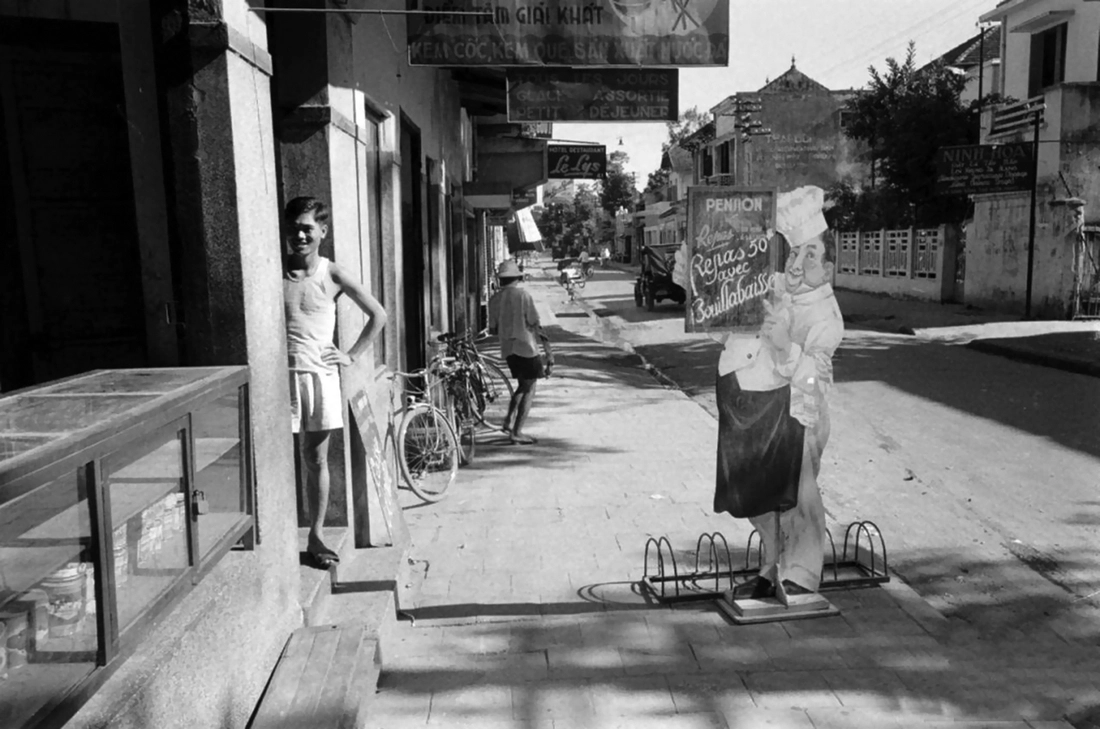
A restaurant with a sign in French in Hanoi in 1954 - Photo: Howard Sochurek
Soup dishes: When you think of Hanoi, you think of Pho.
The top choice for noodle dishes is undoubtedly pho. Except for a few people who don't like pho, when Hanoians think of breakfast, a bowl of pho is usually one of the first options.
Pho, especially beef pho, is a demanding "mayor" of Hanoi's culinary scene. The meticulous effort and dedication put into preparing the broth accounts for two-thirds of a pho's success; sometimes, a bowl of pho can be made edible without any preparation, all thanks to a delicious broth.
To digress a bit, "driverless pho" is a term that originated during the war, referring to pho without meat, only broth made from simmering bones (sometimes flavored with pho seasoning cubes) and rice noodles, sometimes even poured over leftover rice.
"Unmanned" borrows the name from the American reconnaissance planes in the skies over Hanoi, which coincidentally already had a brand name called "Airplane Pho" because there was a pho vendor who wore an airplane helmet, a type of pilot's helmet with two ear loops that effectively kept him warm in the bitter cold (that airplane pho vendor migrated to the South in 1954).
Returning to the broth, it needs the sweetness from the protein in the beef bone marrow for beef pho, or the delicate sweetness of chicken broth for chicken pho. It also needs a certain saltiness to create a deep, sweet sensation, as well as fat to keep the broth hot for longer and the fragrant aroma of roasted ginger to truly stand out.
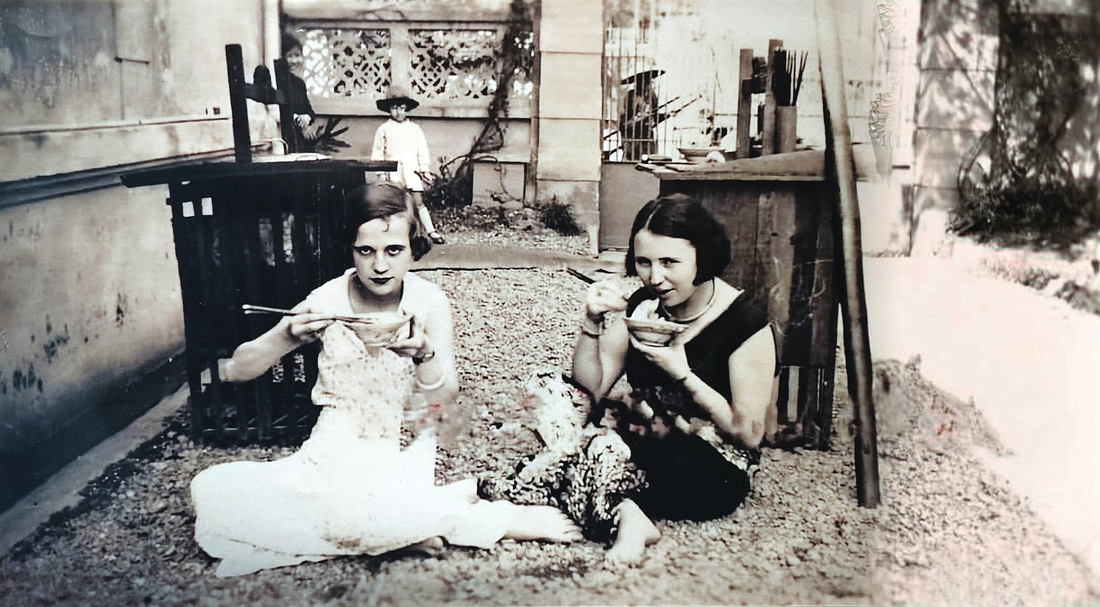
Two French girls eating pho from a street vendor, 1933.
This is how the combination of soft, smooth rice noodles with carefully selected slices of meat (rare beef brisket, flank, tendon, or more elaborate cuts like beef shank, beef tenderloin, or beef stew...) is highlighted, garnished with scallions, chili peppers, black pepper, and various vinegars, garlic, and lime as desired... Meanwhile, the broth of rare beef pho has a sweetness derived from stir-fried rare beef with fried garlic, for those who prefer a rich, savory flavor.
To offer a refreshing alternative to pho, people have a well-stocked list of noodle dishes, each with its own unique broth.
The milder version includes dishes made with chicken such as pho or chicken vermicelli, but to break that mildness, there's bun thang, a type of noodle soup made with chicken broth and sea worms (which can be replaced with dried squid), with shredded chicken thigh or breast, pork sausage, and shredded omelet, plus pickled radish (ca la thau), shrimp paste, coriander, and especially a spoonful of shrimp paste to enhance the flavor.
Sometimes, half a salted egg is added for extra flavor, but above all, the delicate taste must be preserved.
For a richer, more flavorful option, there are various broths made from pork. The most stable dish is bun bung, a noodle soup made with pork ribs, trotters, leg meat, tongue, and meatballs along with taro stems. The broth has a rich, sweet flavor mixed with the sourness of fermented rice vinegar, and a hint of the pungent taste of coriander leaves. Of course, some people go to bun bung restaurants just to eat the tender braised trotters dipped in soy sauce while drinking wine.
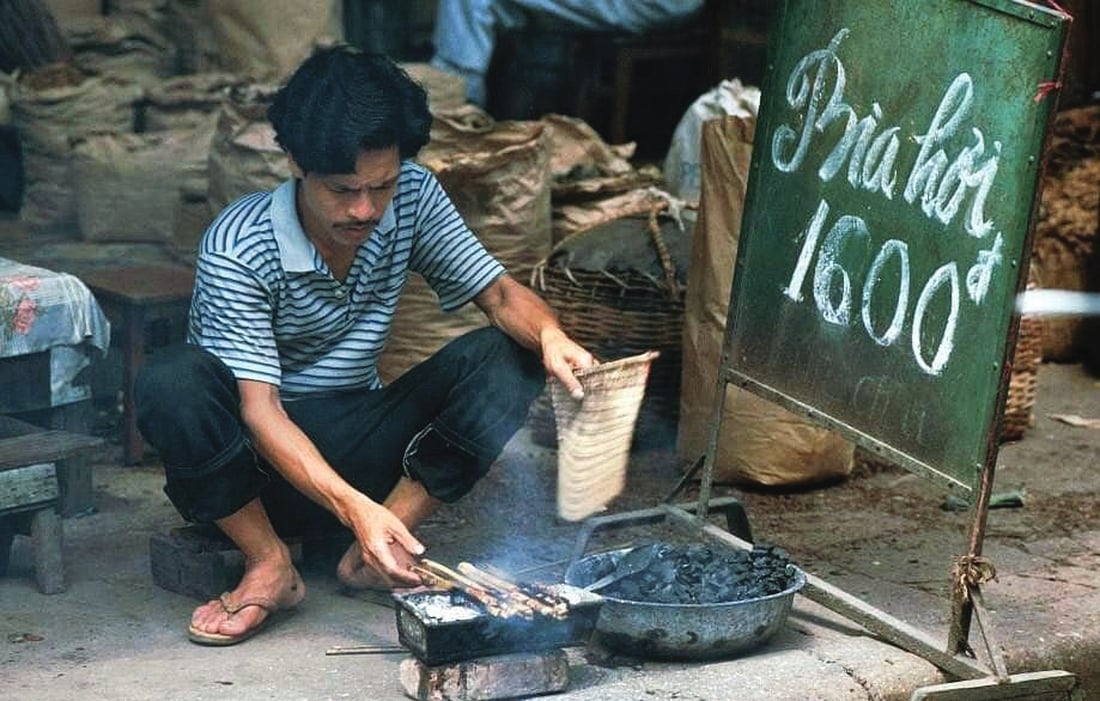
Draft beer and grilled pork skewers, 1991 - Photo: Hans-Peter Grumpe
When talking about noodle dishes in Hanoi, one must mention snail noodle soup and crab noodle soup. These two dishes involve aquatic creatures found in ponds, lakes, and rice paddies – snails and freshwater crabs, which are now often raised in cement tanks to increase production and meet the culinary demands of city dwellers.
To counteract the fishy taste and muddy smell of bottom-dwelling creatures, the broth for snail noodle soup and crab noodle soup often has a sour taste from fermented vinegar and tomatoes, along with the pungent aroma and slightly bitter taste of fried shallots in rendered fat, sometimes with added dried onions as a topping.
Of course, the snails must be delicious, preferably the large and small varieties like apple snails and rice snails, and the crab roe must be fragrant and rich, so that the broth becomes a vibrant symphony of countryside flavors in the city.
Hot snail noodle soup is actually a later version than cold snail noodle soup. The ingredients are very simple: coin-shaped noodles (small, flat, round noodles about three centimeters in diameter), served with boiled snails, dipped in a sauce made from a mixture of fermented vinegar, seasoned snail broth, and chili paste.
The balance of sweet and sour here must be perfectly balanced, with a hint of spiciness and coolness, highlighting the crispness and subtle, slightly fishy taste of the snails, which have been skillfully cleaned, with their heads and bodies containing the intact, golden-brown waxy flesh.
In Hanoi, the number of places that serve delicious cold snail noodle soup can be counted on the fingers of one hand. This dish is a wet dish, and in fact, it doesn't require much broth, but preparing the broth is quite elaborate. Perhaps that's why this cooling dish has a large following among women.

Advertisements for Asia Restaurant on Hang Bong Street, Zephyr ice cream on Francis Garnier Avenue (now Dinh Tien Hoang Street), and Sam Son Wine House on Hang Da Street, painted by artist Hoang Lap Ngon, 1941.
The army was half wet, half dry.
Bun cha, a noodle dish made with pork, is a wet dish but is not served with broth; it's the most famous street food after pho, thanks to the intoxicating aroma of grilled pork patties being fanned enthusiastically during lunchtime.
In the past, people had to keep the fire burning by fanning it over a charcoal stove (a type of stove with small, burning charcoal), a practice so famous that "fanning the fire" became a figurative term for the style of guitar playing used by young men in the city to impress girls.
The dipping sauce for bun cha is made from good quality fish sauce, and it must have a balance of sour, spicy, salty, and sweet flavors (besides the sourness, which is the most important, it must be slightly sweet and not too salty, but rather mild enough to be sipped).
The dipping sauce, much like a soup, contains grilled pork slices (pork patties) and minced pork patties, marinated with spices and onions. Grilling them over charcoal releases the protein molecules in the pork, and thinly sliced papaya and carrots are added to create a rich and fragrant broth. When eating, people add finely chopped chili and garlic, enhancing the flavor of the sauce to a full and intense level before even considering the deliciousness of the pork patties themselves.
Dishes that seem dry, like vermicelli with tofu and shrimp paste or fish cakes, are, of course, only dipped in shrimp paste. Tofu from Mo village or catfish from Viet Tri have been praised ever since the girls from Ke Mo (Tuong Mai, Mai Dong) sold Mo tofu to eat with vermicelli from Tu Ky and Phu Do, dipped in shrimp paste from Thanh Hoa and Nghe An. Or since the La Vong fish cake restaurant on Hang Son street in the late 19th century gave the street its new name, Cha Ca (Fish Cake), many restaurants have continued to transform this dish into a Hanoi specialty.
Shrimp paste pairs well with grilled and fried dishes; its fermented, salty, and fishy flavor neutralizes the richness of grilled fish and crispy fried tofu. The simplicity of the dish's texture has won over a wide audience, both Western and Eastern.
Among the wet dishes, there are also wonton noodles brought by the Chinese, crab rice noodles from Hai Phong, and fish noodle soup bearing the mark of the Son Nam region from Phu Ly down to Ninh Binh. The broth of these dishes has a rich seafood flavor, and the accompanying vegetables are quite abundant, from cabbage to celery.
Meanwhile, noodle dishes like duck noodle soup and eel noodle soup are quite simple in terms of vegetables. Duck noodle soup is served with bamboo shoots, a vegetable that pairs best with duck or goose meat, creating a rich, sweet flavor from the broth combined with the slightly tangy taste of the sour bamboo shoots.
Eel noodle soup is made simply by simmering eel bones, seasoned with fried onions and coriander, creating a deep sweetness and a subtle hint of the fishy taste of the riverine region, often mentioned as originating from Nghe An province, the most famous eel farming area.

Some sketches of street vendors and musical notations of their calls in Hanoi, created by Fénis and painted by students of the Indochina School of Fine Arts, 1927-1929.
Dried food: The power of versatility
There's an entire area in Thanh Tri, south of Hanoi, that produces a type of pre-made rice roll, lightly topped with fried onions, then left to cool. These rolls are usually carried in baskets by young women who sell them. When a customer orders, the seller flips them over and peels each sheet onto a plate.
Diners would dip the rice rolls in diluted fish sauce along with a few pieces of cinnamon-flavored pork sausage from Ước Lễ village in Thanh Oai district. Now, rice rolls filled with minced meat and wood ear mushrooms, originating from Lạng Sơn, and pork fat sausage have dominated the taste of city dwellers.
The dry dishes are sticky rice and cakes. Hanoi sticky rice is a empire challenging the dominance of the pho, bun, and mi kingdoms. The habit of eating sticky rice to fill you up in the morning is one thing, but the ease of carrying it around and the leisurely act of picking up the rice with your fingers has its own charm, like what's now called "finger food."
Sticky rice with corn and sticky rice with shredded chicken have contributed to the "intangible cultural heritage of Phu Thuong sticky rice making," and sticky rice with peanuts is featured in the nighttime street vendor's cry, "Sticky rice with peanuts and sticky rice cake here!" (some people mistakenly hear it as "I am the sticky rice cake here"). There's also a type of sticky rice that's actually a dessert, namely sticky rice served with sweet rice with areca flower, eaten as an afternoon snack or dessert.
This dish actually has a bit of liquid; the "areca flower" here refers to the golden yellow mung beans sprinkled on top of a bowl of sweet soup made with tapioca starch and rock sugar, resembling tiny areca flowers floating on the surface of the water. When eating, you scoop sticky rice (made with glutinous rice and steamed mung beans) into the sweet soup and eat them together. Even that simple dish requires careful preparation to create a perfect bowl of sticky rice and sweet soup.
By examining the varying degrees of dryness and moisture in familiar dishes, one can see how Hanoi's culinary life contributes to the city's charm. Sophistication often stems from keen sensitivity, and sometimes even cunning, in knowing how to perfectly cater to contemporary tastes.
The soil is one thing, but what's important is the place where people gather, creating a diversity of eating and entertainment styles. However, what's truly important is how Hanoians live with and talk about food; it always surprises outsiders, often leading them to think, "Well, let's join the group." And then, before long, the newcomer also lives and talks about food like everyone else…
Source: https://tuoitre.vn/mon-kho-mon-uot-ha-noi-20260204142034993.htm
![[Photo] National Assembly Chairman Tran Thanh Man working with the Standing Committee of the National Assembly's Delegation Affairs Committee.](https://vphoto.vietnam.vn/thumb/1200x675/vietnam/resource/IMAGE/2026/05/20/1779294340023_ndo_br_1-1691-jpg.webp)
![[Image] "Journey of Hope" promotes the organ and tissue donation movement in Vietnam.](https://vphoto.vietnam.vn/thumb/1200x675/vietnam/resource/IMAGE/2026/05/20/1779294400833_1-8910-jpg.webp)

![[Photo] General Secretary and President To Lam works with the Party Committee of the Ministry of Health on the work of Vietnamese traditional medicine.](https://vphoto.vietnam.vn/thumb/1200x675/vietnam/resource/IMAGE/2026/05/20/1779294323718_a1-bnd-2978-3319-jpg.webp)







































































Comment (0)