

 |
| Springtime in the highlands. Photo: Pham Le Dung |
* Legends of the ancient capital
Ninh Binh province can be divided into two parts: the urbanized area, creating a serene atmosphere on a wide, expansive surface, and the area of historical sites and scenic landscapes, interwoven with history and legend, both captivating and profoundly meaningful.
We ventured deep into the Trang An area – a World Heritage Site of culture and nature, the ancient capital of Hoa Lu, and its ancient caves… The further we went, the more we felt lost in a profound spiritual world of our ancestors, of stories of nation-building and defense. It was a journey through Trang An – Tam Coc – Bich Dong – the ancient capital of Hoa Lu, traversing the caves of the ancient Vietnamese people. Visitors were able to relive stories of kings and people protecting the country, relying on the ruggedness of nature to build their empire, and using love as the foundation for stability and development.
We climbed Mount Ma Yen to look down upon Hoa Lu, where the sacred flag, dating back to the time of the Trung Sisters, was faintly visible, erected beside the sacred Sao Khe River. The Dinh and Le dynasties relied on this ancient capital, following the long river to build their new capital (Thang Long), the birthplace of the nation's enduring development. Visiting the Outer and Inner Citadels, witnessing the ancient structures preserved or restored to their original form centuries ago, we were deeply moved and filled with admiration. It brought back memories of our homeland, with the Tran Bien Temple of Literature and the legends of the Dong Nai River and its forests.
We only had the chance to travel along a short, representative stretch of Ninh Binh, but we could never forget the enduring beauty and vitality of the mountains, rivers, and history, which seemed to live on forever. The strength of the people's spirit, their deep national pride and affection, brought a radiant vitality to nature.
Conversely, the sacred mountains and rivers also elevate human awareness and responsibility. I am truly impressed with Ninh Binh's approach to tourism, where a boatman at Trang An wharf also doubles as a tour guide, recounting in detail stories of the kings' refuges and battles, or stories of revolutionary cadres and soldiers, stories of stalactites hidden deep within the mountains, and stories of migratory birds that fly away and then return…
Besides that, Ninh Binh also has An Tiem Cave, Thung Nham - the kingdom of birds, Cuc Phuong National Park, Bai Dinh Pagoda... The cultural and historical values associated with spirituality are an immense spiritual treasure that ensures that when people come to the ancient capital, to Ninh Binh, they will never forget this land that is the starting point of the majestic Northwest.
* Visiting the capital of the Muong region
We arrived in Hoa Binh after a trip to Truong Sa with the Hoa Binh Provincial Ethnic Arts Troupe's shock troupe. Having joined in the songs, melodies, and dances of the artists, listening to the gongs and flutes alongside the soldiers guarding the islands, we were able to feel the soul of the Muong culture and the beauty of the spirit of the people of Northwest Vietnam.
Arriving in Hoa Binh right during the 30th anniversary of the province's Literature and Arts Association, which also coincided with National Day, we had the opportunity to learn more about the ancient capital of the Muong region and the love of the people here for the revolution and for President Ho Chi Minh.
Located more than 10km from the Hoa Binh Hydroelectric Power Plant on the Da River, after passing the Cun slope on the old Highway 6, Giang Mo village in Binh Thanh commune, Cao Phong district, opens up to a very intimate community tourism model of the Muong people. There, we enjoyed fragrant sticky rice, apple wine, Cao Phong oranges, and listened to ancient songs of the Muong land.
The owner of the stilt house sat by the window, enthusiastically telling us about the Muong New Year and Independence Day. During the Muong New Year, people gather to sing folk songs, exchange New Year greetings, and offer wine… Independence Day, on the other hand, lasts exactly one week, starting from September 2nd. The villagers have a huge feast, all the children and grandchildren rush home, and the red flag with a yellow star flies everywhere in the village…
With 40 stilt houses (households), Giang Mo (or Mo Xa) village can welcome domestic and international tourists for relaxation or to learn about Muong culture. The province has guided the village in establishing a gong and dance troupe of its own people to entertain tourist groups. With a serene and self-assured attitude, the villagers always use sincerity, simplicity, and a warm, enthusiastic way of life to bring peace and tranquility to visitors.
During that brief trip, we "stumbled" upon the true capital of the Muong people at the Muong Cultural Heritage Museum – a private museum owned by artisan Bui Thanh Binh, former Deputy Director of the Hoa Binh Provincial Tourism Company. With a total area of over 4,000 square meters and more than 6,000 artifacts on display, this space recreates aspects of the life, culture, and history of the Muong people, including extremely rare artifacts such as a collection of Muong gongs (over 100 pieces), bronze drums, and the Doi calendar (a bamboo calendar reflecting the entire philosophy of life of the Muong people)... And especially, the unique features of the village chief's house, a golden age and shrouded in mystery, are revealed here…
* Lost in the Primitive Village
Very close to the Tay Tien historical site, Pha Luong peak welcomed us in the biting winter sun, with scattered plum and peach trees in bloom. The cold winter doesn't deter tourists from all over from visiting Hang Tau village, also known as Nguyen Thuy village (Ta So village, Chieng Hac commune, Moc Chau town, Moc Chau district, Son La province). This is also a model of community tourism, deeply rooted in the cultural life of the Thai ethnic group, with unique characteristics: no electricity, no Wi-Fi, no motorized vehicles (except motorbikes to take you to the beginning of the village), and no accommodation services. To stay overnight, you must bring a tent, but that's necessary if you want to enjoy the fresh air and the pristine, picturesque nature, untouched by concrete development.
| The Northwest region is majestic, with its rich history and unique ethnic culture, always brimming with a powerful, latent vitality. The Northwest is a land of jagged rocks, mighty rivers, towering mountains, and deep waterfalls… always inviting, the call of the Northwest people overflowing with love. |
The original village consists of only about 20 stilt houses made of wood and thatch, nestled against the rocky mountainside, scattered across a very green and clean meadow. The young men of the village have probably gone into the forest or are bringing visitors in and out, so from the village gate into the green meadow, we mostly encounter women. These women sit by charcoal stoves, busy baking cakes and potatoes while nimbly embroidering traditional fabrics; some diligently clean the grass; others play with their children by the small stream or among the jagged rocks… This scene evokes a strange sense of peace and tranquility. We were captivated by the smiles on the unadorned faces of these women, the eyes and cheeks of the children, and the children playing happily on the grass…
We lingered until late afternoon, watching the villagers herd their geese, pigs, and chickens back to their stilt houses, and following the teenagers as they led their buffaloes across the meadows. Even the gentle, pure white horses bowed their heads in farewell, but we didn't want to leave. The scenery here was beautiful, "like a paradise" (as writer Le Phuong Lien remarked). The villagers promised to bring us back next month to see the peach blossoms, plum blossoms, and buckwheat flowers covering the hills in spring. We could never forget the plump, juicy livestock grazing in Hang Tau village; the deep green of the distant mountain ranges; nor could we forget the undulating, winding slopes and the figure of a child sitting on a cloud-covered mountain overlooking the plain with its sparkling stream…
Little Mai
Source: https://baodongnai.com.vn/dong-nai-cuoi-tuan/202402/mot-thoang-tay-bac-c0d45de/
![[Image] Hanoi's urban life under the challenge of a "scorching hot" environment](https://vphoto.vietnam.vn/thumb/1200x675/vietnam/resource/IMAGE/2026/05/25/1779706979265_nang-nong-t5-2026-minh-duy-7-4636-jpg.webp)


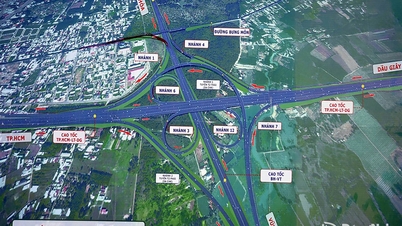
![[Image] Close-up view of the interchange connecting the two expressways and Long Thanh Airport.](https://vphoto.vietnam.vn/thumb/1200x675/vietnam/resource/IMAGE/2026/05/25/1779703378210_ndo_br_z7863716673926-224453a31600126cce10622af6290afd-4549-jpg.webp)




















































































Comment (0)