


Bustling activity on the banks and in the fields.
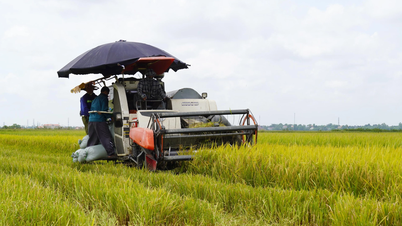
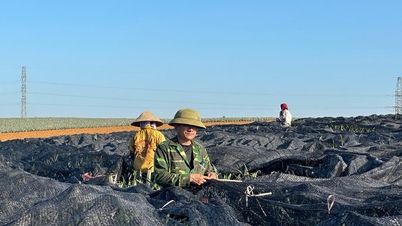
Visiting the lowland villages these days, one can easily spot long lines of trucks waiting on the rural roads to collect fish. On the banks, traders, pond owners, and laborers are busy with ledgers, baskets, and crates, ready to sort, weigh, and sell the fish as soon as they are brought ashore. In the fields, the atmosphere is equally bustling with activity, with dozens of people in protective clothing wading through the water, working together to pull in heavy nets.

For the past 20 years, it has been a tradition for Ms. Vu Thi Yen's family (Doi Chua village, Quynh Luu commune) to start a fish farming season as soon as the winter-spring rice harvest is complete. Ms. Yen shared her secret: after harvesting the rice, she spreads fertilizer to encourage the new rice sprouts to grow, then releases fish and shrimp into the fields so they can utilize the natural food sources of plankton, algae, and new rice sprouts. With 10 hectares of leased land from local farmers, this season she "went big," investing 400 million VND in fry, including freshwater prawns and various types of carp and grass carp.
The results were rewarding. After just the first two fishing trips out of a planned ten, she had already harvested 2-3 quintals of freshwater prawns and 3-4 tons of fish. Yen excitedly calculated that last year, harvesting 10 tons of fish yielded a profit of over 100 million VND. This year, thanks to abundant rain and water resources, the fish are feeding and growing rapidly without needing any feed, so the profit will surely be even higher.

In another rice field, the harvest atmosphere at Mr. Dinh Van Chuyen's family (Quynh Luu commune) was also very lively. Having been anxiously worried about the year's heavy rains causing the ponds to overflow and the fish to swim away, Mr. Chuyen bet: "If the first harvest doesn't yield 5 tons, I'll lose." But then, as the net's arc gradually narrowed, the sound of fish splashing and leaping frantically on the water's surface brought everyone to tears of joy. Mr. Chuyen said that with 9 hectares of water surface and an investment of 500 million VND, including rent, seeds, supplementary feed, and pond embankment repair costs, he expects his family to pocket a profit of nearly 200 million VND after deducting expenses.
From "work for fun, earn for real" to a systematic approach to wealth creation.
The stories of Ms. Yen and Mr. Chuyen are also a common picture of hundreds of households pursuing a model of one rice crop followed by one fish crop in the low-lying areas of Ninh Binh . Talking to those who have been involved with the rice paddies here for many years reveals that the rice-field fish farming industry has undergone a spectacular transformation.
Many locals shared that, in the past, rice paddy fish farming was mostly done spontaneously. People usually just utilized low-lying areas, stocked them with traditional fish species, and left it to nature. But in the last few years, that mindset has completely changed. With close guidance from the Fisheries Sub-Department, from rice paddy improvement and embankment treatment to fish fry selection, farmers have strictly followed technical guidelines.
The most noticeable change is the structure of fish farming. Instead of sticking to traditional fish species, farmers are now boldly introducing high-value economic species into their fields, most notably the giant freshwater prawn. Prawns are more "fussy," requiring more careful care, but their value is many times greater than that of fish, leading to a significant increase in farmers' profits.

However, every profession has its own difficulties. Experienced rice paddy fish farmers often say that this profession is like "gambling with nature." The biggest risk is the unpredictable weather. Just one heavy, prolonged rainstorm, causing the water to rise and overflow the banks, can wash away all the hard work and money. Therefore, alongside the joy of harvesting, farmers always have to worry about reinforcing the dikes and monitoring the water levels. But in return, the greatest benefit of this model is its sustainability. The fish eat clean, grow naturally, and also help clean the fields, eliminate weeds, and make the soil more fertile for the next rice crop.
This year, the joy of fish farmers is doubled thanks to a very favorable market. The fish, raised in a vast natural environment and feeding on clean food, have firm, flavorful meat that is highly sought after by traders. Ms. Hoang Thi Huong, a major trader, confirmed that she has purchased hundreds of tons of fish from this region for distribution to several northern provinces and cities because customers are very fond of them. Prices at the shore are also very encouraging: carp 60,000 VND/kg, black carp 80-100,000 VND/kg, catfish 70,000 VND/kg, and freshwater prawns 280,000 VND/kg...
Besides enriching the pond owners, the rice field fishing season also creates jobs for many local laborers with a remuneration of 400,000 VND per day of harvesting. According to the assessment of the Provincial Fisheries Department, the 2025 rice field fishing season was a comprehensive success. This is considered a model that brings double benefits: it provides economic efficiency many times higher than rice cultivation and protects the ecological environment.
Source: https://baoninhbinh.org.vn/mua-ca-nhay-บน-dong-chiem-251211220507647.html

![[Photo] The heat at the fireworks display site on the opening night of the Da Nang International Fireworks Festival 2026](https://vphoto.vietnam.vn/thumb/1200x675/vietnam/resource/IMAGE/2026/05/27/1779889741485_ndo_br_z7872039145157-fecaba5112f39e8352544099d7ef4738-5140-jpg.webp)

![[Photo] The courage of new recruits of Brigade 144 on the training ground.](https://vphoto.vietnam.vn/thumb/1200x675/vietnam/resource/IMAGE/2026/05/27/1779881651341_anh-man-hinh-2026-05-27-luc-18-32-52.png)















































![[Photo] The courage of new recruits of Brigade 144 on the training ground.](https://vphoto.vietnam.vn/thumb/402x226/vietnam/resource/IMAGE/2026/05/27/1779881651341_anh-man-hinh-2026-05-27-luc-18-32-52.png)






















Comment (0)