


In the past, they followed buffaloes; now they follow machines.
These days, the sound of plows resounds across the fields of Ninh Chau, Truong Ninh, Cam Hong, Le Thuy, Le Ninh, Tan My communes, and other areas. While the plow is tilling the soil of his family's rice field, Mr. Nguyen Huu Cuong (68 years old), from Le Ninh commune, is busy running after the machine, carrying a fishing net and a basket on his back, to catch fish in the rice paddies.
As the "cage" machine runs, the water is pushed to the sides, revealing a layer of bubbling mud where fish, crabs, shrimp, and other aquatic creatures wriggle. At this point, Mr. Cuong simply quickly catches them and puts them into a large container. For larger fish, especially snakehead fish, he has to use a net to catch them before scooping them up.
According to Mr. Cuong, this method of catching freshwater fish has existed since ancient times. Previously, before the advent of machinery, farmers here relied on buffaloes and oxen for plowing and harrowing. In deep fields, they had to pair up buffaloes to have enough strength to pull the plows and harrows. At this time, the water in the fields was drained, and with the vigorous stirring of the soil, the freshwater fish, having nowhere to hide, had to "emerge" from the mud. This was also the time when farmers could most easily catch the fish.
 |
| People in Tan My commune harvest farmed fish during the flood season - Photo: PP |
“In the fields of the former ‘two districts’ ( Quang Ninh and Le Thuy), there used to be an abundance of fish and shrimp. During the plowing season, the fish, especially snakehead fish, were at their peak growth, so they were all plump. After just one morning of ‘chasing the buffalo,’ the amount of fish caught was more than enough to eat, so people would dry them and make fish sauce to eat throughout the year. In the former Le Thuy district, snakehead fish sauce has become a specialty dish, rich in the flavor of the homeland, and anyone who tries it once will remember it forever,” Mr. Cuong shared.
According to Mr. Cuong, over the past 20 years, along with the introduction of mechanization to the fields, farmers have replaced the use of buffaloes for plowing and harrowing with machines for preparing the land for the winter-spring planting season. However, the practice of catching fish in the rice paddies during the "cage" season still persists as a habit, not only to improve their lives but also as a traditional cultural feature of farmers in this low-lying area.
Raising fish during the flood season.
In recent years, due to various reasons, aquatic resources in the fields surrounding Hac Hai lagoon have gradually been depleted. The practice of using cages to catch freshwater fish still exists, but it has somewhat declined due to the low yields. However, farmers in the lagoon area have now grasped the natural patterns of freshwater fish farming during the flood season.
Every year, around the seventh lunar month, heavy rains begin, and floodwaters inundate the Hac Hai lagoon, creating a vast flood season. At this time, the surrounding rice fields are also full of water. Taking advantage of the abandoned, flooded rice paddies, farmers have planned and built dikes, set up nets, and purchased fish fry to raise freshwater fish. Many have even boldly rented land to expand their fish farming area.
Fish raised during the flood season are only kept for about three months because by the 11th lunar month, they must be harvested to return the land in time for the winter-spring crop according to the seasonal schedule. However, raising fish during the flood season, taking advantage of the abundant natural food sources in the rice fields, allows the fish to grow quickly, costs are low, and farmers earn high profits.
In the rice fields of Xuan Bac-Hoa Thuy village (Le Ninh commune), located next to Hac Hai lagoon, during the flood season, the entire field is submerged in a vast expanse of water. For nearly 10 years, farmer Nguyen Cong Ly has leased more than 2 hectares of land to grow rice. In recent years, in addition to growing rice, he has raised the embankments of the fields and enclosed them with nets to raise fish during the flood season, increasing his family's income.
“In the past, the fields were abundant with produce. During the land preparation season for the winter-spring crop, the fields of the ‘two districts’ were like a festival, with the lively sounds of plows, people controlling buffaloes, and shouts as they plowed and harrowed to catch fish and shrimp. Now, the fields are no longer as generous as before. Many human impacts have changed the living environment, and the fish in the fields are gradually depleting, so the tradition of going out with ‘cage’ machines to catch fish is gradually fading away…,” lamented old farmer Nguyen Huu Cuong.
“The end of the summer-autumn rice harvest coincides with heavy rains and rising water levels. This is the time when we begin our short-term fish farming season. Raising fish during the flood season doesn't require feed costs, so the income is quite good. On average, with 2 hectares of rice paddies, my family earns over 60 million VND per farming season after deducting expenses,” Mr. Ly shared.
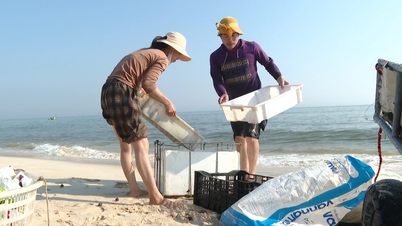
Tan My commune has a decades-long tradition of raising freshwater fish during the flood season. The rice paddies in Tan Hoa, Tan Ha, Tan Ninh villages, and others, cover more than 100 hectares and are currently leased to 40 households for fish farming. These days, farmers here have drained the water, focusing on harvesting the fish and returning the land to the people for the winter-spring rice crop.
While harvesting fish in his rice paddies, farmer Le Xuan Son happily shared: “I and four other brothers bid for 10 hectares of rice paddies to raise fish. At the beginning of the season, we bought fingerlings of various freshwater fish such as grass carp, common carp, crucian carp, and snakehead fish… and released them into the fields. After 3 months of raising them, we harvested them. Because the fish were raised naturally, the meat was delicious and sold at a high price. Grass carp sold for 80,000 VND/kg, while crucian carp and snakehead fish sold for even higher prices, from 80,000 to 100,000 VND/kg. In total, this season, we earned over 300 million VND, and after deducting the cost of fingerlings and land rent, each of us made a profit of over 30 million VND.”
Mr. Tran Duy Hung, Head of the Economic Department of Tan My Commune, said: The model of raising fish in flooded rice fields is developing in the locality, bringing high profits and creating jobs for farmers during the time when the fields are left fallow. Accordingly, each hectare of fish farming, after about 3 months, yields an average income of about 30 million VND.
"Besides economic benefits, raising fish in rice fields also helps to deal with crop residues. Fish eat insects, pests, and weeds that harm rice, and the fish waste helps increase soil fertility, which is beneficial for the next rice crop," Mr. Hung shared.
Phan Phuong
Source: https://baoquangtri.vn/xa-hoi/202601/mua-theo-may-long-di-bat-ca-dong-4770c1e/
![[Photo] Procession of a giant "pig" weighing over 200kg at the La Phu Village Festival](https://vphoto.vietnam.vn/thumb/1200x675/vietnam/resource/IMAGE/2026/03/02/1772444501339_anh-man-hinh-2026-03-02-luc-16-40-20.png)

![[Image] Current situation of houses precariously balanced due to road leveling in Dong Nai.](https://vphoto.vietnam.vn/thumb/1200x675/vietnam/resource/IMAGE/2026/03/02/1772455749144_ndo_br_z7579763955585-6e80a60471e75768fa835d035eba45ea-6979-jpg.webp)






































![[Photo] National Assembly Chairman Tran Thanh Man receives the First Vice President of the Greek Parliament](https://vphoto.vietnam.vn/thumb/402x226/vietnam/resource/IMAGE/2026/03/02/1772444080600_anh-man-hinh-2026-03-02-luc-16-34-09.png)


















Comment (0)