


Officers from the Trung Lý Border Guard Post provided livestock to local people.
Green on barren land
After a project to plant acacia trees more than a decade ago failed to yield the expected results, the question of "what to plant, what to raise" remains a major concern for many villages and hamlets in the border region of the former Muong Lat district. On the high mountain slopes, where arable land is scarce and infertile, many types of crops have been introduced for trial planting only to quietly fail. The people still tend their small, scattered corn and cassava fields, content with just enough to survive each day.
Based on the economic development orientation of the province and district, and through close contact with the local communities, the Provincial Border Guard Command recognized that cassava is suitable for the sloping land in the highlands and can become a cash crop if there is a stable market. From April 2024, border guard posts, in coordination with the Vietnam Cassava Corporation and the former Muong Lat district, implemented a model of high-yield cassava cultivation in border communes, in partnership with Phuc Thinh Agricultural Products and Supplies Processing Joint Stock Company. The model started on the land of the border guard posts themselves, with officers directly planting first to demonstrate to the local people, before expanding it. To date, the area of cassava cultivated by the local people has exceeded 230 hectares, opening up a new direction in the economic development of the highland border region.
We returned to the Mong villages of Ta Com, Canh Cong, and Pa Bua in Trung Ly commune on a morning when thick fog still blanketed the hillsides. On the high-yield cassava fields, the villagers were busy weeding and tilling the soil. More than ten years ago, these hills were still patchy with barren soil, and stunted corn fields clung to the slopes. After each harvest, many families still had to carry corn down to the market to exchange for salt and cooking oil. Major Quan Dinh Thao, Deputy Political Officer of the Trung Ly Border Guard Post, pointed down the hillside and slowly said, "This used to be a corn field. The villagers planted old varieties with low yields. A good harvest provided a little extra feed for livestock; a bad harvest meant poverty." When asked why they hadn't switched crops before, many villagers just shook their heads: they lacked seeds and technical knowledge.
Therefore, when the border guards got involved, they didn't start with lengthy propaganda lectures. From selecting seeds and planting seasons to fertilizing, caring for the plants, and identifying pests and diseases, everything was taught right on the fields. If the villagers were unfamiliar, the officers demonstrated; if the villagers were hesitant, the officers worked alongside them. On days with prolonged mountain rains, when the roads were as slippery as grease, the border guards still carried seedlings and fertilizer up the slopes to the villages. Some even stayed for weeks in stilt houses with bamboo walls, accompanying the villagers to the fields from early morning.
It wasn't easy to convince people right away. In the beginning, many households were hesitant because, for them, cassava was just a secondary crop; they had never thought about growing it for sale or to generate a stable income. But then the results spoke for themselves, dispelling their doubts.
The head of Xa Lung village, Muong Ly commune, Sung Seo Senh, recounted: "Initially, we listened to what the officials said, but we didn't believe it. After trying it out and seeing that we could sell it and earn real money, we told the villagers, and they felt reassured. Now, we not only have enough to eat but also pay off our debts, and we've even managed to save some money thanks to cassava."
The joy is not only felt by the people but also reflects the long-term expectations of the commune's leaders. Mr. Pham Van Son, Secretary of the Party Committee of Muong Ly commune, estimated that the entire commune currently has about 1,000 hectares of cassava in 15 villages, with an average yield of over 20 tons/ha. From a few households experimenting, high-yield cassava is spreading to other villages and then to many neighboring communes. The hillsides that were once planted with corn are now covered with a new green color. Standing in Xa Lung village today, I clearly feel the change, not only in the vast cassava fields before my eyes, but also in the eyes of the people who have found a reliable source of support.
Rising from the mountains and forests
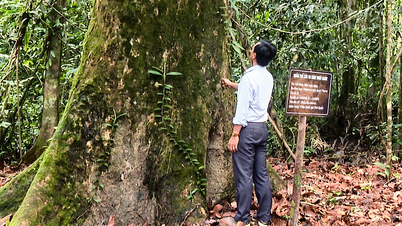
Leaving the cassava fields of Muong Ly and Trung Ly, we followed National Highway 217 to the communes of Tam Lu and Tam Thanh, considered the "capital" of bamboo and rattan. Along the way, convoys of trucks carrying forest products streamed down the mountains, flanked by processing plants with the rumbling of machinery. Yet, even in the heart of this "capital," many households remained trapped in poverty. Exploitation was spontaneous; they cut down trees when there were buyers and sold when there were customers; almost all the young and old trees were harvested. After years of intensive exploitation, many areas degraded, productivity decreased, and the lives of the people remained precarious.
Lieutenant Colonel Le Van Kien, Political Officer of Tam Thanh Border Guard Station, recalled: "Just talking about it is hard for people to believe. To get people to follow suit, officers must go down to the area, work alongside them, and see the results firsthand." Beyond propaganda, border guard officers also work with commune and village officials to guide people in selecting mature bamboo trees for harvesting, clearing undergrowth, and rejuvenating old bamboo groves. Even on days of prolonged rain and slippery slopes, the officers still help the villagers haul bamboo and carry fertilizer over the mountains to care for the newly restored areas.
In Phe village, Tam Thanh commune, Mr. Ha Van Tuyen was clearing weeds under bamboo trees while recounting the changes in his family: "In the past, things like pruning, cleaning, fertilizing, or planting bamboo using cuttings were very unfamiliar. But border guards came down here to guide us, so we understood and followed their instructions."
Mr. Pham Ba Chien, Chairman of the People's Committee of Tam Lu commune, shared: "The most valuable thing is that border guards not only support with seedlings and livestock but also directly go down to the villages to work with the people in developing the economy. Some officers accompany the villagers to the fields and forests for weeks at a time, which makes the people trust and follow them. Thanks to this, many economic models in Tam Lu commune have been able to sustain themselves for a long time."
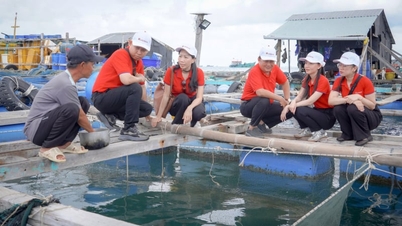
The transformation of border villages today is not limited to bamboo and rattan cultivation. From high-yield cassava farming in Muong Ly and Trung Ly; black pig farming among the Mong ethnic group; to sturgeon farming in cold climate areas... many economic models implemented in coordination with the Thanh Hoa Provincial Border Guard are showing clear effectiveness. Behind the green of cassava, bamboo, and rattan lies a change in the mindset of the people, and the result of the quiet efforts of border guards stationed in these border villages of Thanh Hoa province.
During the period 2015-2025, the Border Guard of Thanh Hoa province implemented 33 models, programs, and movements to help people develop their economy, culture, and society while strengthening national defense and security in border areas. From models of high-yield cassava cultivation and bamboo development to raising black pigs and sturgeon, many models have gradually helped people in border areas change their way of doing business and stabilize their lives. |
Milky Way - Dinh Giang
Final article: A bright future, peace for the people.
Source: https://baothanhhoa.vn/muoi-nam-thap-lua-bien-cuong-bai-2-mua-no-am-289411.htm



![[Image] A brilliant symphony and explosive power in the skies of Da Nang.](https://vphoto.vietnam.vn/thumb/1200x675/vietnam/resource/IMAGE/2026/05/31/1780196945787_anh-man-hinh-2026-05-31-luc-10-08-51.png)
















![[Video] Sunset at Lap An Lagoon – Where the sun sets over the fishing nets](https://vphoto.vietnam.vn/thumb/340x192/vietnam/resource/IMAGE/2026/05/31/1780192137701_beach-landscape-sea-water-nature-grass-745871-pxhere-com.jpeg)







































































Comment (0)