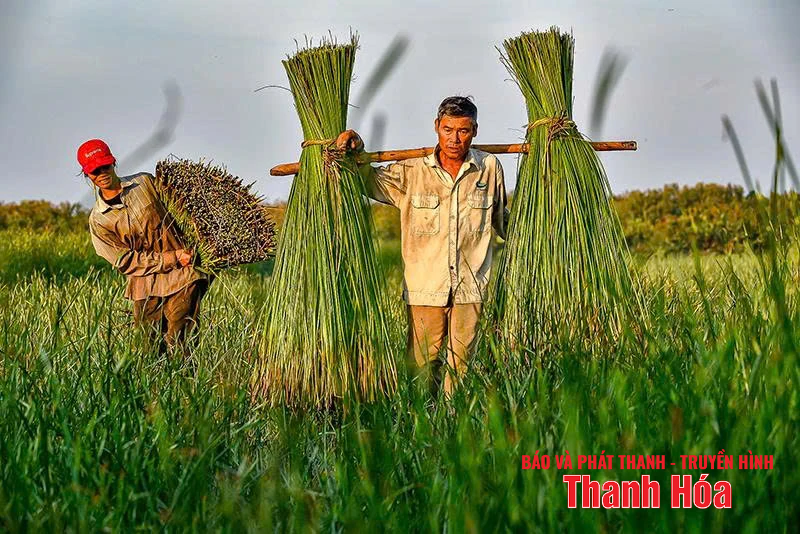
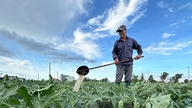
Villagers in Thanh Hoa province harvest sedge under the scorching sun. Photo: Hoang Dong.
Sedge is harvested twice a year, in May and October of the lunar calendar. The first harvest season begins when the scorching sun pours down on the vast green sedge fields in the communes of Quang Chinh, Nga Son, Tan Tien, and Ho Vuong. Farmers diligently cut bundles of sedge under the blazing sun.
Mr. Nguyen Huu Hui from Quang Chinh commune said: "We have to take advantage of the early morning to go to the fields to cut reeds. If we don't cut them early, we can't stand it by 9 o'clock."
Cutting sedge is very hard work, requiring constant bending over, walking backward along each row, and using sharp knives to cut close to the roots. A strong person can cut about 40-50 bundles per hour. After cutting, the sedge must be dried immediately in the field or on a concrete yard for 2-3 consecutive sunny days to be dry enough to sell or be used for weaving.

While sunshine tests endurance, rain is a constant worry for sedge weavers. Prolonged rain prevents the sedge plants from standing upright, making them soft, thin, and short, thus reducing quality. In years with heavy rainfall, the sedge absorbs water, its stems become porous, and when dried, they easily turn black or break into pieces. Long, continuous rains lasting 3-4 days can render an entire sedge field ready for harvest worthless.
Ms. Truong Thi Phuong from Tan Tien commune said: "When it rains, we have to quickly gather the still-wet sedge and bring it home to cover it with tarpaulins and dry it, but it's rarely salvageable. If the sedge turns dark, the weavers won't accept it. Now, many families with large sedge weaving workshops have to spend extra money building concrete yards or covered areas to proactively handle the situation. For households with small sedge cultivation areas and limited capital, it's impossible; if it rains for many days, they just have to give up."
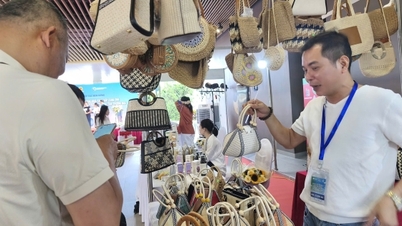
Despite the hard work, the income from sedge cultivation is currently not high, yielding only about 600,000 - 1,000,000 VND per sedge crop. Therefore, young people are gradually leaving the sedge fields. This profession is now mainly practiced by middle-aged and elderly people. To increase the value of sedge and meet consumer demand, companies and cooperatives processing sedge for export have created many unique products from sedge such as brooms, handbags, storage containers, baskets, etc., which are exported to Europe, the US, Japan, South Korea, Singapore , and other countries.
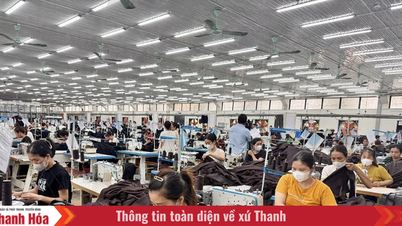
However, the path to elevating the status of sedge weaving still faces many obstacles. The biggest difficulty currently is the shortage of skilled labor. Most young people choose to work as factory workers in industrial zones or switch to other professions with higher incomes. In addition, although the market for sedge handicrafts has expanded, it remains unsustainable and dependent on traders, making producers vulnerable to price manipulation.
In the globalized world, products made from sedge are not merely consumer goods but also carry a cultural story. Each bag, each basket, is a glimpse into the craft village, the hands of the artisans, and the spirit of the Vietnamese people connected to nature. Sedge – the delicate "grass" once associated with the arduous life in the low-lying rice paddies – is now stepping out into the world with its simple, familiar beauty. Elevating sedge through handicraft products is not only a viable economic direction but also a way to preserve and promote traditional values in a new context. From the fields of its homeland to distant international markets, the journey of sedge is opening new doors for Vietnamese agriculture and traditional crafts, provided there is perseverance and love for the craft. Only when farmers not only cultivate sedge but also "design products," and when craft villages not only preserve their craft but also innovate and renew it daily, will sedge truly flourish, and Vietnamese handicrafts truly find their place in the international market.


Phuong Do
Source: https://baothanhhoa.vn/muu-sinh-cung-cay-coi-254536.htm