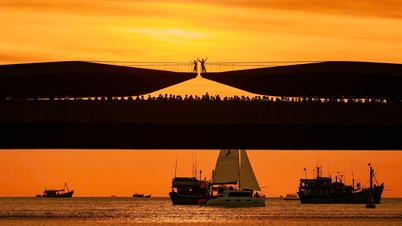
Visitors can visit the Ong Hoang Palace, the ancient Cham tower of Po Sah Inư, or immerse themselves in the life of the fishermen in Mui Ne village.
The Emperor's Pavilion
The Ông Hoàng Pavilion is located on a hill in Phú Hài ward, Phan Thiết city, Bình Thuận province. Visitors arriving in the center of Phan Thiết city should go straight down Nguyễn Thông street and past the slope named after the Ông Hoàng Pavilion. They will then see a sign indicating "Poshanu Tower Relic Site". The Ông Hoàng Pavilion is situated within this tower complex, surrounded by the sea, river, mountains, hills, and a vast area of temples and pagodas.
The Hoàng Palace ruins. Photo: VinWonders
Since 1911, this has been the retreat of the French Duke, De Montpensier. It was one of the most beautiful, comfortable, and modern villas in Vietnam at the time. Beneath the villa was a large rainwater storage cellar, sufficient for a year's use, and a generator for nighttime electricity. The name "Lầu Ông Hoàng" (Royal Mansion) was given by the locals, reflecting the prestige and luxury of the building and the French Duke.
The Emperor's Mansion in the early 20th century. Photo: VinWonders
Several decades later, when the poet Han Mac Tu came here, he left behind his poems. This was also the meeting place of the late poet and Mong Cam. Visitors can enjoy the full view of the sunrise and sunset here.
Po Sah Inu Tower, Pho Hai
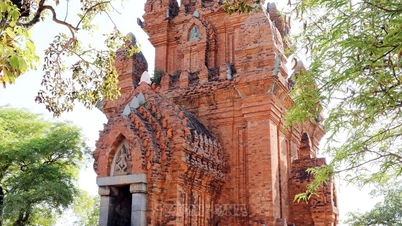
The Pho Hai Cham temple complex, ranging in height from 5 to 15 meters, is located within a 9-hectare area on Ba Nai hill, adjacent to the ruins of Lau Ong Hoang, 7 km from the center of Phan Thiet city. The towers were built in the early 9th century in the Hoa Lai style, bearing the distinct mark of the flourishing period of the Champa kingdom. This was a place of worship for the god Siva. In the 14th century, the Cham people built many temples around the main tower dedicated to Po Sah Inu – traditionally believed to be a princess, daughter of King Parachanh, and older sister of King Po Kathit.
You may also like
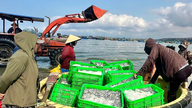
The sea is bountiful, anchovies fill the shore.TP - During the summer months, Mui Ne beach bustles from dawn as boats laden with anchovies arrive one after another. Locals call this the "sea rush" season - a time of abundant fish catches, bringing income to fishermen, traders, and hundreds of coastal workers. When the sea yields its bounty, anchovies blanket the shore, and the entire fishing village comes alive with the hustle and bustle of making a living.
The Katê festival takes place at the Po Sha Inư Cham tower. Photo: Viet Quoc
In 1991, this group of temples and towers was classified as a National Monument by the Ministry of Culture and Information.
Ke Ga Lighthouse
This is the oldest and tallest lighthouse in Indochina, built by the French in 1897, located on Ke Ga Cape, Ham Thuan Nam District, Binh Thuan Province. Approximately 40 km from Phan Thiet city, it's a popular check-in spot for tourists visiting Binh Thuan. To reach the lighthouse, visitors must take a canoe to the island, about 500 meters from the mainland. Round-trip fares range from 30,000 to 50,000 VND per person.
The Kê Gà lighthouse is 35 meters high and was built using materials brought over by the French. The rows of frangipani trees along the entrance were also planted by them in the late 20th century. Next to the lighthouse is a path leading down to a large, strangely shaped rocky area, which the locals call the "rock garden".
Ke Ga Lighthouse. Photo: Hoa Cao
Visitors can come here early in the morning to watch the sunrise or when the sun is high in the sky and the sea becomes clear blue.
Cu Lao Cau
Cu Lao Cau, also known as Hon Cau, is a small island belonging to Tuy Phong district (Binh Thuan province). The island is located approximately 110 km from Phan Thiet city and 240 km from Ho Chi Minh City. Traveling from the mainland to the island requires a boat, larger vessel, or speedboat, which takes about 40 to 50 minutes.
Cu Lao Cau Island is a favorite check-in spot for many tourists. Photo: phuongtet
Visitors can go for a day trip or stay overnight, either independently or by purchasing a tour. The island is uninhabited, has no services, and visitors even need to bring fresh water from the mainland. Here, visitors can check in at Tien Beach, Tien Well, Ba Hon Cave, Love Cave, Ca Suot Beach, and the temple of the God of the South Sea...
Strengthening the friendship between Vietnam and the United States.On July 3rd, as part of the Pacific Partnership - Friends of the Pacific 2026 program, the U.S. Army Pacific delegation, led by Lieutenant General Joel Vowell, Deputy Commander of the U.S. Army Pacific, paid a courtesy visit to the Quang Tri Provincial Military Command.
This place boasts not only luxurious resorts but also a fishing village with a distinct South Central coastal character. Mui Ne fishing village is located about 3 km from the town. Right at the entrance to the village, hundreds of colorful fishing boats are anchored. Not far away is a small market with a peaceful atmosphere.
Boats are anchored in Mui Ne fishing village.
The fishing village stretches only about 100 meters along the coast, but it's where visitors can experience the life of fishermen most vividly. If you visit the fishing village early in the morning, you can buy plenty of fresh seafood as soon as the boats dock.