There are many songs written about rain, but very few about sunshine. The sunshine here is the morning sun, the beautiful sunshine, the kind of sunshine that everyone needs in life... sunshine!
I also have days when I wait for the sun. The song "Sunshine in the Poor Village" by the late composer Pham The My left an indelible mark on me: This is the kind of "sunshine" that a poor village desperately needs, warming the children tending buffaloes, freeing everyone from the worries of rain. The sun peeks out from behind the clouds, flowers and fruits seem to breathe, young shoots sprout, the village awakens... that is the image of villages from bygone years, far from the city, lying silently and desolate but not lonely, peaceful since 1950, where many aspects of village culture were born, and customs and traditions were formed.
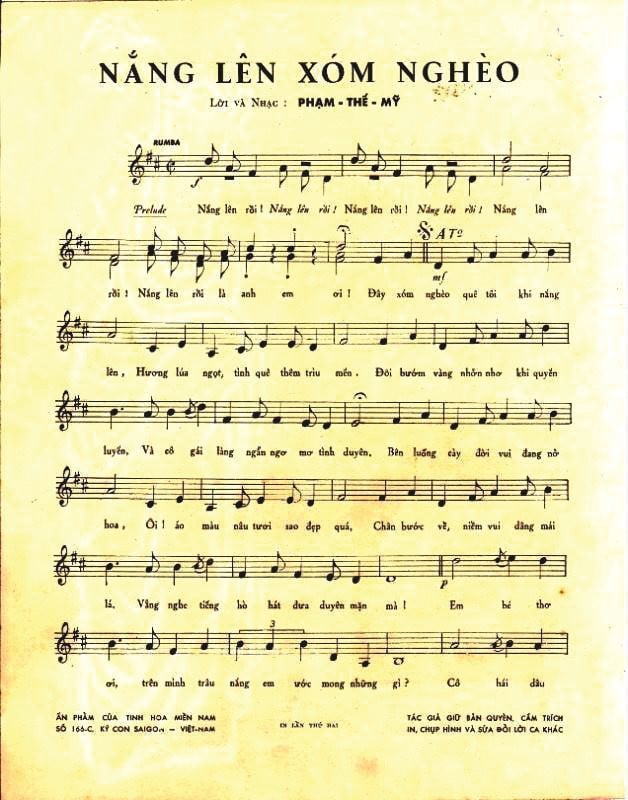
"Sunshine in the Poor Village" has a Rumba melody, but people are used to singing it in Bolero rhythm. There's nothing wrong with that, as it's a habit of "country folk" who love Bolero!
The opening, in the Prélude (opening piece/self-composition): “The sun is up! The sun is up! The sun is up! The sun is up, brothers and sisters!”... Composer Pham The My captures the listener's attention; it seems that the poor village, which had been plagued by gloomy weather and no sunshine for many days, now had the sun and people were shouting: The sun is up!
The song was created in 1950 and published by Tinh Hoa Southern Vietnam. I think you sold the copyright to Tinh Hoa? When I visited you in District 4, I forgot to ask you, and since there aren't many original copies left, I borrowed a photocopy.
"The sun rises over the poor village" is so beautiful! Back then, as now, it would be difficult to find a similar song. Try singing it again, listening again, and try to imagine that poor village where everyone once shared happy moments under the morning sun, watching birds fly back to their nests in the afternoons, studying by lamplight on rainy nights... those years seemed peaceful and tranquil for a lifetime: "Here is my poor village when the sun rises / The sweet scent of rice makes the love of the countryside even more affectionate."
"Two golden butterflies flutter playfully, lingering in the air / And the village girl daydreams of love…" (Sunshine in the Poor Village). And a Boléro… the sunshine of Lam Phương, that is “Beautiful Sunshine of the South,” a love song that touched the hearts of people during wartime: “Here the vast sky, the morning sun peeks over the cliff / Spreading gradually to the green fields…”.
It's also difficult to compare "Sunshine on the Poor Village" and "Beautiful Sunshine of the South." Each poem has its own unique beauty, but both generally feature rice plants. "Sunshine on the Poor Village" is a descriptive piece about a village, while "Beautiful Sunshine of the South" depicts the emotions of a prosperous southern region, illuminated by a dawn that dispels the darkness: "...A thousand shadows of night fade away / The sun rises, shining on life / Our village is now radiant..."
The first compositions of musicians from the post-1954 ceasefire period often focused on rice, and indeed, it was rice-related music that allowed rural people to appreciate music and cherish the rice they cultivated. After peace was restored, both old and new musicians sought out other themes that they considered more appealing and interesting than the poor countryside, the rice, the buffaloes, the fields… some of whom were born there, and who sometimes even "killed off" their hometowns simply because of their… unattractive names.
And there's a song that only features a little bit of sunshine, but it portrays the beauty of rural girls in small villages during wartime: "...There are evenings / When the sun slants down over the mountaintops / The sun shines down on the villages, making the girls' cheeks even more radiant..." (The Way Back to the Small Village - Trinh Hung).


![[Photo] The General Secretary, President and his wife begin their state visit to the Philippines.](https://vphoto.vietnam.vn/thumb/1200x675/vietnam/resource/IMAGE/2026/05/31/1780230559452_anh-man-hinh-2026-05-31-luc-19-28-11.png)
![[Photo] Admire the coral "masterpiece" amidst the million-year-old heritage of Dak Lak province.](https://vphoto.vietnam.vn/thumb/1200x675/vietnam/resource/IMAGE/2026/05/31/1780221235105_anh-man-hinh-2026-05-31-luc-16-53-27.png)

![[Photo] Solemn bathing ceremony and Buddha procession in Hue](https://vphoto.vietnam.vn/thumb/1200x675/vietnam/resource/IMAGE/2026/05/31/1780228263543_1-jpg.webp)









![[Video] Sunset at Lap An Lagoon – Where the sun sets over the fishing nets](https://vphoto.vietnam.vn/thumb/340x192/vietnam/resource/IMAGE/2026/05/31/1780192137701_beach-landscape-sea-water-nature-grass-745871-pxhere-com.jpeg)
































![[Photo] Admire the coral "masterpiece" amidst the million-year-old heritage of Dak Lak province.](https://vphoto.vietnam.vn/thumb/402x226/vietnam/resource/IMAGE/2026/05/31/1780221235105_anh-man-hinh-2026-05-31-luc-16-53-27.png)
































Comment (0)