

Animal husbandry in harmony with nature
During the 2025 flood season, Mr. Pham Van Tuoi, residing in Van Tra hamlet, An Cu commune, released 44,000 snakehead fish fingerlings and 12,000 catfish fingerlings to implement a natural fish farming model during the flood season. This model, implemented by the World Wide Fund for Nature (WWF) in collaboration with the An Cu Commune Farmers' Association, covers an area of 50 hectares.
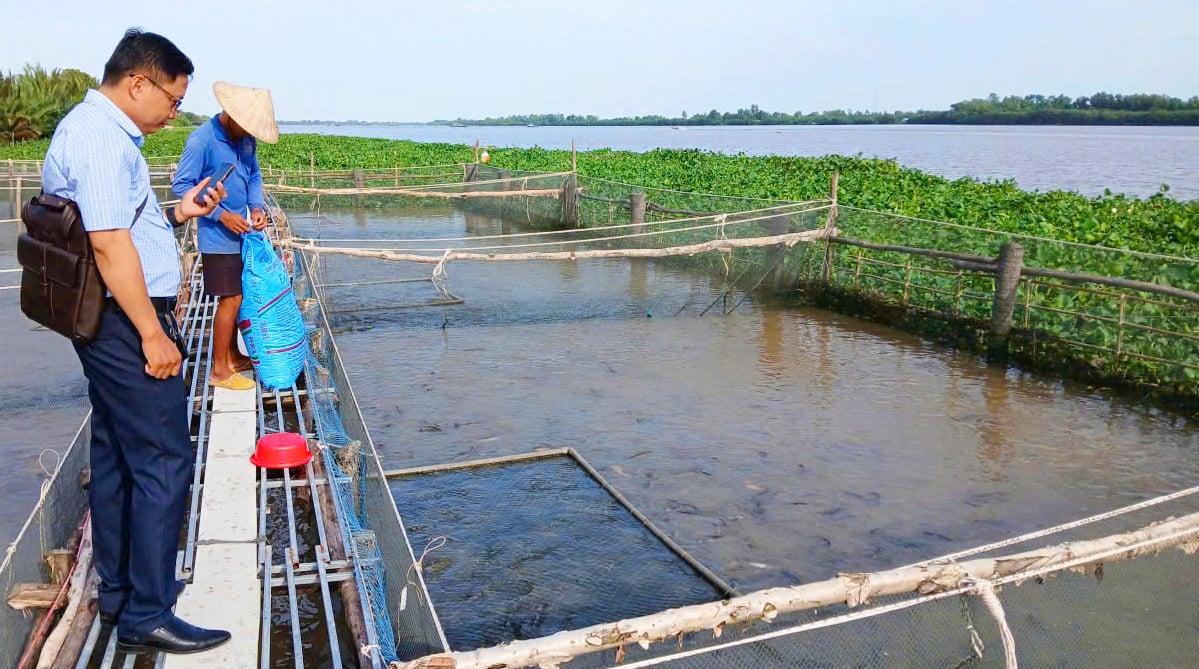
Mr. Duong Van Nhi utilizes the water surface along the Cai Lon River to raise aquatic products. Photo: THANH TIEN
According to Mr. Tuoi, this is the second year he has implemented this model. Last year, due to lack of experience, his profit was less than 20 million VND. However, this profit still brings joy to Mr. Tuoi and the other farmers in the fish farming group. This year, he harvested 850 kg of snakehead fish, earning 36 million VND. It is expected that after harvesting all the fish he is raising, his income will increase further.
Accompanying farmers in implementing the model, Dr. Chau Thi Da - lecturer at Ton Duc Thang University - affirmed that farmers raising fish naturally during the flood season brings many benefits. First, it will create income during the off-season, helping to stabilize farmers' lives. The model also helps regenerate aquatic resources, avoiding indiscriminate exploitation that depletes natural fish stocks.
Also aiming to increase his income, Mr. Duong Van Nhi, residing in Bo Dua hamlet, Vinh Hoa commune, utilizes the water surface along the Cai Lon river to raise aquatic products. Currently, he uses 2,000 m² , with 26 net cages, to raise hybrid catfish, tilapia, snakehead fish, and tilapia. After more than 4 months of raising them, he harvested 6 cages of hybrid catfish, earning 758 million VND, and after deducting expenses, he made a profit of 338 million VND.
Mr. Nhi also utilizes by-products from his family's seafood processing facility as fish feed, helping to reduce investment costs. Currently, the snakehead fish, tilapia, and perch are not yet ready for harvest but are developing well. This model helps diversify aquaculture types, protect natural resources, and serves as a basis for the relevant authorities to develop aquaculture models along the Cai Lon River in the future.
Developing the collective economy
Along with small-scale farming models, farmers in An Giang are also developing cooperatives and livestock farming associations linked to the development of OCOP products. In My Qui hamlet, Vinh Thanh Trung commune, 12 farmers raising snakehead fish fry have formed the My Qui Hamlet Snakehead Fish Fry Farming Cooperative.
Currently, the cooperative raises fish in a total area of 7.5 hectares. With the support of specialized agencies and the Farmers' Association of the commune, members have accumulated experience and applied techniques to improve the quality of fish fry in order to increase profits. Mr. Nguyen Van Phu, a member of the My Qui hamlet snakehead fish fry farming cooperative, said: “I sell my fish every 45 days, earning a profit of about 10-15 million VND. Currently, traders come to buy them to supply farmers in Can Tho City and Vinh Long province. If the cooperative can connect with a stable market, I will expand my farming area.”
Implementing a collective farming model, farmers in Khanh An hamlet, My Duc commune, established the Khanh Hoa Frog Farming, Trading and Service Cooperative. With 10 members, the cooperative supplies approximately 400 tons of commercial frogs to the market annually, at a stable price of 34,000 VND/kg. Mr. Tran Minh Hai, Director of the Khanh Hoa Frog Farming, Trading and Service Cooperative, stated: “Members raise 10-30 ponds annually, yielding about 1 ton per pond. After deducting expenses, they earn a profit of 6-8 million VND per pond. This provides many households with a significant additional income and improves their living standards. Members follow a closed-loop farming process from breeding to raising frogs for meat, without using antibiotics, ensuring completely clean frogs.”
Currently, the cooperative focuses on developing sun-dried frog jerky from commercially farmed frogs. The product guarantees "three no's": no antibiotics, no chemicals, and no preservatives. Each month, the cooperative supplies over 100kg of dried frog jerky to the market, priced from 250,000 to 300,000 VND/kg, and is highly appreciated by consumers. In the future, the cooperative will complete the registration process for traceability, striving to achieve OCOP 3-star product certification for its dried frog jerky, thereby increasing product value and creating a stable market for its members.
Developing diverse forms of livestock farming helps people diversify their production activities and increase their income. Therefore, specialized agencies and localities need to continue supporting farmers in developing more suitable forms of livestock farming, improving their economic conditions, and reducing their dependence on monoculture models.
THANH TIEN
Source: https://baoangiang.com.vn/nang-cao-thu-nhap-nho-thuy-san-a470397.html









![[Photo] Tran Cam Tu, Standing Member of the Secretariat of the Central Committee, presides over the first meeting of the Central Steering Committee on the Development of Vietnamese Culture.](https://vphoto.vietnam.vn/thumb/1200x675/vietnam/resource/IMAGE/2026/03/19/1773895004549_ndo-br-bnd-1195-2-jpg.webp)
![[Photo] The General Secretary and the Prime Minister attend the groundbreaking ceremony for multiple-level boarding schools in border areas.](https://vphoto.vietnam.vn/thumb/1200x675/vietnam/resource/IMAGE/2026/03/19/1773888999705_vna-potal-tong-bi-thu-va-thu-tuong-du-le-khoi-cong-dong-tho-dong-loat-cac-truong-noi-tru-lien-cap-bien-gioi-8649904-3885-jpg.webp)






























Comment (0)