

Brain chip implants are based on decades of research from academic labs and other companies, connecting the human brain to computers to address diseases and disabilities. The first patient received a brain-computer interface (BCI) implant around 2006 through the company Cyberkinetics. Some of the researchers involved in this effort now work for Musk at Neuralink.
Recently, BCI has helped paralyzed people regain their ability to walk, begin recovering contact and speech, and support those with stroke, Parkinson's disease, and ALS. It is also used to treat brain disorders, including depression, addiction, obsessive-compulsive disorder, and traumatic brain injury.
How does the Neuralink implant work?
The Neuralink device records activity from electrodes placed next to individual brain cells, allowing it to read the movements the person intends to make.
The company said it is seeking volunteers for clinical trials who have limited function in all four limbs due to ALS (amyotrophic lateral sclerosis) or who have suffered a spinal cord injury at least a year ago but have not significantly recovered.
Volunteers must be willing to allow the R1 robot to surgically implant itself in a brain region that controls intended body movements. They must also agree to participate in six years of training and follow-up sessions.
Musk's invention doesn't enable a person to walk. To achieve that, a second intervention would be necessary.
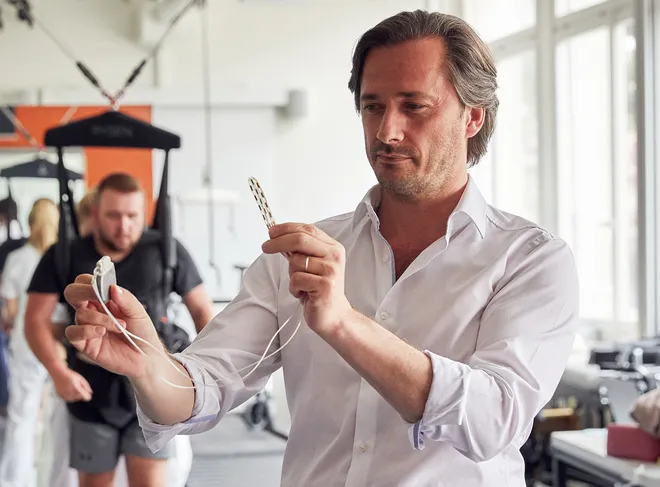
Neuroscientist Grégoire Courtine explains: To restore movement to a person with paralyzed limbs, microelectrodes that "read" brain signals must be connected via a "digital bridge" to the spinal cord, which then stimulates movement. His company has linked its neurostimulation platform to a device (brain-computer interface) to restore movement after paralysis.
Other brain technologies
Other companies and researchers are working on similar devices, as well as devices that read from large populations of brain cells. These could be used to decode the silent speech inside people's heads, according to Richard Andersen, a neuroscientist at Caltech. This would allow people who cannot speak to articulate their thoughts clearly.
Andersen, Professor of Biology and Bioengineering, is also using ultrasound technology to read brain activity using a less invasive method. With this type of device, a "window" would need to be implanted in the skull, allowing ultrasound waves to enter the brain, but the electrodes wouldn't need to be placed precisely deep inside the brain as with other devices.
Deep brain stimulators have long been used to treat conditions such as Parkinson's disease, epilepsy, and essential tremor, delivering specific stimuli. More recently, they've been listening to the brain to know when those stimuli are needed, says Dr. Brian Lee, a functional neurosurgeon at the University of Southern California.
Conversely, brain-computer interfaces, such as Musk's Neuralink, can collect signals and have far broader potential, he said. However, it's still too early to talk about the full potential of Neuralink.
"So far, Musk hasn't shown us anything," Lee said. "Perhaps he'll be able to use those signals, like other labs, to control a cursor on a screen, decode speech, move a wheelchair around."
Andersen said his team and others are now using devices similar to Neuralink, but with much smaller stimulating electrodes, to restore tactile sensation to people who are paralyzed and have lost their sense of touch.
The same device used to help read the intentions of a paralyzed person could potentially help that person sense an object. So they might be able to pick up a soda can without crushing it and take a sip. Anderson hopes such products will be available on the market in the not-too-distant future.
"That will be a target for many of us in this field," he said, with other medical applications following. "Neurotechnology in general is a rapidly accelerating field."
(According to USA Today)
Source
















































![[VIMC's 40-day rapid rollout] VOSA accelerates the deployment of a comprehensive logistics solution for HODA.](https://vphoto.vietnam.vn/thumb/402x226/vietnam/resource/IMAGE/2025/12/23/1766473634002_vosa-23-12-25-2_upscayl_2x_remacri.jpeg)













![[Photo] Closing Ceremony of the 15th Conference of the Central Committee of the 13th Party Congress](https://vphoto.vietnam.vn/thumb/402x226/vietnam/resource/IMAGE/2025/12/23/1766462841764_a1-bnd-3731-1647-jpg.webp)






























Comment (0)